As a child, long before I was enamoured by the likes of Nancy Drew, The Hardy Boys and Sweet Valley High, I existed on a steady diet of Archie comics. My ‘Double Digests’ binge was only interrupted when the latest issue of Target magazine arrived at home. I would always seek out the Gardhab Das and Detective Moochwala comics first, before turning my attention to the issue’s many other delights.
Back then, I had little understanding of comics beyond the knowledge that the small squares provided a sharp and fleeting pleasure. As I grew up, the idea that comics were not serious reading was drilled into my head and I was forced to move on to other literary pastures. What an absolute shame.
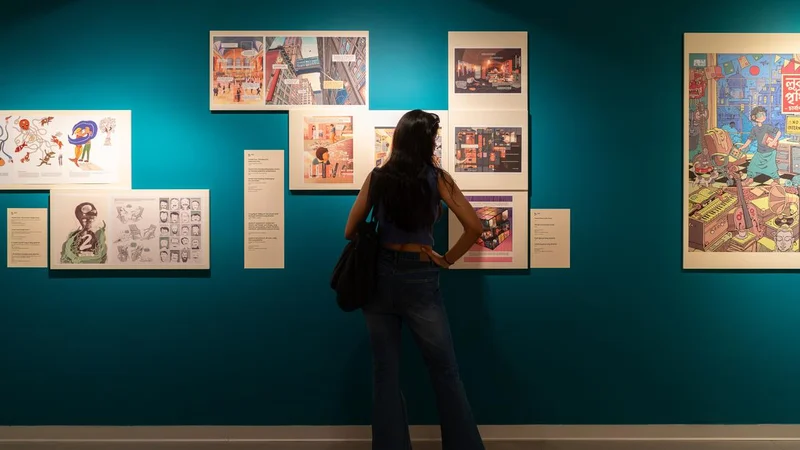
Walking through the impeccably curated A Moving Line: 1,500 Years of Indian Visual Storytelling, a new exhibition at the Museum of Art and Photography (MAP) in Bengaluru, I am struck by how much I have missed out on. Curated by the painter and graphic novelist Amruta Patil, the exhibition traces India’s journey in visual storytelling across 15 centuries.
Yes, there’s an Indian comics scene
The idea for the exhibition took root when Patil was in Angoulême, France, a city that has been hosting an international comics festival for over 50 years. “You should do something about the Indian comics scene,” she said to a friend working at the comics museum there. His response, she says, was unsurprising: “There’s an Indian comics scene?”
The exhibition is proof that such a thing does indeed exist. More than 250 works are on display — ranging from temple friezes to print comics, graphic novels, Instagram cartoons and more — giving visitors a chance to trace Indian comic creation.
Spread across two exhibition halls, it is artfully designed with the first space presenting a more chronological overview, while the second groups work thematically. Central spaces also allow visitors to sit down and browse comic books and anthologies in which some exhibits were originally published, and a special publication that explores themes reflected in the show. “It includes an introduction by Amruta, followed by nine essays and 11 graphic narratives,” says Khushi Bansal, a curator with MAP and co-editor of the publication.
“Traditional inflections in our visual storytelling include a maximalist aesthetic and bias towards bold lines and vibrant palettes. In terms of storylines, we have always loved multiple story tracks running parallel, ‘nested’ stories, the presence of a sutradhar [oral storyteller]. The Indian publishing industry’s lack of familiarity and experience with graphic novels proved to be an unexpected first-mover advantage for authors. Authors were not bogged down by canonical rules, which led to experimentation with form and content, and the emergence of distinctive visual styles.”Amruta PatilCurator, painter and graphic novelist
‘A boggling diversity of styles’
Upon entering the space, one is met by a hero stone, a temple frieze from the city’s Someshwara temple depicting the wedding of Shiva and Parvati, and a painting of Hanuman meeting Sita in Ashok Vatika garden. Each shows how, long before the word comic even existed, the art of telling stories sequentially has existed in India.
Beside a kaavad, a portable painted shrine with panels that itinerant storytellers unfolded as they narrate their tales, sits pattachitra scrolls that unspool myths in ochre and vermilion. These give way to a wall covered with Amar Chitra Katha (ACK) covers, including one of Shivaji, Mirabai and stories from the Panchatantra. Alongside, a cluster of ACK vinyls play audio stories.
Sitting comfortably alongside Phantom, Tin Tin and Captain Vyom comics, is a space dedicated to colonial India’s burgeoning comics scene, steeped in satire. Bengal dominates this space, from Basantak to the contributions of the Tagore and Ray family. I would, however, have loved to know more about Sukhalata Rao, Satyajit Ray’s aunt and, by most accounts, India’s first female cartoonist. It’s a footnote that feels like it deserves its own show.
Patil says she intentionally clustered unexpected work together — comics that feature the adventures of Amitabh Bachchan beside a futuristic panel from Bishakh Som’s Apsara Engine, a miniature painting of Sita next to Orijit Sen’s work based on the Hamza Nama. “This way, you get a sense of the boggling diversity of styles, themes, and nuanced points of view,” she says.
An Indian idiom
Personally, as a children’s book author, it was wonderful to see how artists such as Priya Kuriyan, Parismita Singh, Lokesh Khodke, Rajiv Eipe, and Soumya Menon, whose work I’m familiar with in the creation of picture books, have tackled themes of gender, migration, climate, caste and Indian life outside of children’s publishing.
But what will young comic-book readers who inhale manga make of the exhibit? “It is rare that young Indians who consume homogenised narratives from the Global North get to see alternatives: intelligent writing and original visual styles that emerged out of an Indian idiom,” Patil says, adding that she hopes all visitors will approach the displays with curiosity and an open mind.
The exhibition certainly opened my eyes to the breadth of narratives and styles that exist in the Indian comics scene, which has picked up momentum in recent years — from Comixense, Orijit Sen’s quarterly for teenagers and young adults, to the Indie Comix Fest, run by and for self-published creators, and even Westland’s recent announcement of Lattis, a new imprint for comic adaptations of classic Indian stories.
Awareness levels about India’s visual storytelling legacy certainly needs bolstering, something that is difficult Patil says, given how much has been lost to lapsed print runs, language silos and unimaginative custodians. Add to this, the lack of archives, and one sees the exhibition in a new light. It is a labour of love. And one can only hope that those who come, leave having fallen a little bit more in love with Indian comics.
A Moving Line is on till November 15 at MAP.
The writer is a children’s book author and columnist based in Bengaluru.
Published - August 06, 2026 09:11 am IST