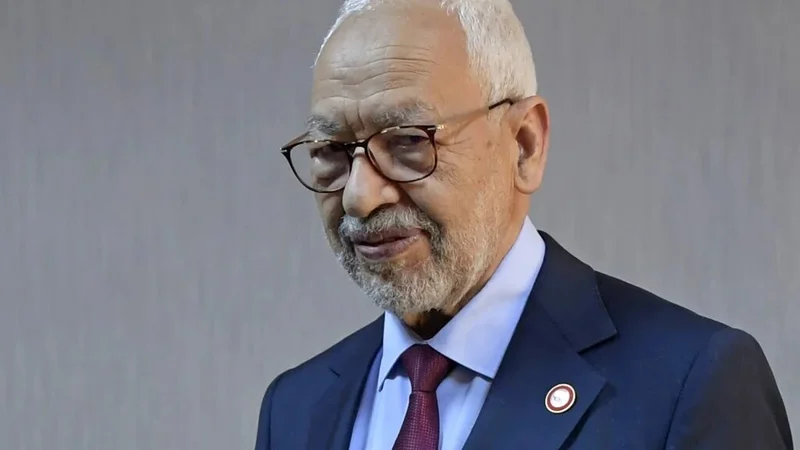
Fresh concerns have emerged over the health of Tunisia's jailed opposition leader Rached Ghannouchi after an eyewitness said she watched the 84-year-old politician lose consciousness inside prison.
Haifa Chebbi, the daughter of imprisoned opposition politician and lawyer Ahmed Chebbi, said in Facebook video on Tuesday that she witnessed Ghannouchi faint whilst she was visiting her father at Mornaguia prison amid an intense summer heatwave that has swept across the country.
Chebbi said that Ghannouchi later regained consciousness, but she described the incident as alarming, particularly given his age and declining health.
"I can't describe what it feels like to leave prison. I couldn't breathe," she said, contrasting her ability to leave the prison complex with the situation of those who remained inside.
"We are all responsible. We are all complicit," she added, before singling out Tunisian authorities for blame over Ghannouchi's ailing health.
New MEE newsletter: Jerusalem Dispatch
Sign up to get the latest insights and analysis on Israel-Palestine, alongside Turkey Unpacked and other MEE newsletters
Maher Medhioub, a former parliamentarian and aide to Ghannouchi, said in a Facebook post: "Time is running out. The risk to his life is becoming increasingly serious.
"We call upon world leaders, parliamentarians, legal professionals, journalists, and all defenders of human dignity to give urgent attention to this humanitarian situation and to uphold the principles of justice, human dignity, and the rule of law."
The report comes as Tunisia grapples with exceptionally high temperatures, with parts of the country recording temperatures above 45 degrees Celsius.
The heat has placed growing pressure on the national electricity grid, with power cuts reported in several areas as demand for air conditioning has surged.
Rights advocates have warned that such conditions pose particular risks for elderly prisoners and those with underlying health conditions, especially in overcrowded detention facilities where ventilation is poor and cooling is limited.
Saied's crackdown on opponents
Ghannouchi, the former speaker of parliament and leader of the Ennahda movement, has been imprisoned since April 2023, when he was arrested as President Kais Saied's government intensified its crackdown on political opponents.
His detention has become emblematic of the wider campaign against opposition figures launched after Saied suspended parliament, dismissed the government and began ruling by decree in July 2021, moves critics described as a coup against the country's democratic transition.
'Time is running out. The risk to his life is becoming increasingly serious'
- Maher Medhioub, a former parliamentarian
Since July 2021, dozens of politicians, lawyers, judges, journalists and activists have been arrested or prosecuted in what international rights organisations have described as an unprecedented assault on political freedoms in the country.
Saied has repeatedly rejected accusations that his government is persecuting political opponents, insisting that Tunisia has an independent judiciary and that those facing trial are being prosecuted for ordinary criminal offences rather than their political views.
His critics, however, argue that the cases form part of a broader effort to dismantle the political opposition that emerged after Tunisia's 2011 revolution.
Ghannouchi himself faces a growing list of prosecutions and convictions that his lawyers and supporters say are politically motivated.
Since his arrest, Tunisian courts have handed him multiple prison sentences in separate cases involving allegations ranging from incitement and illicit foreign financing to terrorism-related offences and conspiracy against state security.
Ennahda has consistently rejected the accusations as fabricated, saying the charges criminalise peaceful political activity and opposition to Saied's rule.
The UN Working Group on Arbitrary Detention said in a report last year that Ghannouchi's imprisonment was arbitrary and called for his immediate release, while organisations including Human Rights Watch and Amnesty International have accused Tunisian authorities of using the judiciary to silence political dissent.
Middle East Eye reached out to Tunisia's Ministry of Justice for comment but did not receive a response by time of publication.