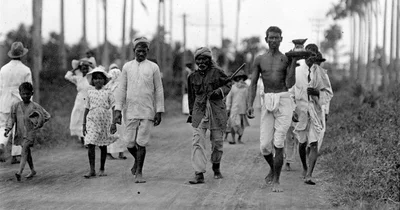
You … may be largely acquainted with the Indian ‘coolie’ as he is called with some contempt. It is true perhaps because India herself has sunk to the coolie ranks among nations, and perhaps that contempt is justified, but remember that if India has gone down, she has also the vitality to rise again.
Speaking to Indian communities during a tour of Malaya, Ceylon, and Burma in 1937, Jawaharlal Nehru articulated a vision of India’s place in the emerging international order that was inescapably intertwined with the figure of the benighted “coolie.” The coolie had long been a spectre of anxiety for nationalist elites – the migration of millions of labourers across the Bay of Bengal and Indian Ocean in the 19th and early 20th centuries through systems of indenture and state regulation had seemingly tarnished India’s reputation and held a mirror to its subjugated, emasculated, and colonised status. Such damage could apparently only be resolved by redefining who could access and represent India in the international realm.
The birth of Indian diplomacy would go hand in hand with efforts to end indenture and curtail the prolific if undesirable mobility of the coolie, in defiance of calls by caste-oppressed communities who asserted their right to free mobility. While early Indian diplomats derived their locus standi as Agents and Commissioners posted to regions shaped by labour migration, they asserted their difference from the coolie “other” whom they sought to engage with and civilise. Such narratives were shaped by a caste-based paranoia over the transcontinental circulation of the term “coolie” and the fact that it was being applied not just to labourers but also to caste elites and, by extension, India itself. Concerns about India’s relegation to the “coolie ranks among nations” are therefore not just a comment on a racialised world order, but an effort to reckon with the loss of caste status – evident in the ways in which elites like Mohandas Gandhi read the term “coolie” as synonymous with “what a pariah or untouchable means to us.”
This book locates anxieties over the coolie migrant as foundational to Indian diplomacy. Conceptualising the international realm as a space produced by labour migration and imbued with the afterlives of indenture, it provides a new paradigm for Indian diplomatic history that centres caste and the negotiation of “undesirable” mobility. The book makes four key interventions – first, it goes beyond the longstanding neglect of caste in much of the literature on Indian diplomatic history and international relations by foregrounding caste as a constitutive category in the making of Indian diplomacy. Drawing on a growing critical caste studies scholarship, it interrogates the figure of the “coolie” as one shaped not just by racialised and gendered unfree labour but also caste – a framing that provides for a more critical engagement with the deployment of caste and race in diplomacy.
Second, it locates histories of both indentured and “assisted” labour migrants as intertwined with the origins and practice of Indian diplomacy. In so doing, it unsettles notions of the Indian state’s “break” from the diaspora in 1947 to showcase the complex ways in which the afterlives of indenture and the regulation of mobility shaped postcolonial diplomacy. It also brings histories of indentured labour across the Caribbean into conversation with the increasingly regulated yet non-indentured labour migration to regions like Ceylon and Malaya which relied on a “kangani” (overseer), usually one who had long experience working in plantations as a labourer, to recruit coolies from village and kin networks in southern India.
Third, it goes beyond the “high politics” focus of the scholarship to reframe the conventional subjects and spaces of Indian diplomacy. Even as it traces how caste elites sought to curtail undesirable mobility and reframe the “coolie” stigma attached to Indian international status, the book also examines the ways in which anti-caste leaders and migrants powerfully confronted such efforts by arguing that coolie life abroad, despite its travails, was still markedly better than the violence of caste at home. In so doing, it seeks to subvert the Indian state’s narrative of coolie migrants merely as recipients and problems of diplomacy. Finally, by examining quarantine camps at Mandapam en route to Ceylon, Labour Department activities in Madras, cultural and pedagogic missions in the Caribbean, regional passport offices in India, and migrant houses in Birmingham as interlinked diplomatic sites, it challenges top-down, Delhi-centric narratives of Indian diplomacy and their dominant focus on conflicts and conferences. Such a layered focus sheds new light on the evolution of postcolonial Indian diplomacy as shaped by its engagement with coolie migrants – a history that has irrevocably shaped the Indian state and what is now the world’s largest diaspora.
In some ways then, this book intertwines migration and diplomacy to examine the contestation over one key question – who was best suited to represent India in the sanctified international realm? This manifested in multiple efforts to end indenture, undo the prolific mobility of the coolie migrant, and replace it with what one journal termed the “intelligent emigration” of “skilled” Indians, with striking continuity across late colonial and early postcolonial contexts.
These efforts were challenged by a whole host of actors – from the Tamil Adi Dravida politician Rettaimalai Srinivasan who critiqued the restriction of indentured labour migration in interwar India, to Ishwar Das Pawar, the first Scheduled Caste gazetted officer in Punjab, who sought to confront the hierarchies of the discretionary postcolonial passport system by enabling the mobility of Dalit communities. Even as they critiqued the coercive structures of indenture, anti-caste leaders and organisations in colonial Madras emphasised that a ban on indenture must not entail curtailing the mobility of caste-oppressed communities. In the postcolonial context, where Indian diplomats sought to mediate the mobility of the “coolie class” in Britain and established pedagogic missions tasked with reconnecting post-indenture societies in the Caribbean to their “lost” Indian culture, here too they would experience resistance. “Unskilled” migrants challenged the postcolonial state’s negation of their mobility through a series of efforts, including the use of forged passports, while many descendants of indentured labourers critiqued the Indian culture and tradition propounded by diplomats as a harkening back to rigid, caste-coded norms that were a far cry from the diversities of life in the Caribbean.
While scholars of indenture and “assisted” labour migration have long examined the centrality of race and plantation economies in shaping ideas of the coolie as a “raced” category, there has not been sufficient focus on how such ideas are just as much imbricated in caste. That caste is not a sidenote but constitutive of ideas of the coolie is only now receiving closer attention – Najnin Islam, for one, has called for more focus on how “race articulates with caste to produce the figure of the coolie and this articulation is central to making particular bodies legible as capable of plantation labour.” Moreover, while there has been much attention to the hierarchies of caste that informed nationalist campaigns against indenture during the First World War, there has been little focus on how such campaigns also shaped the making of Indian diplomacy at much the same time.
Even as I point to the ways in which caste shapes the anxieties over the term coolie and, in turn, Indian diplomacy, this is not to replicate a deeply flawed framing prevalent in some academic contexts where the study of caste has rarely involved self-reflection or sustained study of savarna society and is instead taken to be synonymous with studying Dalits. Indeed, as Sumeet Samos notes, “Caste studies concerns itself with the discrimination and exclusion of those at the bottom and does not engage with power and accumulation at the top.” This book is therefore very much concerned with the ways in which caste elites called for the emergence of an Indian diplomacy that would protect their own interests – a discourse entirely shaped by a brahminical desire to maintain hierarchy, both at home and abroad.
My concern with the intersections of caste, mobility and diplomacy is also not to simplistically argue that all labourers who were categorised as coolie migrants belonged to “lower” caste backgrounds. To be clear, thousands of migrants from caste-oppressed communities did seek to rebuild their lives through the act of emigration – the historian John Solomon, for one, has argued in the case of Singapore that “untouchables” were “amongst the first groups to undertake migration.” This is also true of Ceylon, where a huge number of labourers travelling from southern India were fleeing experiences of “caste-based oppression in the form of agrestic enslavement and servitude, indentured labour, and socioeconomic marginalisation.” And yet, scholars of indenture have done important work in emphasising the diverse caste backgrounds of labourers, and the heterogeneity of the experience itself – the contexts and histories varying considerably in regions. This book therefore underscores that discourses of the coolie migrant were intimately shaped by, understood through, and narrated via the lens of caste. Take, for instance, the report of prominent Indophiles and campaigners against indenture, Charles Freer Andrews and William Pearson:
We were startled every now and then to find in the coolie 'lines' a young lad of high caste and education, whose whole appearance showed that he had no business at all in such a place. The condition of such lads, when they arrive and have to be lodged in the same quarter with men of low morals and unclean habits of life, is pitiable indeed.
Thus, a brahmin or high-caste coolie might very well be present in Fiji, but was deemed an oxymoron by Andrews and Pearson – in contrast to what they deemed the norm of the “lower” caste indentured labourer. My concern with interrogating caste in Indian diplomatic history is therefore to underscore that a brahmanical paranoia over caste manifested in anxieties over the presence of the coolie abroad. As we will see, this shaped multiple narratives – not just regarding the labourer whose coolie status was deemed a blot on Indian identity, but also the fact that this term was being utilised internationally for all Indian migrants, including caste elites.
Excerpted with permission from Coolie Migrants, Indian Diplomacy: Caste, Class and Indenture Abroad, 1914-67, Kalathmika Natarajan, Oxford University Press.