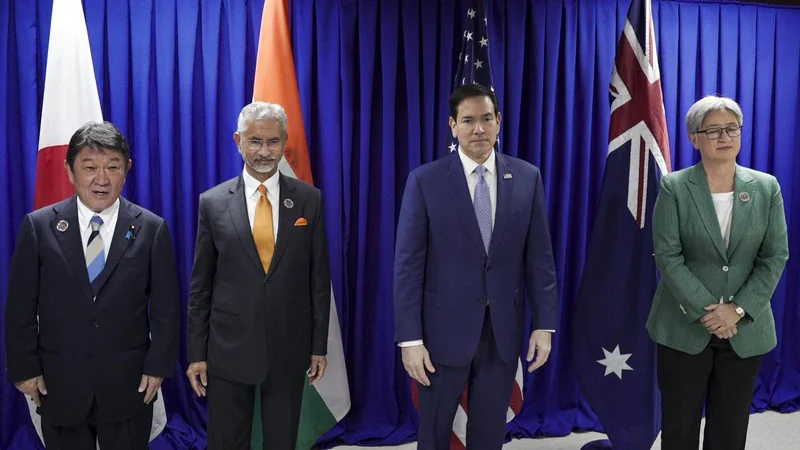
India joined its Quad partners in calling for peace and stability in the Indo-Pacific while reaffirming ASEAN’s centrality in the region amid China’s increasing military muscle-flexing in the South China Sea.
Besides Mr. Jaishankar, the Quad meeting held in Manila on Wednesday (July 22, 2026) was attended by U.S. Secretary of State Marco Rubio, Australian Foreign Minister Penny Wong and her Japanese counterpart Toshimitsu Motegi.
The Quad foreign ministers last met in New Delhi in late May, when Mr. Rubio travelled to India.
A joint statement said the Quad reaffirmed its commitment to strengthening a free and open Indo-Pacific while extending “unwavering support” for “ASEAN unity and centrality”.
The ASEAN, or the Association of Southeast Asian Nations, is considered one of the most influential groupings in the region, and India and several other countries, including the U.S., China, Japan and Australia, are its dialogue partners.
“We are deeply invested in the region’s success and in cooperating with ASEAN and its member states,” the Quad foreign ministers said in the statement.
The Quad foreign ministers also discussed regional challenges and opportunities to strengthen support for the practical implementation of the ASEAN Outlook on the Indo-Pacific (AOIP), it said.
The focus was on shared priorities of maritime and transnational security, economic prosperity and security, critical and emerging technologies, and humanitarian assistance and emergency response, it noted.
“We are united in our conviction that peace and stability in the Indo-Pacific maritime domain underpin the security and prosperity of the region,” the foreign ministers said in the statement.
Mr. Jaishankar said on social media that the Quad foreign ministers reviewed “the Indo-Pacific landscape and discussed recent developments”.
“Followed up on the outcomes of the recent New Delhi meeting. Committed to a free and open Indo-Pacific with a recognition of ASEAN centrality,” he said.
Mr. Rubio said the Quad foreign ministers’ meeting emphasised the message that strong cooperation is “vital to supporting ASEAN’s own priority and centrality in the region”.
The U.S., India, Australia and Japan share a vision of a free and open Indo-Pacific grounded in the rule of law, sovereignty and territorial integrity, he said.
The Quad remains a priority, and we will meet again later this year, he noted.
Japanese foreign ministry said the Quad meeting confirmed that the grouping will continue advancing “concrete cooperation” to realise a free and open Indo-Pacific that focuses on maritime and transnational security, economic prosperity and security, critical technologies, and humanitarian assistance.
Mr. Motegi said it is very significant that the Quad ministers had gathered again so soon after their meeting in May, and Wednesday’s (July 22, 2026) meeting sends a strong message that Quad is committed to promoting cooperation that benefits the region.
“The four ministers confirmed that the Quad will continue to advance concrete cooperation to realise a Free and Open Indo-Pacific (FOIP), focusing on the four areas of maritime and transnational security, economic prosperity and security, critical and emerging technologies, and humanitarian assistance and emergency response,” a Japanese statement said.
The Ministers held candid discussions and “aligned” their perspectives on the situations in the Indo-Pacific and West Asia, including the East China Sea and the South China Sea.
Mr. Motegi shared strong opposition to “any unilateral attempts to change the status quo by force or coercion and grave concerns over export restrictions, including on critical minerals, and emphasised the commitment to the complete denuclearisation of North Korea,” the statement noted.
The four ministers “expressed that they look forward to the convening of the next Quad Leaders’ Summit and foreign ministers’ meeting”, it said.
Published - July 22, 2026 07:27 pm IST