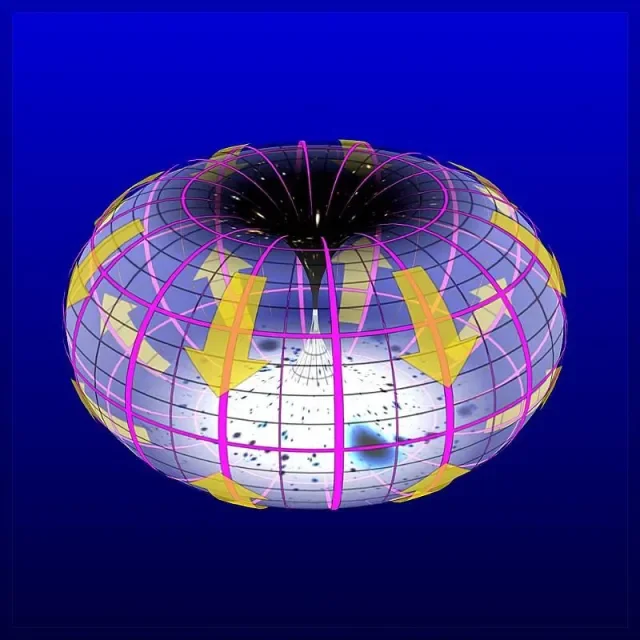
13.8 billion years ago, the most consequential event in our entire Universe occurred, as cosmic inflation came to an end and the hot Big Bang emerged in its aftermath. The conditions, at that moment, were that the Universe was filled with matter, antimatter, and radiation, and existed in an ultra-hot, ultra-dense, but rapidly expanding-and-cooling state. By the time we arrive at the present day, the volume containing our observable Universe has expanded to be approximately 46 billion light-years in radius, with the light that’s only now arriving at our eyes today setting the limit for how far away we’re capable of measuring. Although it’s a huge distance to be able to see out to 46 billion light-years away, it’s not infinitely large; it’s merely the limits of what we can observe in the here-and-now. What, then, lies beyond those limits? What about the unobservable Universe? Is there any way to use what we know and can measure about the Universe we inhabit to answer the question of whether it’s finite or infinite? About whether what we know of as “the Universe” goes on forever, or whether there’s some ultimate limit to all that’s out there? Let’s examine the full suite of what we know today, right up to the limits of what our measurements tell us, and find out what we can learn from it. If you look farther and farther away, you also look farther and farther into the past. If the number of galaxies, the densities and properties of those galaxies, and other cosmic properties like the temperature and expansion rate of the Universe didn’t appear to change, you’d have evidence of a Universe that was constant in time. Credit: NASA/ESA/A. Feild (STScI) As we look to greater distances, we also wind up looking back in time. Here in our Solar System, the differences are small: we see the Moon as it was 1.25 seconds ago, we see the Sun as it was a little over 8 minutes ago, and we have to wait between 7 and 22 minutes for a signal sent from a rover on Mars to arrive. The nearest major galaxy, Andromeda, located some 2.5 million light years away, appears to us as it was 2.5 million years ago. The reason for these delays is because light requires a certain amount of time to journey to our eyes from when it was emitted: light only travels at the speed of light. More distant galaxies, well beyond our Local Group, appear as they were tens of millions, hundreds of millions or even billions of years ago. As we look ever farther away in space, the light we see from the Universe comes from earlier in cosmic history. Therefore, as we look back in terms of distance, we can also measure how the Universe evolved over its history. And the Universe has indeed involved significantly. While it was hot, dense, uniform, and compact in its past, it is cold and clumpy today, and also continues to expand and gravitate. When we look to greater and greater distances, however, we indeed find that the Universe was less cold, less clumpy, and more uniform. The smaller the amount of time that’s elapsed since the Big Bang, the less time that gravitation has had to form large, complicated structures; early on, the “clumps of matter” that formed in the Universe were smaller and less massive. Similarly, the early, distant Universe was also hotter. The expanding Universe causes all of the light that travels through it to stretch in wavelength as it travels. As those wavelengths stretch, the light loses energy, becoming cooler. This implies that the Universe was hotter in the distant past: a fact we’ve confirmed through observations of distant features in the Universe. The observational evidence that probes the temperature of the cosmic microwave background at different epochs in the Universe, including at present (red star), in the relatively nearby Universe (blue points), and in the distant Universe (red points) all shows that the Universe was hotter in the past, and has cooled as it’s expanded exactly as predicted by the Big Bang theory. Credit: P. Noterdaeme et al., Astronomy & Astrophysics, 2011 We can measure the temperature of the Universe as it is today, 13.8 billion years after the Big Bang, by simply looking at the leftover, remnant background radiation from that hot, dense, early state. Today, this shows up in the microwave portion of the spectrum and is known as the Cosmic Microwave Background, or CMB. Coming in with the most perfect blackbody spectrum ever measured and a temperature that peaks at 2.725 K, it’s easy to confirm that these observations match, with an incredible precision, the predictions that arise from the Big Bang model of our Universe. Moreover, we know how this radiation evolves — both in energy and in wavelength — as the Universe expands. A photon’s energy is directly proportional to the inverse of its wavelength. When the Universe was half its size, the photons from the Big Bang had double the energy, while when the Universe was 10% of its current size, those photons had ten times the energy. If we’re willing to go back to when the Universe was just 0.092% its present size, we’ll find a Universe that’s 1089 times hotter than it is today: around 3000 K. At these temperatures, the Universe is hot enough to ionize all the atoms in it. Instead of solid, liquid, or gas, all the matter in the entire Universe was in the form of an ionized plasma: where instead of light freely traveling through space unimpeded, it would constantly scatter off of that sea of free electrons. In the hot, early Universe, prior to the formation of neutral atoms, photons scatter off of electrons (and to a lesser extent, protons) at a very high rate, transferring momentum when they do. After neutral atoms form, owing to the Universe cooling to below a certain, critical threshold, the photons simply travel in a straight line, affected only in wavelength by the expansion of space. Credit: Amanda Yoho for Starts With A Bang One of the remarkable properties about the Universe, at this early stage, was how almost perfectly uniform it was. Yes, some regions within it are more or less dense than average, but the amounts that the densest (corresponding to the coldest observed temperatures) or least dense (i.e., hottest) regions depart from the average is tiny: about 1-part-in-30,000. That’s enough for the overdense regions to grow into the stars, galaxies, galaxy clusters, and cosmic web that we see today, and for the underdense regions to give up their matter and become cosmic voids. Seeing the Universe as it was back then, as well as how it is today, allows us to understand how it grew from that early state into the one we inhabit today. The way we arrive at the size of the visible Universe today is through understanding three things in tandem: how quickly the Universe is expanding today, something we can measure via a number of methods, how hot the Universe is today, which we know from looking at the radiation of the Cosmic Microwave Background, and what components, in what densities, the Universe is made out of, including normal matter, radiation, neutrinos, antimatter, dark matter, dark energy, and anything else that might exist. By making measurements that give us answers to those questions, we can take the Universe we have today, extrapolate back to the earliest stages of the hot Big Bang, and arrive at figures for how the age and size of the Universe evolve alongside one another. The scale of the Universe (y-axis) versus the age of the Universe (x-axis) on logarithmic scales. Some size and time milestones are marked, as appropriate. Everything contained within the entire observable Universe was once contained in a very small volume, as shown by the size scale on the y-axis. Credit: E. Siegel From the full suite of observations available, including: the cosmic microwave background, supernova data, large-scale structure surveys, measurement of baryon acoustic oscillations features, and more, we come to our modern understanding of the Universe we inhabit. In the here-and-now, 13.8 billion years after the Big Bang, the observable Universe now extends for 46.1 billion light-years in all directions, from our perspective. That’s the limit of what’s presently observable. Any farther than that, and even something moving at the speed of light since the moment of the hot Big Bang will not have had sufficient time to reach us; the signal will still be on the way, having not yet arrived. As time goes on, the age and the size of the observable Universe will increase, but there will always be a limit to not only what we observe, but what it’s possible to observe. So what can we say about the part of the Universe that’s beyond the limits of our observations? We can only make inferences based on the laws of physics as we know them, and the things we can measure within our observable Universe. If space were positively curved, like we lived on the surface of a 4D sphere, distant light rays would converge as they approached our eyes, telescopes, and instruments. If space were negatively curved, like the surface of a 4D saddle or Pringles chip, distant light rays would diverge. Instead, what we see is that distant light rays continue to move in their original direction, neither converging nor diverging. The fluctuations that we see in the CMB indicate that, to the limits of our measurement capabilities, the Universe is perfectly flat. The magnitudes of the hot and cold spots, as well as their scales, indicate the curvature of the universe. To the best of our capabilities, we measure it to be perfectly flat. Baryon acoustic oscillations and the CMB, together, provide the best methods of constraining this, down to a combined precision of 0.4%. To the best we can measure, the universe is indistinguishable from spatially flat. Credit: Smoot Cosmology Group/LBL Our best measurements, from WMAP to Planck to ACT to SPT and beyond, all indicate that the Universe is spatially flat on the largest scales: it’s neither positively nor negatively curved, to a precision of 0.25%, or about 1-part-in-400. (For comparison, our Universe is roughly 68% dark energy, 27% dark matter, 4.9% normal matter, 0.09% photons, and 0.01% neutrinos.) Because we live in three spatial dimensions, a curvature of no more than 1-part-in-400 corresponds to an unobservable Universe that’s at least (400)³ times the volume of our observable Universe: more than 64 million times as much space. If we assume that our current laws of physics are correct, this calculation allows us to set limits on how large, at least, the full, unobservable Universe must be before it curves back on itself. But, big as that figure is, it still isn’t infinite. A lower bound of the Universe being at least 18 trillion light-years in all directions is tremendous, but it’s still finite. Assuming that the Universe contains no topological weirdness, like curving back on itself while still being spatially flat (like having a geometry akin to a hypertorus), observations of the cosmic microwave background and the large-scale structure inform us that the full, unobservable part of the Universe must be at least 37 trillion light-years in diameter: an enormous figure. Exponential expansion, which takes place during inflation, is so powerful because it is relentless. With every ~10^-35 seconds (or so) that passes, the volume of any particular region of space doubles in each direction, causing any particles or radiation to dilute and causing any curvature to quickly become indistinguishable from flat. After only a few hundred doubling times, or ~10^-32 seconds, a fluctuation that was initially smaller than the Planck scale would now be stretched to be larger than the presently observable Universe. Credit: E. Siegel (L); Ned Wright’s Cosmology Tutorial (R) However, there are good theoretical reasons to believe that our entire Universe, whether finite or infinite, is even larger than that. The hot Big Bang might mark the beginning of the observable Universe as we know it, but it doesn’t mark the birth of space and time itself. Before the Big Bang, the Universe underwent a period of cosmic inflation. Instead of being filled with matter and radiation, and instead of being hot, the Universe was: filled with energy inherent to space itself, expanding at a constant, exponential rate, and creating new space so quickly that the smallest physical length scale, the Planck length, would be stretched to the size of the presently observable Universe every 10-32 seconds. It’s true that in our region of the Universe, where we now reside, inflation came to an end, and did so 13.8 billion years ago. The conditions that we identify with the hot Big Bang only emerged in the aftermath of this inflationary stage, with many pieces of evidence pointing to an inflationary origin. But there are three big questions that we don’t know the answer to: questions that have a tremendous influence on how big the Universe truly is, and whether it’s infinite or not. In a Universe that comes to be dominated by dark energy, there are four regions: one where everything within it is reachable, communicable, and observable, one where everything is observable but unreachable and incommunicable, one where things will someday be observable but aren’t today, and one where things will never be observable. The labeled numbers correspond to our consensus cosmology as of 2024, with boundaries of 18 billion light-years, 46 billion light-years, and 61 billion light-years separating the four regions. On scales of ~10 billion light-years and larger, the Universe is almost perfectly uniform. Credit: Andrew Z. Colvin/Wikimedia Commons; annotations: E. Siegel 1.) How big was the region of the Universe, post-inflation, that created our hot Big Bang? Looking at our Universe today, at how uniform the Big Bang’s leftover glow is, at how flat the Universe is, at the fluctuations stretched across the Universe on all scales, etc., there’s quite a bit we can learn. We can learn the upper limit to the energy scale at which inflation occurred; we can learn how much the Universe must have inflated; we can learn a lower limit for how long inflation must have gone on. But the pocket of the inflating Universe that gave rise to us could be much, much bigger than that lower limit. It could be hundreds, or trillions, or googols of times larger than what we can observe: it could even truly be infinite. Without being able to observe more of the Universe than we can presently access — or even more than the full future visibility limit allows — we don’t, and won’t, have enough information to decide. Wherever inflation occurs (blue cubes), it gives rise to exponentially more regions of space with each step forward in time. Even if there are many cubes where inflation ends (red Xs), there are far more regions where inflation will continue on into the future. The fact that inflation never comes to an end absolutely everywhere is what makes inflation ‘eternal’ once it begins, and where our modern notion of a Multiverse (where the regions with a red X describe separated, disconnected universes) comes from. Credit: E. Siegel/Beyond the Galaxy 2.) Is the idea of “eternal inflation,” where the Universe inflates eternally into the future in at least some regions, correct? If you consider that inflation must be a quantum field, then at any given point during that phase of exponential expansion, there’s a probability that inflation will end, resulting in a Big Bang where that occurs, and also a probability that inflation will continue, creating more and more space. These are calculations we know how to do in the context of quantum physics (given the assumptions we currently make about our cosmos), and they lead to an inevitable conclusion: if you want enough inflation to occur to produce the Universe we see, then inflation will always create more space that continues to inflate compared to the regions that end and produce Big Bangs. While our observable Universe may have come about from inflation ending in our region of space some 13.8 billion years ago, there are regions where inflation continues — creating more and more space and giving rise to more Big Bangs — continuing to the present day. This idea is known as eternal inflation, and is generally accepted by the theoretical physics community. How big, then, is the entire unobservable Universe by now? From a pre-existing state, inflation predicts that a series of universes will be spawned as inflation continues, with each one being completely disconnected from every other one, separated by more inflating space. One of these “bubbles,” where inflation ended, gave birth to our Universe some 13.8 billion years ago, with a very low entropy density, but without ever violating the 2nd law of thermodynamics. Credit: Nicolle Rager Fuller 3.) And, finally, how long did inflation go on prior to its end and the resultant hot Big Bang? We can only see the observable Universe created by inflation’s end and our hot Big Bang. We know that inflation must have occurred for at least some ~10-32 seconds or so, but it likely went on for longer. But how much longer? For seconds? Years? Billions of years? Or even an arbitrarily long, potentially infinite amount of time? Has the Universe always been inflating? Did inflation have a beginning? Did it arise from a previous state that was around eternally? Or, perhaps, did all of space and time emerge from nothingness a finite amount of time ago? These are all possibilities, and yet the answer is untestable and elusive at present; we have only theoretical arguments to guide us. From our best observations, we conclude that the Universe is an awful lot bigger than the part we can observe. Beyond what we can see, we strongly suspect that there’s plenty more Universe out there just like ours, with the same laws of physics, the same types of physical, cosmic structures, and the same chances at complex life. But as inconceivably large as that entire Universe — or Multiverse, if you prefer — may be, it might not be infinite. In fact, unless inflation went on for a truly infinite amount of time, or the Universe was born infinitely large, the Universe ought to be finite in extent. In inflationary cosmology, the volume that space occupies is stretched to an inconceivably large volume in a tiny fraction of a second, and wherever inflation ends, a hot Big Bang (and a Universe like ours) ensues. This creates a virtual “infinity of worlds,” but the number is likely not quite infinite after all. Credit: Jaime Salcido/EAGLE Collaboration The biggest problem of all, though, is our limited ability to access information. We are certain that we don’t have enough information to definitively answer the question, because that decisive information isn’t contained within our observable Universe. And we are only capable of accessing the information that’s available inside our observable Universe: within those 46 billion light-years of us in all directions. The answers to the biggest of all questions, of whether the Universe is finite or infinite, in space as well as in time, might be encoded within the full, unobservable Universe itself, but the limited part that we can access doesn’t give us the answers we so desperately seek. Until we either figure it out, or come up with a clever scheme to expand what physics is capable of, all we’ll have are the various possibilities to consider, and theoretical arguments that point in certain directions, under assumptions that we cannot be certain still hold beyond the limits of what we can observe, test, and measure. This article was first published in April of 2022. It was updated in August of 2026. This article Is the Universe truly infinite in size? is featured on Big Think.
Is the Universe truly infinite in size?