Industry leaders are enthusiastic about nine new secondary school subjects announced on Thursday, but the teachers' union warns the timeline to develop and introduce them is extremely tight.
The government says industry skills boards will develop the subjects for introduction in 2029, when a new qualification replaces the NCEA.
The subjects are:
- Next-Gen manufacturing
- Applied intelligent systems
- Construction and built environment
- Energy and infrastructure
- Engineering technology
- Food and fibre systems
- Health services and care
- Hospitality, food and beverage
- Tourism
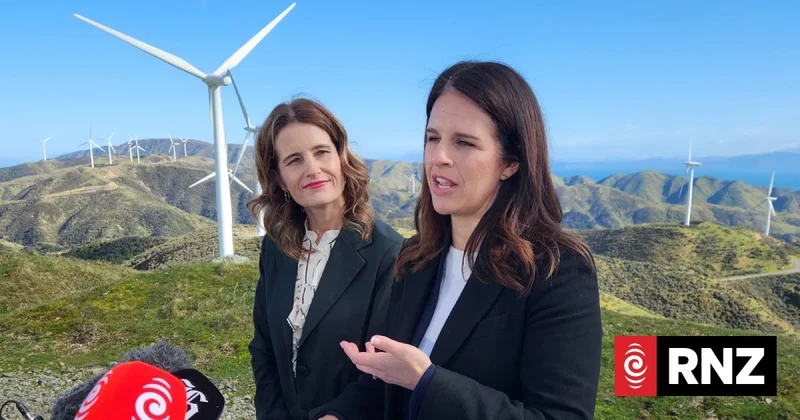
Education Minister Erica Stanford launched the subjects with Finance Minister Nicola Willis at Meridian Energy's Mākara windfarm, overlooking Cook Strait.
New proposed subjects may sway number of early leavers
She said it was critical that industry helped write the new content.
"They are the people on the ground who know what the skills and knowledge are that they will need for the future," she said. "That is being built into the curriculum, so these young people, when they leave school, will have relevant knowledge and skills to be able to.. walk into either jobs, further training, apprenticeships or through to university."
Stanford said the new subjects would vary less than NCEA subjects, and would better equip teens with skills and knowledge that employers wanted.
She said more industry-led subjects may be added.
Stanford said not all schools would be able to offer all nine subjects, and some might work together or with local trades academies to provide them.
"There will, of course, always be some in-school provision as well, and that's why we're working with the likes of the PPTA and the Teaching Council to make sure that we can get those people the pay that they require to be able to teach," she said.
Industry leaders at the launch were enthusiastic and said one of the main effects of the new subjects would be to open students' eyes to potential careers in industries they had never heard of, many of which faced serious workforce shortages in future.
Energy and Infrastucture Industry Skills Board chief executive Philip Aldridge said the energy and infrastructure subject would bring entirely new courses to schools.
"This is new," he said. "In my sector - energy and infrastructure - there's nothing at school.
"There's a bit of geology, a bit of physics, but really there's nothing about energy and infrastructure."
Aldridge said the board wanted to see the subject offered in all schools.
He said whether the subject would be taught in schools or in trades academies run by polytechnics or other tertiary providers was yet to be determined.
Some of the new subjects, such as tourism and building, already existed in some form in schools.
Construction and Specialist Trades industry skills board chair David Kelly said letting industry have a hand in what's taught would have several advantages over the current system.
"One is it raises the status of some trades, so that it gives it equal status within the secondary schools," he said. "Secondly, it does give recognised skills across the country, so when students come out of secondary school, they've got something to show that is a nationally accepted standard that they've achieved.
"It will be more comprehensive and more linked-up, so it's connected to potential employment. At the moment, there are some good courses, but they're not consistent right across the country and really depend on the individual school."
Rotorua Girls High School principal Sarah Davis was seconded to the Education Ministry to work on the subjects.
She said the involvement of industry would ensure the subjects created real pathways to jobs.
Davis said some teachers already had industry qualifications and might be able to teach the new subjects.
"That's not going to be the case across the board and, in some cases, I'm thinking for my school Rotorua Girls', we might look to Toi Oho Mai, our local polytechnic, to support us with the delivery of those courses it kind of depends," she said.
Teacher union vice-president Kieran Gainsford said the PPTA supported industry-led subjects, but there was a lot to work out before 2029.
"In some cases, schools are going to need very technical learning spaces or technical equipment," he said. "They're going to need specialist staff often from industry and those people are going to have to be recruited... and then we have to keep them in schools.
"There's a lot of work to happen between now and then, and unless we get the details pretty pronto, that timeline does start to look a little bit unrealistic."
Gainsford said who would teach the subjects was not clear.
"We're desperately keen to know exactly what the government's plan is for the delivery of these subjects, because until we see that, we can't get started on making it work for the kids," he said.
Gainsford said some of the subjects could be offered by schools and already were, but others, like applied intelligence systems, would require more teachers.
"There's going to have to be some additions to the teaching workforce to make those possible and that needs to happen really now," he said. "We want those people in schools before we start teaching this stuff."