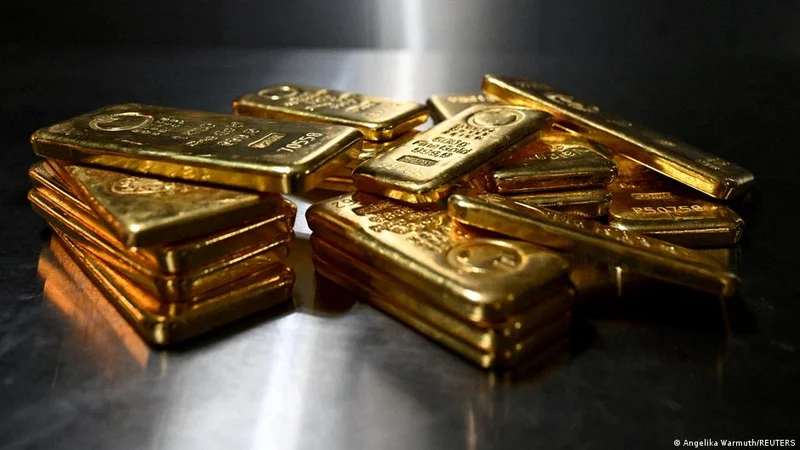
Russia has sold significant volumes of its gold reserves so far in 2026 as the Kremlin seeks to raise cash to offset a big budget deficit.
The Russian Central Bank announced recently that its gold reserves stood at 73.4 million troy ounces, or 2,282 metric tons, as of the start of July. That represents a decline of around 43.5 metric tonnes since the start of 2026.
It means Russia's gold reserves are now at their lowest level since before the full-scale invasion of Ukraine began in February 2022.
Gold prices hit record levels earlier this year, with prices averaging around $4,800 (€4,210) per ounce in the first four months before falling back to a current level of around $4,000 per ounce. Moscow's sell-off is likely to have raised more than $5 billion.
"The fact that they're selling gold means that they're running out of other more liquid assets," Elina Ribakova, an economist with the Peterson Institute for International Economics, told DW. "So there is pressure on the deficit and also pressure on the sources to finance this deficit."
Budget problems
Russia's budget has been under serious strain in recent years due to its massively increased defense spending, which funds the war in Ukraine.
Earlier this year, the Financial Times reported that the country's finance ministry had warned the cabinet in a letter that overspending on the war would be at least $28 billion in 2026, with further overspends expected in 2027 and 2028. Defense spending has more than quadrupled since 2021. It totalled around 16 trillion rubles in 2025 ($204 billion; €178 billion).
Chris Weafer, a Moscow-based financial analyst with the consulting firm Macro-Advisory, says that while the Russian gold sell-off is significant, it is not a case of panic selling.
"It's an extraordinary situation, but it's a relatively normal trend," he told DW. "It doesn't represent any element of Russia going broke, running out of money, not having anything else and literally selling the household silver."
He says that the gold Russia has offloaded has mostly been sold by the country's finance ministry, via its National Welfare Fund (NWF), rather than the Russian Central Bank.
"Since early 2022, gold was one of the assets that the National Welfare Fund could buy, because US treasuries and bunds weren't available to them (as a result of sanctions following the invasion of Ukraine)."
Weafer pointed out that the asset had become a key liquid component of the fund, which, he said, was precisely what a national welfare fund is intended for: to be sold when funds are needed, particularly during difficult times. "To that extent, one can argue it is serving the intended purpose."
The fund's gold sale is intended to replenish its so-called liquid assets. Weafer estimates that the fund is worth approximately $150 billion, with around $50 billion of that being described as "liquid."
"The Kremlin doesn't want that buffer to go down because that would lead to maybe more speculation about financial crisis or economic difficulties, and it would undermine the Kremlin's geopolitical position," said Weafer.
"It likes to portray the country as being very stable and very strong, and that $50 billion of cash is an important part of that."
He says another important factor to consider is that as one of the world's biggest producers of gold, Russia can replenish stocks it has sold relatively quickly by buying from its domestic producers. Russia holds the fifth-largest reserves in the world, around the same level as China, France and Italy, and significantly behind the top two, Germany and the US.
Ribakova agrees that this offers Russia a significant buffer.
"Russia has an advantage," she said. "It does produce gold itself. So when it was worried about sanctions, it allocated part of the money into the gold purchases, which they were buying from the domestic producers."
Funding the war for the foreseeable future
The fact that Russia has become one of the biggest sellers of gold has raised further questions about its budget deficit and what that says about wider economic stability.
Russia's federal budget spending and deficit could exceed official plans by more than 1 trillion roubles ($12.85 billion) in 2026, according to recent government data. The budget deficit is currently projected to be 1.6% of GDP for 2026, which is approximately $40 billion, and could yet grow.
However, improved revenues from oil and gas, boosted by higher oil prices due to the war in Iran, has helped Moscow to offset the budget difficulties so far in 2026.
Ribakova says everything comes back to the prices and revenues Russia gets from its oil and gas, calling it the "real limit" on Moscow's capacity to finance the four-and-a-half-year-long war in Ukraine.
"Everything hinges on that," she noted. "When the oil price is high, Russia gets revenues. It's easier to borrow, its domestic financial system is healthier. If the oil price drops, say, to sixty or forty, then you immediately have a crisis."
Both she and Weafer caution that despite the obvious economic difficulties the Russian economy has at present, it can continue to fund the war for the foreseeable future by cutting back on non-defense spending.
"Putin can continue going for years in the current environment," said Ribakova. "Maybe not making any progress on the front line, which we haven't seen any progress for the last couple of years, but still being able to throw resources at the war with Ukraine."
"Even if the deficit continues as is, Russia can still find the money and really won't be in any sort of a financial crisis or a weak geopolitical position over the next 12 to 24 months," said Weafer.
Yet he points to obvious longer-term damage being done to the economy and the trouble that may bring further down the tracks.
"It is creating this huge distortion in the economy and creating this longer-term negative picture that's now creating divisions in government," he said.
He added that the situation had a divide between those responsible for economic growth and the Kremlin. Their message, he said, is that the current approach could not be sustained, "if you want the economy to go back to a more normal trajectory after peace. That's the bottom line."
Edited by: Rob Mudge