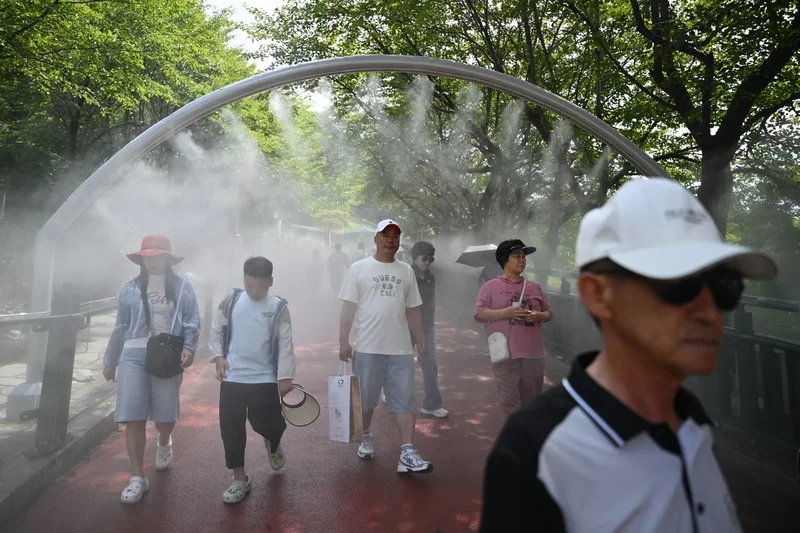
At least 21 people have died in South Korea's heatwave, with an area in Seoul recording 39.5 degrees Celsius on Thursday.
It was after a night in which temperatures in some neighbourhoods barely dropped below 30C.
"Extreme heat on a scale we have never experienced is continuing day after day. Heatwave conditions once seen only in foreign news reports have now become our reality," president Lee Jae Myung told a response meeting on Thursday.
He ordered ministries and local governments to commit all available staff and resources until the heat eases, with rest breaks for outdoor workers enforced during the hottest hours.
The capital had recorded 39.6C in August 2018 during the country's last extreme heat event.
A weather station in Yeongdeungpo, in western Seoul, recorded 40.0C on Thursday afternoon, the first reading above 40C anywhere in the capital since August 2018, according to the Chosun Ilbo.
The station is not used in the weather agency's official statistics because it can read higher than the true air temperature. Elsewhere in the city, Yongsan reached 39.5C and Guro 38.9C.
The national record fell on Sunday, when Yangsan, an inland city in the south-east, reached 42.5C, the highest temperature measured in 122 years of observation. Britain's own record, set at Coningsby in Lincolnshire in July 2022, is 40.3C.
Seoul has suspended construction work and cancelled outdoor events under its highest level of heat warning, which was issued for the whole city this week for the first time since the system was introduced in June. The Korea Baseball Organisation called off all 10 fixtures scheduled for Wednesday and Thursday after spectators fainted in the stands, including one at a game in Incheon.
Forecasters have linked the intensity of the heat to Typhoon Dolphin, which poses no direct threat to South Korea but has strengthened the easterly winds crossing the mountain range that runs down the peninsula.
The air warms and dries as it descends the western side, a process known as the foehn effect, pushing temperatures up over Seoul and the rest of the west.
The heat has emptied streets and changed how people shop and eat, South Korean media reports.
Deliveries usually fall during the July and August holiday season as people travel, but this year they have risen sharply because so many have stayed at home, according to the Korea JoongAng Daily.
Sales through the rapid delivery service run by the convenience store chain GS25 nearly doubled in the last week of July compared with a year earlier, while those at its rival CU rose by 281 per cent, with customers ordering ice and ice cream to their doors rather than walking to shops often only a few hundred metres away, the newspaper reported.
Orders for cold noodles, chilled bean soup and shaved ice desserts rose by double digits over the same period on the delivery app Baedal Minjok, the paper reported, while the online grocer SSG.com sold 44 per cent more frozen ready meals than a year earlier.
Air-conditioned department stores have filled up as people go there to sit rather than to shop. Visitor numbers at Lotte, Hyundai and Shinsegae stores rose by 30 per cent, 17 per cent and 14 per cent respectively in the week to Monday, with food and drink sales at the three chains up by between 20 and 40 per cent.
"Temperature has now become one of the key variables shaping consumer spending," Lee Hong-ju, a professor of consumer economics at Sookmyung Women's University in Seoul, told the Korea JoongAng Daily.
The number of days each year on which South Korea's temperature reaches at least 33C has more than doubled over the past five years, to 19, from eight in the 1970s.