- See more Daily Mail on Google - save us as a Preferred Source
After days of speculation, Reform this week unveiled their new masterplan for solving the small boats crisis.
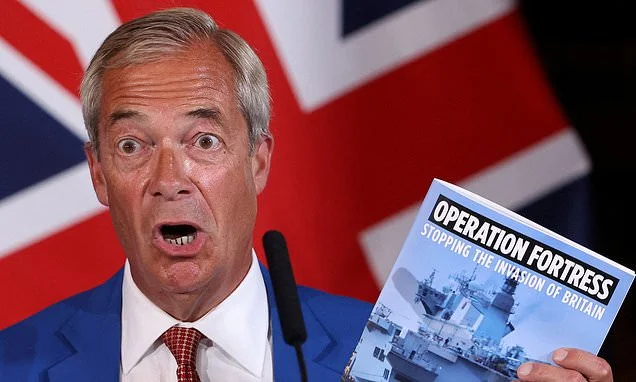
The document, hastily cobbled together with an imposing but blurred image of an aircraft carrier, was entitled Operation Fortress and ran to 28 pages.
But it could actually be summarised in four words: ‘We will invade France.’
Nigel Farage entered Parliament two years ago on the back of legitimate public fury over the failure of successive governments to secure the nation’s borders. It was the defining issue of Brexit. And the policy area that has defined British politics in the following decade.
So, Farage and his aides have had a long time to work on yesterday’s document. But what we received was a work of fiction that attempted to take the British people for fools.
It’s hard to know where to start with the paper. Perhaps the bit where it claims ‘lethal force would be available where lawful and necessary in self- defence or defence of others against an imminent threat to life’. The passage that declares ‘the ECHR does not create a general right to asylum, to enter a country, or to remain there’, is in direct contradiction of every argument the party has presented to support its policy of junking that treaty.
Or, best of all, its fantastical assertion: ‘Operationally, we anticipate agreed returns to French or Belgian ports or transfer points, but will anticipate and plan for returns without the receiving state’s consent.’ In the ten years since Britain voted to leave the EU, this is the best Farage’s brightest brains have come up with. Grab the migrants, dump them back on the beaches of France, cross our fingers and hope the French don’t notice, or mind.
Over the past few years Reform’s leader has recast the political landscape. He has given a voice to the country’s patronised and belittled working class. He has poked at, and popped, the conceit of the establishment elite. And finally shattered taboos that should have been broken decades ago.
Farage is right. There will be a binary choice at the next election. But it will be between Andy Burnham’s Labour Party and Kemi Badenoch’s Conservatives
Reform’s dramatic political advance reached its zenith in the polls last October. The party was at 31 per cent, Labour way back on 20 per cent, the Tories a further three points behind.
That was Nigel Farage’s moment. The opportunity for him and his colleagues to kick on and move up to the next level. To start to demonstrate that they had the ability not just to scream obscenities at the furies assailing the British people but to come up with concrete proposals to confront and ultimately vanquish them.
To move, in other words, from a party of opposition to a serious alternative party of government.
And they have completely blown it. By my reckoning, Reform have recently announced three significant policy initiatives.
The first was a U-turn. Farage, having stated he opposed the two-child benefit cap, suddenly announced he didn’t. Asked to rationalise his stance, he meekly said he’d simply lost the argument.
The second was the announcement from the party’s Home Affairs spokesman Zia Yusuf that in the wake of the murder of Ann Widdecombe all MPs, and a significant number of former MPs, would be granted round-the-clock armed police protection.
When it was put to him this was a £3billion spending commitment, he shrugged off concerns by saying he didn’t care what the cost was.
The most recent initiative was their jerrymandered offering on small boats. Which one naval expert, in one of the more objective analyses of the policy, described as a ‘crock of s**t’.
Kemi Badenoch has began to carefully and methodically set out a modest but deliverable Conservative – and conservative – prospectus for government
It is impossible to ignore the impact Nigel Farage and his party have had on British politics. Or the long-needed shock they have delivered to the two main parties, who have both in their own differing ways also taken the voters for idiots.
But it is now equally impossible to ignore another simple fact. Reform are currently not a serious party. They are not remotely close to being an alternative party of opposition. And they are even further away from being an alternative government.
Yesterday Farage claimed ‘the next election will be a binary choice between Reform and Labour’. But it will not. Because Reform’s own leader has ensured it cannot be.
Two years after their worst rejection in modern electoral history, Kemi Badenoch’s Tory Party remains in a deep political hole. But the contrast with which she has used the 24 months that have followed could not have been starker.
Despite the entreaties of some in her inner circle, she ignored the lure of easy populism. She rejected calls to engage in an arms race with Reform over who could lurch the furthest to the right.
And she began to carefully and methodically set out a modest but deliverable Conservative – and conservative – prospectus for government. A pledge to abolish stamp duty. A Golden Economic Rule that would ensure at least half of government savings are channelled towards cutting the deficit, tax cuts or growth. A commitment to phasing out the addiction to Net Zero.
True, few of these policies secured the fanfare of yesterday’s announcement from Nigel Farage. But they at least had the benefit of not advocating the storming of the beaches of a Nato ally with lethal force. And as the polls and recent parliamentary election results show, they are starting to resonate with the electorate.
As one Tory insider revealed: ‘It’s clear from our research 2024 Reform switchers are worried Farage & Co aren’t doing the work and that their announcements look good but fall apart under scrutiny.
‘By contrast, Kemi doesn’t let anything out the door until it’s been fully tested.
‘We do the work and make the policies bulletproof.’
As evidence, they point to the Aberdeen South by-election, which they claim swung on whether the oil and gas industry believed in Badenoch’s commitment to change Tory energy policy. ‘People called on us to stand down for Reform in Makerfield and they’d stand down for us in Aberdeen. Reform lost by miles and we won in Aberdeen even with Reform on the ballot paper.’
Within Reform’s ranks there are thoughtful people. A few years ago, I spent a couple of hours with Richard Tice, in which he delivered an articulate analysis of the nation’s problems and his personal solutions for addressing them.
Robert Jenrick once set out for me one of the most compelling and cogent critiques I’ve heard of the modern Right and his prescription for its ills.
Danny Kruger’s deconstruction of the Assisted Dying Bill was one of the most effective examples of parliamentary statecraft I’ve ever witnessed.
But they are currently being neutered. Or worse, forced to jump through increasingly bizarre populist hoops in a desperate effort to re-energise Nigel Farage and Zia Yusuf’s fading circus.
Farage is right. There will be a binary choice at the next election. But it will be between Andy Burnham’s Labour Party and Kemi Badenoch’s Conservatives.
Because Reform have proven themselves incapable of crossing even the most basic threshold of competence necessary to be entrusted with the governance of a nuclear-armed nation state.
We do indeed need an Operation Fortress.
One that ensures that, until Reform grow up, they are never allowed within a country mile of the levers of power.