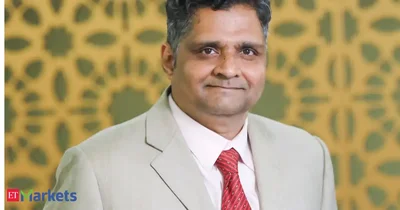
UTI AMC's Executive Vice President - Equity, V Srivatsa, believes investors may be better off leaning towards largecaps despite the superior long-term growth prospects of midcap stocks. With the midcap segment trading at a record valuation premium over largecaps, he said the risk-reward has turned more favourable for largecaps, whose earnings growth is improving while valuations remain around historical averages. Edited excerpts from a chat:With valuations elevated in several pockets, how do you assess the broader market’s risk-reward proposition today?
While valuations remain in excess in certain pockets such as capital goods, consumer durables, defense and healthcare albeit this is led by better earnings visibility and growth, there are also pockets where valuations are below mean in sectors such as banks, insurance, information technology and telecom. Thus, risk reward remains balanced. The earnings growth for Nifty 50 for next year is around 14% as per Bloomberg estimates after two years of sub-par growth and valuations also remain below the last couple of years. With the oil price stabilising and rupee stabilising, we see more macro stability ahead coupled with the earnings growth should lead to positive risk reward going ahead.
Where do you currently see a better balance between growth and valuation: largecaps or midcaps?
The Nifty 50 trades at one year forward estimates of around 17x (as per Bloomberg) which is in line with the last five-year averages and the earnings growth of around 14% is respectable which is led by capital goods and services, telecom, metals and financials. The mid cap also is expected to grow in similar lines and trades at 50% premium to large caps. While the longer-term outlook for mid cap is superior to large caps, the valuation premium is at record high and there could be mean reversion especially when the growth is picking up for the large cap. Hence on a risk reward basis, a large cap looks superior.
Which sectors offer the strongest earnings visibility over the next three to five years, and where are expectations running ahead of fundamentals?
In terms of sectors, power equipment, defense, electronic manufacturing services (EMS), healthcare and retail offers highest earnings visibility led by strong order book in case of capital goods and EMS players and strong trends in demand in healthcare and retail. In case of capital goods (power equipment/defense, EMS), while the order visibility is high, there could be peaking of orders in the next three years posing cyclical risks post three years and current valuations do not factor any medium-term weakness which is not ruled out as these businesses are pro cyclical. In case of healthcare and retail, valuations are fair and there could be a long tail of growth justifying the valuations.
Does AI represent a structural growth opportunity for Indian IT companies, or could productivity gains disrupt their traditional revenue model?
AI represents a very good long-term opportunity as the global companies embrace AI in their business, they would need the service of Indian IT service providers to integrate the AI into their systems, and this would present a significant opportunity for them. However, in the near term, there could be pressure on two counts, one is to incorporate AI to reduce cost of delivery and passing on the benefits to clients and second is possible cuts in IT services spending as AI hardware costs crowds out the IT services spending. Yet we believe that there would be long term benefits to the Indian IT services companies.
Capital goods companies have benefited from the investment cycle. What indicators would signal that the cycle is strengthening or approaching a peak?
The key indicators that we will watch to assess the cycle are changes in the government policies, upward or downward revision in government capex, global demand for global linked industries, weakening profitability in end user industries and capex announcements. Government policies and corporate profitability and demand would be the key signals to watch out for the capex order cycle.
What are the biggest risks to Indian equities today: earnings disappointments, stretched valuations, global uncertainty or domestic growth moderation?
Global uncertainty would be the biggest risk for the Indian markets as the geo political risks have increased manifold in the last few years and it has important bearing on the oil prices wherein higher oil prices can cause instability in the Indian economy and also high geo political risks affects global sentiment towards equities and flows trends towards safer assets .
If you have to start an SIP of Rs 10,000 as an investor with moderate risk appetite at this stage, how would it be spread out across various fund categories?
I would suggest a mix of flexicap or large mid cap funds and smaller allocations towards hybrid funds.