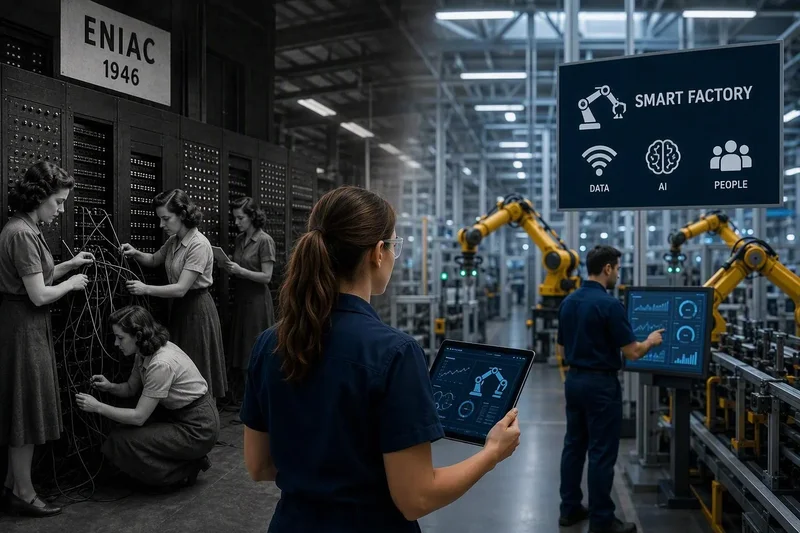
In February 1946, the U.S. Army unveiled a computer that could calculate an artillery shell’s trajectory faster than the shell could reach its target.
ENIAC was massive: 30 tons, 18,000 vacuum tubes, 3,000 switches. The computer was a marvel. So were the six mathematicians who figured out how to program it: Kathleen McNulty Mauchly Antonelli, Jean Jennings Bartik, Frances “Betty” Snyder Holberton, Marlyn Wescoff Meltzer, Frances Bilas Spence and Ruth Lichterman Teitelbaum. Their names belong here because history ignored them for decades while the computer and its hardware inventors got the glory.
These women worked for the Army as human “computers,” calculating artillery trajectories by hand. Then they were asked to program ENIAC while it was still being built. With no programming languages, manuals or classes, they studied electrical diagrams, broke equations into thousands of steps and used cables and switches to guide each calculation through the machine. In the process, they helped create the profession of computer programming.
Manufacturing is now facing its own ENIAC moment. The smart factory is arriving before the workforce needed to run it has fully taken shape. Robots run production lines, sensors track what’s happening across the plant, and AI spots defects, predicts failures and helps adjust production in real time. All of it depends on people who can run, fix and improve these systems.
No single title has emerged for these jobs. Some companies call them automation technicians; others call them mechatronics specialists. Whatever the title, the problem is the same: there are not enough people who can do the work.
For years, manufacturers struggled to find enough entry-level workers. Now the shortage has moved up the skills ladder. A recent MAGNET survey of Ohio manufacturers found that demand for workers with technical training and experience has reached a seven-year high.
That same shift is playing out nationally. Across four technical occupations alone, U.S. manufacturers are expected to add nearly 90,000 jobs over the next decade. The irony is that automation is reducing many of the entry-level jobs that once taught people how a factory worked. The first rung of the career ladder is disappearing just as manufacturers need more people to climb it.
Computer programming took decades to develop recognizable career paths through universities, employer training, certificates and boot camps. Manufacturing cannot wait that long. It needs to build those paths now.
1. Build a New First Rung for Technicians
For generations, entry-level production jobs also served as manufacturing’s training ground. People learned by loading a machine, setting it up, watching it fail and standing beside someone who knew how to get it running again. Some eventually moved into machining, maintenance, quality or supervision.
Automation is removing much of that repetitive, dangerous and physically demanding work. It is also shrinking the place where people once learned how a factory worked.
Manufacturers need to treat every entry-level hire as a future technician, even if that person arrives with no technical skills. That means creating a pathway inside the plant to help employees develop the skills they—and the company—need.
A new employee should be able to see that path from day one: start here, learn these skills and qualify for this job.
2. Build a Culture of Opportunity
The smart factory will keep changing the skills it requires. One manufacturing workforce study estimated that 40% of current skill requirements in advanced manufacturing would evolve within five years.
Manufacturers cannot treat training as a one-time event. Employees need to see how learning a new skill leads to greater responsibility, a better job and higher pay. Supervisors should be expected to identify people who can move up, and experienced workers should have time to teach them.
Start by mapping which jobs are changing, what skills they will require, and which employees could grow into them. Then give those employees paid time to learn and a clear path to the next role.
A factory that invests in smarter equipment without giving its people a way to grow with it will keep recreating the same skills shortage.
3. Stop Hiring Only for Experience
Manufacturers often search for technicians who already know the exact machine, control system or software on the plant floor. That person may not exist, especially when the job itself is still taking shape.
The six women who programmed ENIAC had never programmed a computer. They understood mathematics, logic and the problem the computer had been built to solve.
Manufacturers need to look for that same kind of potential. The next great technician might be an operator who notices subtle changes in a machine or a mechanic who knows how to trace an electrical problem. Hire for how people think, then teach the equipment.
Job descriptions should reflect what the work truly requires. A short, job-related problem can reveal more than a résumé. Ask candidates how they would diagnose it and pay attention to what they notice, test and question.
The industry cannot solve a shortage of experienced workers while refusing to hire anyone who still needs experience.
4. Train People Before the Technology Arrives
An operator does not become a robotics technician because the company bought a robot. A maintenance mechanic does not suddenly understand software, controls and production data because the equipment became more advanced.
Every major technology investment should answer a few basic questions before the purchase is approved. Who will run it? Who will fix it? Who will improve it? Which employees could grow into those jobs? What training will they need, and when will it begin?
Too often, those questions come after the machine arrives. Production targets are already waiting. The vendor provides a few days of instruction, and employees return to their regular workload before they have time to learn the system. Companies end up calling the vendor every time something goes wrong.
Training should be part of the purchase. Vendors should help train internal experts. Workers need protected time to learn before they are responsible for keeping production moving.
5. Use AI to Capture Tribal Knowledge
Some of the most valuable knowledge in a factory never made it into a manual. It is the sound a machine makes before a bearing fails, the adjustment that prevents a recurring defect or the sequence that gets a line running after a shutdown.
Much of that knowledge sits with experienced workers who are nearing retirement. In MAGNET’s survey, 70% of manufacturers said they were transferring knowledge from retiring workers to younger employees.
AI can help turn that experience into something others can use. Record experienced employees talking through recurring failures and difficult repairs. Combine those conversations with maintenance histories and equipment manuals, then organize the material into a searchable knowledge base.
A newer technician could describe what a machine is doing and quickly find similar problems, past fixes and the reasoning behind them.
AI will not replace the judgment of an experienced technician. But it can preserve examples of that judgment and make them available long after the expert has retired.
6. Build the Pipeline Through Partnerships
Most small and midsize manufacturers cannot build this workforce alone. One company may need only a few technicians. Twenty companies in the same region can fill a classroom.
But that requires real collaboration. Manufacturers need to agree on the core skills they need, share how many people they expect to hire and commit to paid experience and jobs. Schools and community colleges can then build training around real demand. Workforce and community partners can help people enter the program and finish it.
A factory tour can create interest. It cannot create a technician. That takes a connected path from the classroom to paid experience to a real job.
When employers, educators and community partners create that path together, small manufacturers can build a talent pipeline none of them could achieve alone.
Eighty years ago, the computer arrived before computer programming existed as a profession. ENIAC was a room full of hardware until six mathematicians studied its wiring and figured out how to make it work. In doing so, they helped create the field that allowed computing to change the world.
Smart manufacturing has reached a similar point. The technology is arriving on the shop floor faster than the people and career paths needed to make it useful.
The next great manufacturing breakthrough may not be a machine at all. It may be the path that teaches someone to run one.