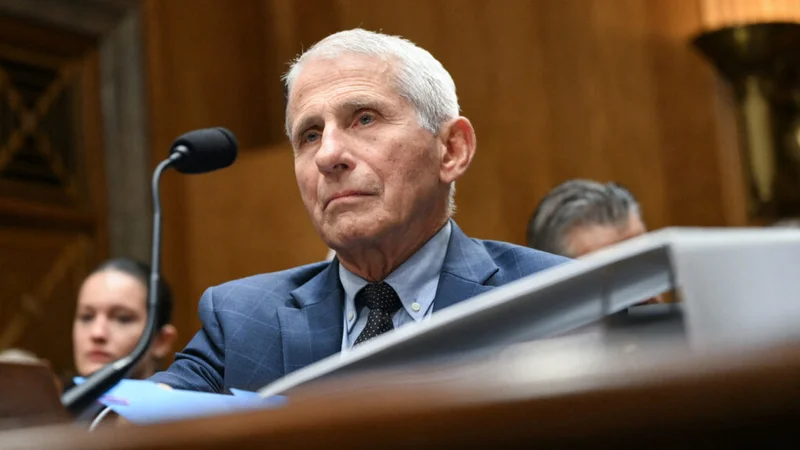
WASHINGTON — A Senate committee voted Thursday to hold Anthony Fauci, who declined to answer questions in a hearing last week about his role in the lead-up and response to the Covid-19 pandemic, in contempt of Congress in a party-line vote, 8-7.
Now the matter will go before the entire Senate, where the vote would be subject to the filibuster. If the Senate votes to hold Fauci in contempt, it will be up to the Department of Justice to decide whether to prosecute him.
Conviction can carry a penalty of up to $100,000 in fines and one to 12 months in prison.
Fauci was subpoenaed to appear last week before the Homeland Security and Governmental Affairs Committee, where Sen. Rand Paul (R-Ky.) led a marathon hearing questioning the former chief of the National Institute of Allergy and Infectious Diseases, who has faced a number of accusations from Paul and others, including that he was involved in a conspiracy to cover up the origins of the pandemic.
In response to every question, Fauci, who has accused Paul of pursuing a groundless, “unhinged” campaign against him, declined to answer, asserting his Fifth Amendment right against self-incrimination. He had previously received a “preemptive” pardon from President Biden due to Biden’s belief that the Trump administration and Republican lawmakers were likely to target Fauci. Even before last week’s hearing, Paul had repeatedly referred Fauci to the Justice Department for prosecution.
Before the Thursday contempt vote, Paul, who has been fiercely critical of Fauci for years, said the American people deserve more information about the federal government’s role in the early days of the pandemic.
“A subpoena with no consequence is not a subpoena. It’s a suggestion,” he said.
Sen. Gary Peters (D-Mich.), the ranking member of the committee, used the hearing to again argue that Paul’s oversight efforts have been partisan and rushed, and he noted a criminal contempt vote would not force Fauci to comply. (Paul has denied that the investigation was partisan or rushed.)
Peters said Paul has indicated he might refer the matter to the Justice Department before bringing it before the floor (which would be a departure from precedent), and moved to table the resolution until Paul assured the committee. The motion to table the resolution failed after a party-line vote.
Paul didn’t respond to Peters’ comments. Though reporting to the Senate floor is not expressly required by the law, according to a 2023 Congressional Research Service report, “congressional practice and at least one judicial decision suggest” it may be necessary.
Peters also said the vote threatened Fauci’s Fifth Amendment right — as well as that of all future witnesses before Congress.
After last week’s hearing, Paul questioned Fauci’s right to decline lawmakers’ questions, arguing someone who received a pardon is not therefore permitted to dodge them. (Paul conceded his theory had yet to be tested in court.)
Sen. James Lankford (R-Okla.) also suggested there may be precedent for holding Fauci in contempt: Lois Lerner, a former IRS employee who made an opening statement to a congressional committee before taking the Fifth when asked questions, was found to be in contempt under the theory that she had waived her Fifth Amendment right by making an opening statement. But the Department of Justice rejected that reasoning and declined to prosecute Lerner.
Fauci made a brief opening statement at his own hearing before declining to answer questions. His decision came after health secretary Robert F. Kennedy Jr. and Paul had previously suggested that he would lie before the committee and that his answers could make him vulnerable to prosecution — a goal of some policymakers still enraged by the federal response to the Covid pandemic.
If Fauci lied to Congress in the hearing, he could be prosecuted because the preemptive pardon he received under Biden only covers him through Jan. 19, 2025.
The saga is the latest effort by Republicans looking to settle scores over what they see as Covid-era failures. Disgust over the government’s handling of the pandemic helped fuel the rise of many top Trump health officials — and their agendas of upending the nation’s public health apparatus.
Criminal charges against Fauci remain a concrete — and long-held — goal for Paul, Kennedy, and their allies.
But there are other legal risks that could be ahead for Fauci, even if Paul’s push for contempt isn’t successful. Sen. Ron Johnson (R-Wis.) also asked that Fauci and others participate in transcribed interviews with the Homeland Security and Governmental Affairs committee, threatening subpoenas if they don’t comply. On Wednesday evening, the Wall Street Journal reported that Johnson’s committee had obtained a copy of Fauci’s phone.
“My investigation has just begun,” Johnson said on Thursday.
The House Oversight Committee chair, James Comer (R-Ky.), said in a statement his committee wanted to ask Fauci about Covid-era journal entries that were obtained and released by Paul’s panel. Should House Republicans find reason to hold Fauci in contempt, they wouldn’t need to overcome a filibuster in their full chamber vote.
At least one state government is joining in, too.Florida’s attorney general, James Uthmeier, said he was opening an investigation, though he didn’t detail precisely what he would investigate. His office did not respond to request for comment.