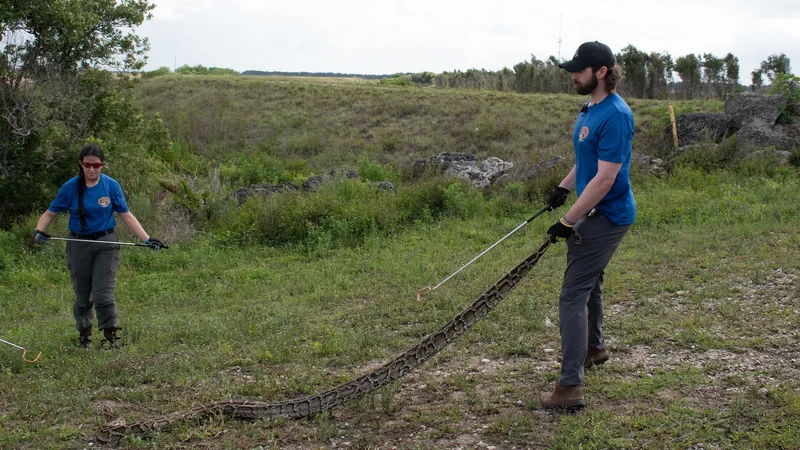
The full list of this year’s top python hunters is finally here. The Florida Fish and Wildlife Conservation Commission (FWC) announced the results of this year’s Florida Python Challenge, which featured 907 participants from 30 states as well as Vietnam and Canada. Over 10 days, hunters scoured locations like Everglades National Forest to remove as many Burmese pythons (Python bivittatus) as possible in an effort to promote ongoing mitigation efforts against the destructive invasive species.
Challenge participants collectively removed a total of 280 snakes from south Florida, bringing the annual competition’s overall tally to more than 1,600 pythons.
While Tom Rahill walked away with the $10,000 grand prize for removing 96 snakes, Rahm Levinson won $1,000 with the longest python measuring an impressive 16-feet, five-inches. Another $14,000 was distributedacross multiple categories.
PROFESSIONAL
- Most Pythons Prize: $2,500 — Christina Kraus — 36 pythons
- Most Pythons Runner-Up Prize: $1,500 — Taylor Stanberry — 34
NOVICE
- Most Pythons Prize: $2,500 — Bart Shreve — 9 pythons
- Most Pythons Runner-Up Prize: $1,500 — Michael Marousky — 4 pythons
- Longest Python Prize: $1,000 — Vincent Poole — 8 feet, 2 inches
**MILITARY — Active Duty and Veteran **
- Most Pythons Prize: $2,500 — Stephen Payton, U.S. Army — 3 pythons
- Most Pythons Runner-Up Prize: $1,500 — Jonathan Miller, U.S. Air Force — 2 pythons
- Longest Python Prize: $1,000 — Jeffery “Heath” Roser, U.S. Army — 8 feet, 7 inches
“The number of invasive pythons removed from the Everglades during the 2026 Florida Python Challenge is a major victory for Florida’s native wildlife and a testament to what can be accomplished through strong partnerships and public participation,” FWC chairman Rodney Barreto said in a statement.
Since 2017, the FWC and South Florida Management District contractors have removed over 19,000 snakes from the state. Burmese pythons have rapidly disrupted the native ecosystem while putting immense stress on local wildlife populations since their accidental introduction into the Everglades during the 1970s. Researchers estimate 100,000 to 300,000 of the apex predators can now be found in Florida, many growing over 13 feet long.
“The Florida Python Challenge shows what is possible when we all come together around a shared conservation goal,” added Fish & Wildlife Foundation of Florida executive director Nick Wiley.