The most effective crypto onboarding tool ever built may turn out to be one the industry did not invent, because the gift card has been quietly teaching the world to accept digital value for twenty years. An iTunes card taught a generation to load stored credit into an app store, a Steam card did the same for gaming, and the format now moves so much money that the digital segment alone is worth roughly $680 billion in 2026 and is projected to reach $1.25 trillion by the end of the decade, growing 17 per cent a year. The corporate side is growing faster still, with the business and institutional segment compounding at nearly 20 per cent annually as companies standardize gift cards into trackable instruments for rewards, incentives and loyalty, and the preference data explains why: 54 per cent of employees would rather receive a gift card than a physical gift, and digital issuance now outpaces physical by two and a half to one. The format is familiar, the procurement workflows already exist, and nobody needs a tutorial to understand what a gift card is.
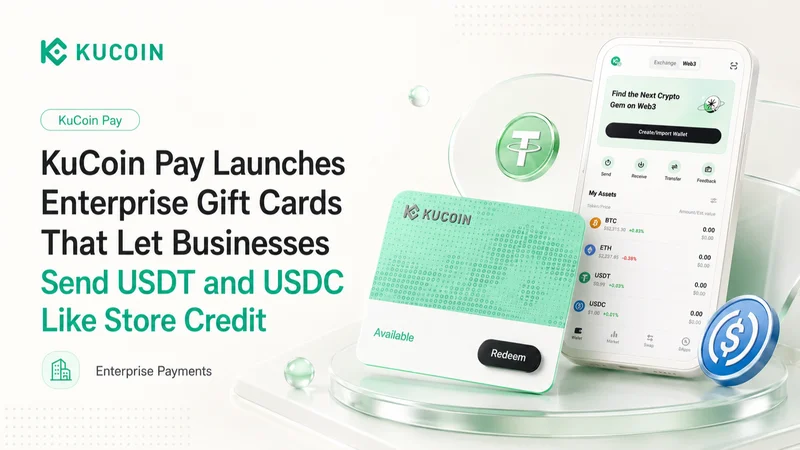
KuCoin Pay is now loading that familiar format with a very different asset. The payments arm of the KuCoin exchange has launched KuCoin Gift Card, an enterprise solution that lets businesses distribute USDT and USDC globally through digital gift cards, with bulk issuance and API integration designed for customer rewards, promotional campaigns, employee incentives and community engagement.
Recipients redeem the cards through KuCoin and receive the underlying assets, and from there the value stays live: it can be held, transferred, or spent across supported scenarios in the ecosystem, including through KuCoin Pay's merchant network, which supports more than 50 cryptocurrencies across online and in-store checkout. Alicia Kao, KuCoin's managing director, framed the launch around a claim worth taking seriously on its own terms, which is that the next phase of adoption will be driven less by how people trade digital assets and more by how easily they exchange and use them in everyday economic activity, with the gift card acting as the connective tissue between sending, receiving and using.
For the issuing business, the pitch is operational rather than ideological, since distributing crypto to thousands of customers or employees today means wrestling with wallet addresses, chain selection and support tickets, and a bulk-issuance API that reduces all of it to the workflow companies already use for Amazon cards is selling the removal of complexity rather than the addition of it.
The Most Familiar Wrapper in Commerce Meets the Fastest-Growing Asset in Finance
Total stablecoin supply has grown from $6.8 billion in March 2020 to more than $320 billion in April 2026, a 47x expansion that survived a full bear market drawdown and has decoupled from the crypto price cycle, with Citigroup projecting $420 billion by the end of the year and roughly 269 million onchain addresses now holding a stablecoin balance. Enterprise adoption stopped being theoretical somewhere in the past eighteen months, as Visa, Mastercard, Fiserv and Western Union moved stablecoin programs into production and business-to-business stablecoin payments grew from under $100 million a month in early 2023 to more than $6 billion by mid-2025, a sixty-fold expansion in thirty months.
An estimated 741 million people worldwide now own cryptocurrency, about 9 per cent of the planet, and the composition of that ownership is shifting in exactly the direction a distribution product wants, because stablecoins are increasingly the entry point for payments-focused users and 65 per cent of owners say they would prefer to pay with crypto where possible. A market where two-thirds of holders want to spend rather than merely hold is a market where the missing infrastructure is not another trading venue but the unglamorous machinery of moving value into people's hands in the first place, and gift cards are, historically, the single most effective machine ever built for that job.
The Product: From One Transfer to a Value Loop
A traditional gift card is a dead end by design: the business issues it, the recipient redeems it, the value is spent at the register, and the relationship ends there, which is fine for a retailer whose goal was the sale. KuCoin's version restructures the same motion so that redemption is the beginning rather than the end, because the recipient receives an actual bearer asset, USDT or USDC, that remains live after the card is consumed: it can sit as savings, move to another person, or spend through the merchant network, and every one of those behaviors happens inside the KuCoin ecosystem. Kao's language about building a complete value loop across sending, receiving and using is, stripped of its politeness, a statement that the gift card is the top of a funnel and the ecosystem is the funnel's floor.
Read commercially, that loop is the real product, and it deserves to be named plainly: every redeemed card creates a funded, verified KuCoin account belonging to someone a business paid to reach. Exchanges spend enormous sums acquiring users who arrive empty-handed and often leave the same way, while a gift card recipient arrives with a balance, a reason to have shown up, and a relationship with the brand that issued the card, which makes this among the cheapest plausible user acquisition channels an exchange could build, financed by other companies' marketing budgets. The enterprise features, bulk issuance and API integration, are what make the funnel scale, because they let a loyalty program, a promotional campaign or an HR rewards system embed stablecoin distribution the way such systems already embed conventional e-gift providers, and the corporate rewards category those systems serve is precisely the segment of the gift card market growing at nearly 20 per cent a year.
Final Thoughts
Crypto has spent fifteen years designing onboarding experiences and the most effective one may simply be the one commerce already trusts, a format so familiar that 54 per cent of employees actively prefer it and so large that its digital half alone clears half a trillion dollars a year. KuCoin's insight is less about technology than about packaging: the stablecoin is the fastest-growing monetary instrument on earth, the gift card is the most frictionless way ever devised to put value in a stranger's hands, and nobody had built the enterprise-grade bridge between them at scale.
Product launches are easy to announce and hard to interpret, but this one comes with an unusually clean test, and it will be visible within a year. Either businesses integrate the API and the activation rates show recipients actually crossing the redemption gate into funded accounts, turning other companies' rewards budgets into KuCoin's user growth, or the friction at the toll gate wins and the cards join the long list of crypto products that mistook issuance for adoption. In a market where every exchange claims to be building for the next billion users, a product whose success is measured in redeemed gift cards has at least chosen a metric that cannot be faked by trading volume.
Don't forget to like and share the story!
Vested Interest Disclosure: HackerNoon has reviewed the report for quality, but the claims herein belong to the author. #DYOR.