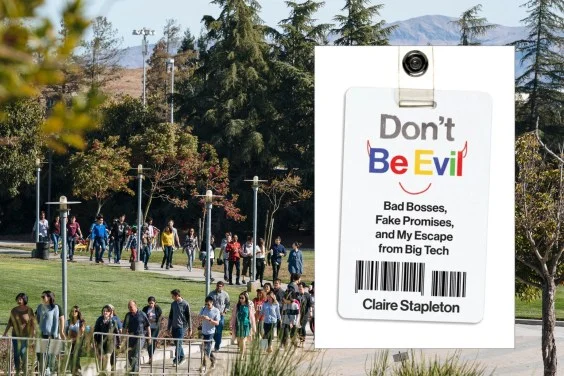
It feels a little perverse to be writing this review in a Google doc. In 2018, over 20,000 Google employees walked out to protest working conditions at the tech juggernaut. Claire Stapleton was one of the protest's primary organizers. She had started at the company as an internal communications associate, drafting copy to explain the work product of the company to actual employees. Her quippy emails earned her multiple promotions and even the internal moniker “Bard of Google.” After a few years, however, Stapleton, along with many other employees, were fed up with the sexism, racism, and intense hierarchy of the company. Andy Rubin, who was accused of extensive sexual harassment, had received a $90 million exit package from CEO Larry Page. Many Black employees were underpaid and many women were exhausted by the boy’s club environment. New York magazine wrote an extended oral history of the highly publicized event. Almost a decade later, Stapleton has published an account of her turbulent time in labor organizing, titled Don’t Be Evil: Bad Bosses, Fake Promises, and My Escape from Big Tech.
What starts as a straightforward memoir eventually evolves into a reckoning. Can you work in tech without losing your morals? The epigraph of the book is from Graham Greene: “Sooner or later, one has to take sides. If one is to remain human.” The problem, Stapleton realizes, is that while Google claims to have principles, it’s a big company like any other, prone to power plays and the bottom line. “It was half utopia, half dystopia, and somehow completely unable to tell the difference,” she writes. Perhaps even worse: “It was the kind of evil that doesn’t even realize it’s evil.”
Stapleton’s older brother Scott, who died early on in her career, was one of the first to call Google a cult even as she began to rise through the ranks. His passing highlighted the way her sense of self had been warped by the corporate world. After helping send out an email announcing her brother’s death, she realized that she “had become someone who managed my life like I was in a permanent performance review.” Her friend noted that “people wanted to see you perform a productive version of grief.”
Stapleton originally drew attention at the company because of her quirky, TGIF emails which served as a form of internal communications for Google employees. “My job, at its core, was to tell the company its own story … folklore and fanfiction, the refrains of the gospel," she writes. "The irony was that my rise in the comms department was powered by not sounding corporate.” Here, the casual, chatty, gossipy voice took hold. The Catholic-born and -raised writer could flex her fluency with the liberal humanities and Thomas Pynchon in the hallowed halls of Google’s Mountain View headquarters. She could write in all lowercase and make use of bon mots like “Go off, king.” This voice is unfortunately mostly absent from Don’t Be Evil, save for a few excerpts from her time at Google. But Stapleton is a great storyteller—turning a tale we’ve all heard about a disgruntled tech worker into a tender account of workplace abuse and navigating being a “wokescold.” (Stapleton would later take up her original voice to write a Substack called Tech Support.)
Life in the Googleplex was glamorous. Barack Obama, Taylor Swift, Lady Gaga, and Natalie Portman all graced the office. Merriam-Webster added “Google” to the dictionary. But the “indoctrination” started early. Everyone was expected to work hard—and then harder. “That was the culture: You always assumed the problem was you,” Stapleton writes. “Never the system, never the people in charge.” Being late was always the employee’s fault. Employees were encouraged to analyze themselves—and blame themselves—for any perceived weakness. Everything fed into the inescapable vision of the company. “Even the adversarial questions were absorbed into the Google spirit—it all melted into laughs, love.”
After ghostwriting speeches for Page and penning the massively successful TGIF email, Stapleton eventually moved over to the Creative Lab where she struggled to get delegated work. Her boss didn’t seem to like her personality and often took her off projects, or simply didn’t assign her any tasks at all. Of course, later on, he’s inappropriate with her at a party. These events drained Google of any magic. She started being pushed from one department to another in order to find the right fit. Luckily, she also met her husband-to-be Shane and read Bullshit Jobs by David Graeber—a solid grounding for her eventual work in labor.
Soon Stapleton found herself at the Google-owned YouTube. Here, too, she found roadblocks at every turn. YouTube was a “mirror” for society, claiming to be woke one moment and then defending big earners like PewDiePie and Logan Paul. As her relationship to her boss deteriorated and news broke about Rubin’s lucrative exit package, she decided it was time for a walkout.
The organization and execution of the walkout occurs over just a few chapters. It’s the meat of the story, but its lead-up and aftermath are Stapleton’s real focus. Could her corporate side and activism coexist? Would Google just subsume any attempt at actual change? Looking back, it’s obvious. But Stapleton’s search for staying the ethical route is far more self-searching than many recent tech work memoirs. Unlike some, she’s not oblivious.
The walkout was a hit—even if it led to some disgruntled bosses and awkward conversations. The sheer spectacle and intense press interest forced Google to at least take meetings with their frustrated employees. But Stapleton found that the company had no real interest in changing or living up to its ideals. Using the “veil” of PR, they pretend to celebrate Stapleton—even buying her new boots for a stilted photo op—but her boss slowly takes tasks off her plate. A silent demotion. While outwardly Stapleton seems to be soaring—even appearing on Kara Swisher’s podcast—she’s starting to consider exiting tech.
Meanwhile, her band of tech crusaders is struggling to agree on tactics. After being photographed by a protest photographer who also snapped pics at Ferguson, Mo., they struggle to agree on how to best go ahead effecting change. Some want incremental improvements, and some want to burn things down. Some believe in reforming Google, and others want to become true saboteurs. One woman suggests boycotting the company, though Stapleton bristles at such an idea: “Anyway, what did a boycott of Google even mean? It was like the air we breathed—they even powered the Wi-Fi in downtown Manhattan.”
When she finally decides to leave, Stapleton discovers negotiating an exit package with her former ex-girlboss isn’t easy. “Make the woman hysterical," she notes, is a key corporate strategy. Her name is dragged through the mud all over Google. “This way out of Oz,” she wryly remarks when she finally leaves headquarters for the last time.
There are moments it would have been nice if Stapleton had written more about how her narrative connects to wider problems and schisms in the tech world. She brings up AI and Trump 2.0 in the last few pages—and even makes a joke or two about Gemini—but she focuses primarily on Google and the walkout. Fair enough. But one wonders what the book could have done if, like Karen Hao’s Empire of AI, it zoomed out to understand the complicated relationship of labor, tech, and ethics. Still, the book that Stapleton has written is a smart, fun, and enjoyable read about escaping Google. The questions she raises about ethics and corporate life are vital, and her writing is clear and enjoyable. The gift that Stapleton gave Google—her voice—is now her own. This isn’t a juicy tell-all, but an intelligent memoir about a woman growing up in Silicon Valley.