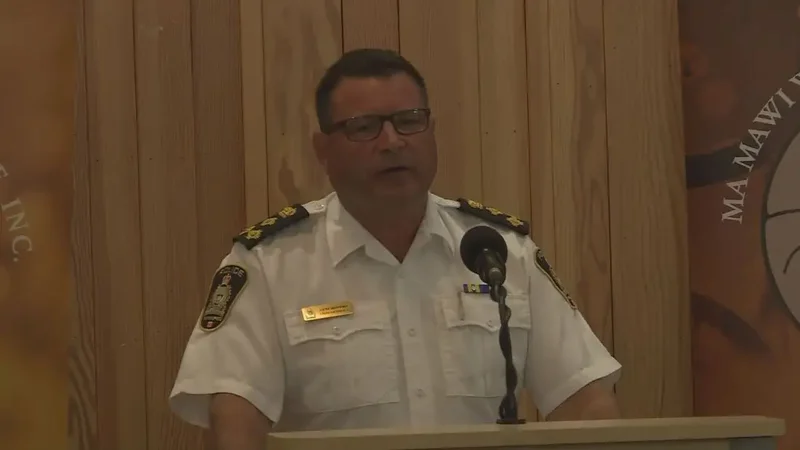
Winnipeg police Chief Gene Bowers said the service’s 10-day open drug use enforcement initiative “produced positive results,” justifying its renewal and continuation into the fall.
The 10 days of increased enforcement launched on June 24 and resulted in 106 arrests, police said at a news conference Thursday. It included an increased police presence in downtown Winnipeg and Point Douglas, which were areas chosen by police due to elevated crime rates and high naloxone administrations.
The police chief said the results aligned with what the Winnipeg Police Service (WPS) hoped for, adding that an expanded version of the project will launch Friday.
“Enforcement isn’t a solution by itself, but it has a place,” Bowers said.
“While enforcement remains an important tool in addressing drug trafficking and related criminal activity, our initial open drug use initiative has also produced positive results.”
During the 10-day stint, the WPS responded to more than 1,000 project-related events, which prompted 106 arrests, police said in a news release.
Of those arrests, 93 were related to a warrant or breach of conditions. Five drug possession charges and three drug trafficking charges were laid.
Seven people were transported to a detox or protective care centre, police added.
Violent crimes fell by 16.5 per cent and property crimes decreased by 10.5 per cent, compared to the same time frame in 2025, the news release said.
Get weekly health news
Following its late-June launch, the plan was met with feedback saying WPS should have collaborated with community partners, Winnipeg’s police chief said. Since receiving those critiques, police began working alongside some stakeholders.
“We arrived at a shared commitment to work together to achieve the best possible results for those we serve,” Bowers said.
“Beginning tomorrow, and continuing into November, residents can expect to see a visible police presence in specific areas.”
The project will expand its scope to include Osborne Village, as well as continuing work downtown and Point Douglas, according to police.
Bowers said crime data, public complaints and calls for service to WPS or the Winnipeg Fire Paramedic Service contributed to the decision of areas in need of increased enforcement.
Winnipeg’s police chief said he hopes those results are bolstered by the new project, which will see community outreach teams who may work alongside police patrollers. Outreach workers or volunteers can provide resources and immediate assistance to people in need and may also offer follow-up support.
Jackie Anderson, executive director of Ka Ni Kanichihk, said the non-profit will use its Indigenous knowledge to assist WPS, and care for people who are struggling with homelessness or drug addiction.
- Edmonton police investigating suspicious death of man on Wednesday afternoon
- Suspects arrested in Salsa on St. Clair shooting, Toronto police chief says
- Teen among suspects charged in latest U.S. Consulate shooting: Toronto police
- Driver shot dead as auto theft leads Toronto police into Mississauga: SIU
“Following the recent sweep, a community coalition was formed, bringing together urban Indigenous organizations and non-Indigenous allied organizations to work alongside the Winnipeg Police Service using an Indigenous model of care,” Anderson said.
“Together, we will create the much-needed village our relatives need.”
Eleven groups have joined the Indigenous-led coalition so far, Anderson continued. The organization’s model of care is designed to help connect people with resources, including helping them find emergency shelter or detox treatment.
Winnipeg Mayor Scott Gillingham commended the revised program.
“The status quo is simply not working. This is not a choice between compassion and public safety. Winnipeg needs both, and I believe what we’re seeing is both,” he said.
“We should care about people (and) we need to care about people who are struggling with addiction and still say that open illegal drug use in public spaces is not acceptable. We can support outreach while taking firm action against drug trafficking and unsafe conditions in our shared spaces.”
Chief Bowers said the program will run until November. At that point, he said, it will be “reassessed” to determine next steps.