- Published
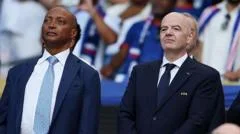
For now, beleaguered Fifa president Gianni Infantino still has some allies in world football, particularly in parts of the world where less well-off football associations have benefited from his presidency.
Infantino's position has been under scrutiny since his controversial plan to sell stakes in Fifa's global competitions to private investors was scrapped having been opposed by some regional governing bodies.
Late on Thursday, the executive committee of the African confederation (Caf) unanimously confirmed its support for Infantino, after leading African football administrators sent messages backing him.
Five of the seven African countries on the Fifa Council - Egypt, Morocco, Niger, Mauritania and Comoros - have already supported him publicly.
Support from the continent largely stems from Fifa's Forward programme, a funding scheme Infantino introduced in 2016 that many African federations have become increasingly reliant on to fund football projects in areas where commercial and government investment in the sport is limited.
Our reporters and correspondents have explained below where some of Africa's key footballing nations stand.
Morocco
Morocco's rise as one of Africa's football success stories has largely been driven by government funding, but the country has also become a key partner for Fifa.
Morocco's capital, Rabat, is home to Fifa's Africa regional office, they have hosted Fifa Club World Cups, a women's U17 World Cup and will co-host the men's 2030 World Cup alongside Spain and Portugal.
Morocco's football (Frmf) president Fouzi Lekjaa reaffirmed his support for Infantino after he withdrew the controversial Fifa Forward Enterprise (FFE) proposal last week.
In a statement, Lekjaa described Infantino's decision to withdraw it as "wise", adding it put the unity of Fifa's 211 member associations first.
Infantino also received the backing of senior football executives at a meeting in Morocco on Wednesday, following a turbulent period after the proposal's collapse.
Reporting by Celestine Karoney
Egypt
Egypt is home to the Confederation of African Football headquarters and remains one of Infantino's strongest institutional allies in Africa.
The relationship is reinforced by the influence of Hany Abo Rida, a Fifa Council member and one of the continent's most prominent football administrators, who has maintained close ties with Infantino since his election in 2016.
During Infantino's presidency, Egypt has benefited from Fifa's Forward programme, which has funded infrastructure projects, youth development, coach education and women's football.
Like other African member associations, the Egyptian Football Association has also received increased development funding under FIFA's expanded investment strategy, while new and expanded football competitions have created additional commercial and sporting opportunities.
But support for Infantino in Egypt is accompanied by growing expectations. Officials and observers increasingly argue that Fifa's engagement with Africa should extend beyond financial assistance. Greater emphasis is being placed on good governance, transparency, sustainable football development and giving Cafmore room to shape the continent's own priorities.
Reporting by Mohamed Alkaaoud in Cairo
DR Congo
The Congolese Football Federation (Fecofa) has welcomed Infantino's decision to withdraw the controversial Forward Enterprise proposal, calling it "wise" in a statement earlier this month.
Pointing to a decade of work promoting football worldwide - and in particular his support of African nations - the federation stressed that the episode should not overshadow Infantino's wider record.
Fecofa stressed that the episode, born of good intentions, should not overshadow Infantino's wider record. It pointed to his decade of work promoting football worldwide, and particularly his support for African federations and those with fewer resources.
The federation said it had "greatly benefited" from Fifa's programmes, citing investment in development and infrastructure.
The declaration was signed by Véron MosengoâOmba, elected president of Fecofa in May 2026. His election ended a period of uncertainty following the resignation of Constant Omari Selemani in 2021 and the subsequent Fifaâappointed Normalisation Committee established in April 2023.
MosengoâOmba assured Infantino of Fecofa's "full support" would continue beyond 2027, recalling mandates renewed in Paris in 2019 and Kigali in 2023. The statement underlines Congo's alignment with Fifa leadership at a time when divisions remain sharp elsewhere in world football.
Reporting by Emery Makumeno
Nigeria
The Nigeria Football Federation (NFF) has largely aligned itself towards a supportive stance for Infantino's leadership, despite thee wider backlash globally.
For a football federation facing chronic funding constraints and enormous infrastructure needs, Infantino's proposed plans would have been difficult to dismiss.
Former President of the NFF and deputy chairman of Fifa's Men's National Teams Competitions Committee, Amaju Pinnick, argued that Infantino's plan would deliver a much-needed financial boost to every member association without over-relying on local governments.
Nigeria is eligible for up to $8m (£5.95M), for the current Fifa Forward funding, despite failing to qualify for the last two men's World Cup tournaments.
The most prominent Forward project currently underway in Nigeria is the redevelopment of the NFF Technical Centre in Abuja. The project, funded with approximately $4.88 million, includes the reconstruction of training pitches, and the construction of a modern accommodation complex for Nigeria's national teams.
Reporting by Emmanuel Akindubuwa
What others in Africa have said
The Minister of Sports, Arts and Culture of South Africa, Gayton McKenzie, posted on X saying that Infantino had been "very good to African football".
"Africa should be cautious in joining the public lynching of Infantino. He has been very good to African football.
"We can debate his ideas but let's not forget who has been a friend to us. Many of those calling for his head want the old status quo back too."
Speaking to the BBC after Infantino's proposal emerged, football officials from Malawi and Uganda said Fifa investment had transformed the game both on and off the pitch, arguing such funding is vital given the financial realities facing many African nations.
"Malawi needs money. Malawi needs stadiums, our government cannot manage to give us even $1m (£740,000) every year for football," Malawi FA president Fleetwood Haiya told BBC's Newsday programme.
"Our government is not able to make sure that they have medical supplies in hospitals [and] at the same time to look at football", he said.
President of the Gambia Football Federation, Lamin Kaba Bajo, told BBC Sport: "As far as I'm concerned, most of my colleagues are concerned, we'll encourage him [Infantino] to stay, and we'll do everything within our means to ensure that he is re-elected come next year, 2027.
"That's my personal opinion as president of the federation, and a good number of African memberships also stand on that line. He is here to stay."
But support for the project on the continent was not universal. Former Sierra Leone FA president and ex-Fifa Council member Isha Johansen was among African voices opposing it, warning it risked over-commercialising football asking, "what price does one have to pay in order to get to this elevated development for football in Africa?"
Johansen urged African football chiefs to think carefully about the game's future.
Last month, Caf president Patrice Motsepe lauded Infantino for his "excellent work" after this year's World Cup and hailed him as "a good friend".
"He is loyal to Africa," Motsepe said on 22 July. "When people have been loyal to you, you never stab them in the back."
Other nations are yet to comment publicly, including Senegal, whose men's team is the second-highest ranked African team behind Morocco.