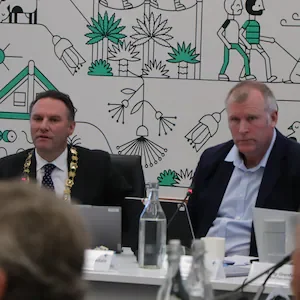
Western Bay of Plenty Mayor James Denyer (left) and Tauranga Mayor Mahé Drysdale supported the councils working together on forming a new subregional unitary authority, but the Western Bay council voted overall to reject the plan. Photo / Ayla Yeoman
Tauranga City Council has been left at the altar by its proposed amalgamation partner, the Western Bay of Plenty District Council.
But resistance to the union may prove futile, with Tauranga agreeing to push ahead with a proposal without its neighbour’s support.
The two councils held a five-hour joint meetingin the Western Bay chambers yesterday to discuss submitting an outline proposal through the Government’s Head Start local government reform process.
Tauranga councillors first voted in favour of pursuing the creation of a new joint unitary authority covering the Tauranga and Western Bay areas, as part of a wider Bay of Plenty application.
A unitary authority includes district/city and regional council functions.
Their Western Bay counterparts then voted 6-4 against this, opting instead for the Government-led Backstop reform process.
Tauranga reconfirmed, in an 8-2 vote, that it would stick with its plan.
Tauranga Mayor Mahé Drysdale said the city would join other Bay of Plenty councils in proposing to create three new subregional unitary authorities: Eastern Bay (Whakatāne, Kawerau and Ōpōtiki); Western Bay (Tauranga and Western Bay); and Rotorua.
“As of today, five of the six councils support that, and Western Bay will be dragged into it,” Drysdale told the Bay of Plenty Times.
He said it was always going to be a close vote for Western Bay: “That’s democracy for you”.
Drysdale believed forming a unitary council was the right thing for the subregion and would “deliver significant benefits for all that live here”.
He understood Bay of Plenty was the first region to find a solution that “works for everyone” and expected the application would be well-received by Cabinet.
He believed the biggest issues, debt and representation, could be resolved.
He preferred the councils to be in charge of their own destiny.
Tracey Coxhead said she was not comfortable with feedback she had heard or the city council’s high debt levels, and was concerned smaller communities would lose their voices.
“Our two councils are not entirely aligned in our values and objectives.”
Shane Beech said the 90 days was not long enough to do meaningful community engagement.
He said the two councils had differing priorities, including urban versus rural priorities.
Darlene Dinsdale said she would vote in favour as it set a plan and direction.
Other Bay of Plenty councils
Kawerau, Whakatāne, Ōpōtiki district councils each voted this week to pursue creating an Eastern Bay subregional unitary council – though with reluctance.
Rotorua Lakes Council will meet today to finalise its approach, but has backed the three-unitary model.
Bay of Plenty Regional Council cannot participate in a Head Start application.
It was set to discuss its response to local councils’ plans in a meeting yesterday, but elected to wait for the Tauranga/Western Bay meeting to finish.
Cabinet will assess Head Start applications and announce which ones will progress next month.
Final proposals would be due March 2027, with subsequent decisions expected in May.
If proposals were declined or a council opted for the Backstop pathway, this process would begin after the 2028 local elections.
– LDR is local body journalism co-funded by RNZ and NZ On Air.
Ayla Yeoman is a Local Democracy Reporting journalist based in Tauranga. She holds a Bachelor of Arts majoring in communications, politics and international relations from the University of Auckland, and has been a journalist since 2022.
Additional reporting by Samantha Motion of the Bay of Plenty Times and Mathew Nash of Local Democracy Reporting.