(This article forms a part of the Science for All newsletter that takes the jargon out of science and puts the fun in! Subscribe now!)
When a certain brilliantly-coloured butterfly, found halfway around the globe—from India to Japan—closes its wings, you cannot tell it apart from a dead leaf: the ‘dead leaf’ butterfly’s wings turn a deeply-veined brown or yellow, ending in a point. And so, when a bird pursues it aerially, the butterfly closes its wings and drops down motionless on to the forest floor, disappearing into the undergrowth and confounding its predator. This butterfly exhibits masterful mimicry to escape predators, as do many insects around the world.
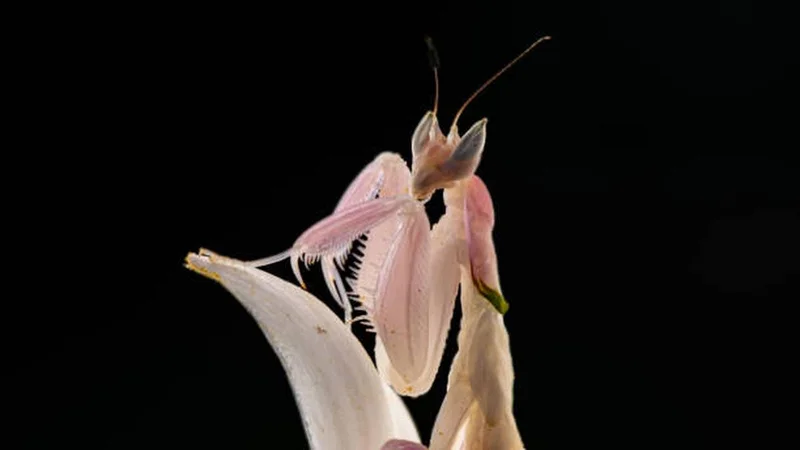
In Southeast Asia, for instance, the pink-hued, green-eyed ‘orchid mantis’ (in the picture), with legs that mimic flower petals, is cleverer still: it uses its camouflage to both avoid predators and attract pollinating insects by absorbing UV light as flowers do: it even sways like a flower in the wind.
The insect world is indeed replete with examples of mimicry: they can be indistinguishable from tree barks to twigs and moss to lichen to protect themselves or attract prey. In May this year, scientists reported an extraordinary rainforest insect that glowed a hot pink in Panama, transforming into green in under two weeks, “perfectly mirroring the life cycle of tropical leaves that emerge pink before maturing,” said their paper.
The specific mimicry of flowering plants was once thought to date back to 47 million years ago from fossil records. But now, a new paper in Insect Science records evidence of flowering-plant mimicry farther back to 99 million years ago, when plants were just beginning to morph Earth’s ecological landscape.
Scientists discovered the fossil of a moth lacewing, a broad-winged and intricately veined insect, preserved in amber dating back 50 million years before than earliest recorded. The authors report that this earliest known insect mimicking flowering plant leaves, Dryadithone cretacea, found embedded in amber, was a “sophisticated camouflage” achieved by mimicking the midvein, pinnate framework (a feather-like pattern), and reticulate venation (a leaf vein pattern that appears like a web-like net) of plant’s leaves.
“This fossil shows that insects responded to the rise of flowering plants in a way we rarely expected, treating them not just as food or habitat but also as models for defensive mimicry,” said the researchers in a release. It more than doubles the timeline of such adaptations “and points to intricate ecological interactions linking flowering plants, insects and their predators during the Cretaceous [a period between 145 to 66 million years ago].”
Insects have evolved in the most ingenious ways to mimic plants, other insects, and even the excreta of other creatures, conservationist Aswathi Asokan told The Hindu. “In just our urban spaces, there are different species of mantises that may look like tree bark, a small twig, or a vibrant flower; even butterfly caterpillars (like the common baron) vanish along the midrib of a leaf.” Scores of insects and spiders resemble ants and these imposters are so precise, you can only distinguish them from ants if you look very close.
The research paper says, “Insect mimicry of plant structures drives their co-evolution with plants,” adding that fossil evidence of insect–flowering plants mimicry “is exceedingly scarce”.
Mimicry, an adaptive evolution in nature, involves three roles: the “model,” the “mimic,” and the “receiver,” the paper explains. By imitating the shape, colour, or even behaviours of the model, the mimic deceives the receiver from detection and confers survival advantages, the authors add. “This process leads to a co-evolutionary “arms race” between insects and their predators.”
These evolutionary disguises, that evolved over millions of years of natural selection and mutations “create masterpieces of deception that helps each insect differently,” said Dr. Asokan.
From the Science pages
Question Corner
Flora and fauna
Published - August 05, 2026 04:09 pm IST