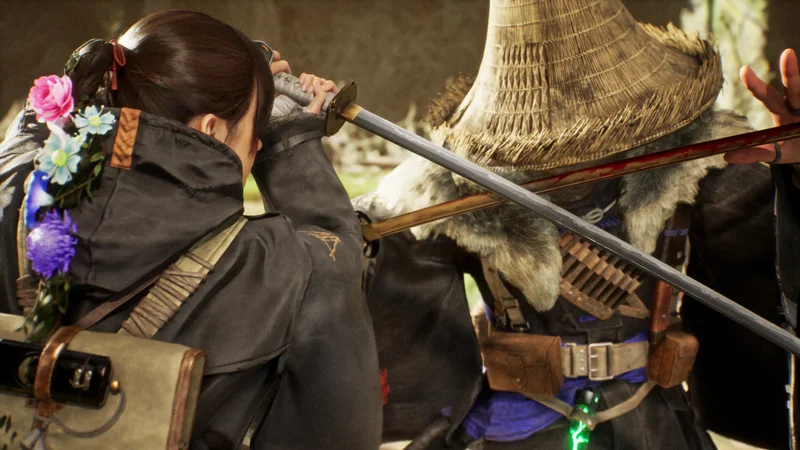
In the distant future, the world is in tough shape. Emma, a hero with the skill and fortitude to save the world, wanders a harsh wasteland that is hellbent on eliminating humanity. Beast of Reincarnation, the new action RPG from Game Freak, chronicles her journey and puts players in charge of seeing it through to its conclusion.
The game is tough, and at times its mechanics can feel nigh-inscrutable. Brief opening tutorials walk players through convoluted systems as they deal with the reality that a single blow might mark the end of their progress. At least, that’s how it all works in Normal mode. But there is a “Story” (read: easy) setting that is considerably more forgiving. Thing is, Beast of Reincarnation’s easy mode is not a great fit.
As noted, enemies in Normal mode pose a genuine threat. Emma sneaks through fields of flowers with her dog Koo running by her side. He’s a faithful companion, even if he sucks the fun out of discovering hidden treasure on the battlefield. He’ll typically point out an enemy that is waiting to stab her in the back, but if he doesn’t? Well, that could be the end of her.
Even when Emma has a full life meter, a vicious golem could potentially assassinate her with a single well-placed thrust, before she even knows he’s there. Head-on battles with some of the more elite enemies scattered across the map can also prove perilous. Boss battles with the large and fearsome Nushi monsters Emma hunts might end in mere seconds.
That’s fine, though. I’m not complaining. By default, the game relies on a stiff challenge to make the adventure feel worthwhile, and it handsomely rewards players who persevere. Simply accept that it’s that kind of game and you’ll do fine. Don’t accept it and, well, there’s always Story mode.
Whatever setting you choose, Beast of Reincarnation expects you to make the most of its systems. You’re supposed to run into trouble, then figure out how to resolve it by equipping better armor, upgraded weapons, and spirit stones. You’re supposed to master unique skills, unlocked from a skill tree, which let Emma deal crushing blows, recover health while standing amidst impromptu flower gardens, and inject stimpacks while engaged in close encounters of the boss kind.
The difference between Story mode and Normal mode is jarring, however. A lethal monster that once felled even an over-leveled Emma with one quick strike suddenly shaves off only a tiny sliver of health with each blow landed. It develops a glass jaw, falling quickly to a barrage of arrows it shrugged aside on the higher settings. And it moves without the same sense of purpose.
I’ll admit it: when I first played Beast of Reincarnation, I was absolutely terrible at it. I scrapped with the first Nushi several times and almost beat it, but I always fell just short because I hadn’t bothered mastering Emma’s most lethal moves. I kept trying to snipe my adversary from a distance, and it responded by eliminating the space between us in two seconds flat while I fumbled to change between my projectile weapons.
Finally, because the game lets players shift difficulty levels whenever it suits them, I tried my luck in Story mode. That experience briefly left me wondering if it was even possible for Emma to fail.
I’ve never minded when games give me the option of taking it easy. The Legend of Zelda: Breath of the Wild presented me with a manageable wilderness that I was happy to enjoy on its terms until I finally decided to look for ways to make Hyrule more dangerous. I’ve had a good time with all sorts of difficulty settings, which is why I feel that Beast of Reincarnation’s developers missed an opportunity. The game’s difficulty options suggest they were meant to provide a proper range of experiences. They just didn’t go far enough.
The Story setting really is, as it notes in its menus, for “those who wish to focus on the story.” Beast of Reincarnation makes the adventure more manageable for genre newcomers and casual players or folks who can’t grasp the myriad systems it introduces and doesn’t properly explain (except in tedious tutorial screens players will be tempted to ignore).
The accommodation certainly makes sense. I’m not always prepared to tend gardens in the apocalypse so that my friend can make me delicious meals that improve my stats, no matter how often the characters suggest that I really ought to. And I’m not often eager to explore the branches of multiple skill trees, piecing together brilliant skills that will let me thrive. (Beast of Reincarnation’s skill trees are particularly byzantine.) After a rough day’s work, I might just want to hack my way to victory without spending too much time thinking about parrying windows.
Story mode in Beast of Reincarnation is generous with its damage reduction. But when it’s the only option this side of an excessively demanding experience, it risks turning too many elements of the adventure into filler. Prizes for exploration and the constant challenge of continued survival lose their meaning. And the nodes on the skill tree hardly appeal, because I don’t even need to rely on the skills they impart to stand a chance against the next boss. The Story mode, in other words, turns down the difficulty a bit too much from Normal.
The game could definitely benefit from an additional difficulty setting, somewhere between Story and Normal. Such a setting would require more from players without expecting them to master every intricacy. Enemies might hit half as hard as they do in Normal mode, and suffer twice the damage. Honestly, something like that sounds just about perfect. Players who want a challenge — but maybe not too much of one — could still find it. Perhaps we would even feel inspired to improve our fighting prowess along the way, to practice a bit on this middle-ground setting before learning the ropes and kicking it back up a notch.
Beast of Reincarnation has a lot to offer, but it wants you to work for it. Story mode modifies the game’s favored approach by turning barriers into speedbumps. With the thrill that comes from surviving against overwhelming odds all but eliminated, the visit feels less like an adventure and more like a vacation.