By Song Sang-ho
WASHINGTON, July 22 (Yonhap) -- U.S. Trade Representative (USTR) Jamieson Greer said Wednesday that his office will release its "final responsive action" on its trade investigations into 60 trading partners over forced labor concerns as soon as Thursday, as South Korea and other countries await new U.S. tariffs.
Greer made the remarks in a written statement submitted to the Senate Committee on Finance, as U.S. President Donald Trump's administration is expected to unveil its new tariffs based on the investigations that the USTR had conducted for months since March under Section 301 of the 1974 Trade Act.
Washington carried out the investigations, as well as separate Section 301 probes into South Korea and 15 other economies to uncover "unfair" trade practices related to "structural" excess capacity and production, as it has sought to replace country-specific "reciprocal" tariffs struck down by the Supreme Court in February.
"As soon as tomorrow, USTR will release its final responsive action on its Section 301 investigation of our top 60 trading partners' failure to address international trade in forced goods at their borders," Greer said.
"The United States is the only country in the world which has both adopted and effectively enforced such a rule. This investigation is the culmination of years of effort to persuade our trading partners to join our efforts and create a level playing field for American workers and businesses," he added.
His remarks came as the Trump administration's temporary 10-percent global tariff is set to expire on Friday.
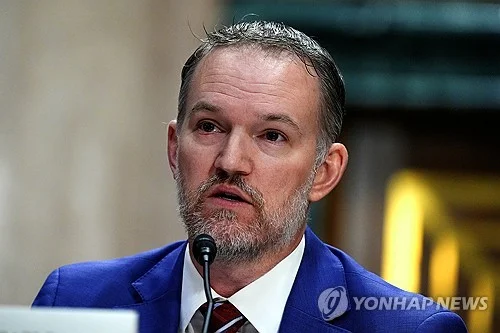
U.S. Trade Representative Jamieson Greer testifies during a Senate Committee on Finance hearing on Capitol Hill in Washington on July 22, 2026, in this photo released by the Associated Press. (Yonhap)
Greer defended Trump's tariff policy, stressing the importance of levies amid what he called a "national emergency." The Trump administration had invoked the 1977 International Emergency Economic Powers Act (IEEPA) to justify the "reciprocal" tariffs, which were invalidated by the Supreme Court.
"That national emergency still exists, and so our policy remains the same," Greer said.
"The specific authorities this administration is using have changed, but the trade strategy has not. Specifically, we are continuing to impose tariffs and negotiate deals to support the reindustrialization of our economy, protect American workers and increase their wages, and shrink our trade deficit."
Last month, the USTR proposed a 12.5 percent tariff on South Korea and dozens of other economies over their alleged failure to enforce import bans on products made with forced labor.
In comments submitted to the USTR, the South Korean government urged the U.S. to reconsider the proposed forced labor tariff on South Korea, calling the proposal "unwarranted" and "disproportionate" given the relevant circumstances of Asia's fourth-largest economy.
sshluck@yna.co.kr
(END)