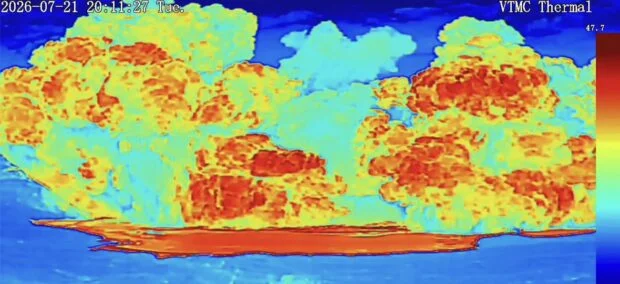
A second minor phreatomagmatic eruption occurs at the Taal Volcano Main Crater at 8:09 p.m. on Tuesday, July 21, 2026. — Screengrab from Phivolcs/Facebook
LUCENA CITY — The Philippine Institute of Volcanology and Seismology (Phivolcs) has detected renewed signs of unrest at Taal Volcano after recording a sharp increase in volcanic earthquakes and a rise in sulfur dioxide (SO₂) emissions over the past 24 hours as of Thursday, July 23.
In its morning bulletin, Phivolcs said the volcano generated 61 volcanic earthquakes and three episodes of volcanic tremor lasting from three to 31 minutes.
The latest seismic activity marked a significant increase from the previous day’s monitoring, when only single-digit volcanic earthquakes were recorded except on Wednesday (July 22), with 10 quakes. No volcanic tremor was detected on July 12 and July 14.
Article continues after this advertisement
READ: Taal Volcano logs increased seismic activity, 2 eruptions in 24 hours
According to Phivolcs, volcanic earthquakes are caused by magma-related processes occurring beneath or near an active volcano, while volcanic tremors are continuous low-frequency seismic signals that persist for more than a minute.
After several days of relatively low sulfur dioxide emissions, Taal again released a high volume of volcanic gas on Wednesday.
Phivolcs measured 741 metric tons of sulfur dioxide emitted from the volcano’s main crater. The gas plume rose about 800 meters before drifting southwest and was classified as a moderate emission.
The latest SO₂ output was substantially higher than the 129 metric tons recorded on July 20 and 21.
Article continues after this advertisement
No upwelling of hot volcanic fluids was observed in the Main Crater Lake, and no volcanic smog (vog) was detected during the monitoring period.
Taal remains under Alert Level 1, indicating low-level volcanic unrest.
Article continues after this advertisement
Phivolcs emphasized that the current alert level does not mean the volcano has returned to its normal condition or that the possibility of hazardous volcanic activity has been eliminated.
Located in the middle of Taal Lake in Batangas province, Taal Volcano is the Philippines’ second most active volcano, with 38 recorded eruptions in the country’s history. /das
Your subscription could not be saved. Please try again.
Your subscription has been successful.