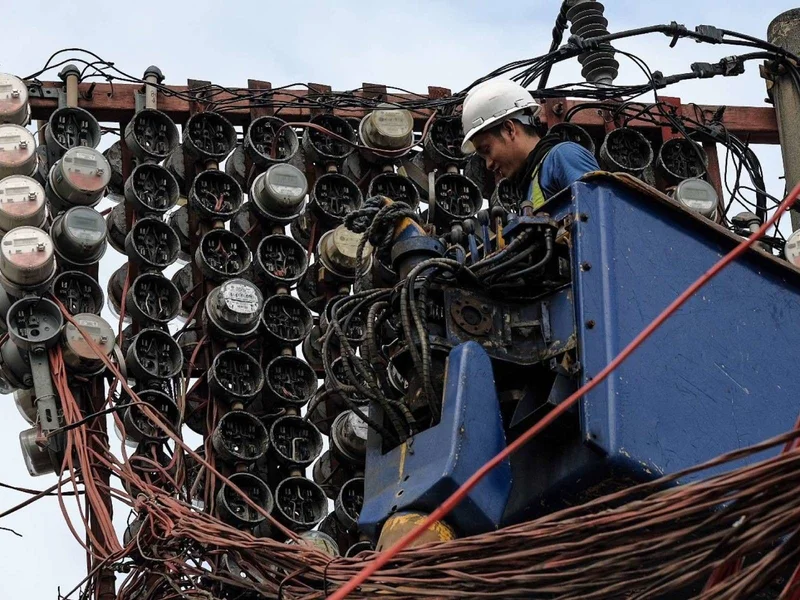
MANILA, Philippines — Forty-eight distribution utilities (DUs), or local energy providers in the Philippines, charge consumers higher electricity rates than the record-high national average rate of P12.43 per kilowatt-hour (kWh) in June, according to a study by an energy advocacy group.
The Institute for Climate and Sustainable Cities (ICSC) gathered and analyzed the data through its electricity rate monitoring platform, PRESYO-PH, which records and ranks distribution utilities every month based on the actual price their customers pay per kWh.
The group’s analysis followed the Department of Energy's announcement on Monday, July 20, that the Philippines now has the most expensive power rates in Southeast Asia. The country has already surpassed Singapore’s P0.09 per kWh, which used to be the highest in the region.
ICSC said, however, that the national average rate does not reflect the reality faced by most Filipino consumers, as higher residential charges from DUs indicate that most households are paying more for electricity than the benchmark.
DUs with above-average rates
ICSC records the electricity rates of 116 DUs in the Philippines. Ten of these are off-grid, while 106 are on-grid.
On-grid DUs are connected to a main transmission network and can draw or supply electricity without local battery storage. Off-grid DUs, on the other hand, operate in remote areas and islands independently of the main transmission network.
Generally, on-grid DUs are expected to charge less because they are more cost-effective than off-grid DUs, which are heavily reliant on imported fossil fuels, local generation and battery storage to meet consumer demand.
However, out of the 106 on-grid DUs, nearly half, or 48, charge their customers electricity rates higher than the national average in June.
TARELCO I in Tarlac has the lowest rate among those above the national average at P12.45 per kWh, while Southern Leyte’s SOLECO charges P16.57 per kWh, the highest.
Meralco, the largest private energy company in the country, ranks ninth, charging its customers P14.48 per kWh.
Generation charge
This July, consumers are facing higher electricity charges.
Meralco alone, which holds 80% of the market share, announced on July 10 an upward adjustment of P0.3428 per kWh, bringing the overall rate to P14.8261.
This translates to an increase of P69 in the electricity bills of households consuming 200 kWh.
ICSC said generation charges consistently make up the largest portion of what consumers pay for electricity. Based on its data, generation charges account for at least 46% of the rate mix of distribution utilities, while other costs make up the rest.
The group said this indicates the country's need to reduce its dependence on imported fuels. According to the US International Trade Administration, liquefied natural gas, a critical transition fuel in the Philippines, accounts for 22% of the country's power generation in 2026, resulting in increased imports that make up 46% of the natural gas feedstock.
The group further emphasized that, beyond that, diversifying the country's power mix by using indigenous renewable energy resources is also highly needed.
“Beyond reducing exposure to imported fuel price volatility, a more diversified power mix can strengthen the country's long-term economic competitiveness, enhance resilience to external shocks, and improve the well-being of Filipino consumers,” ICSC’s study read.