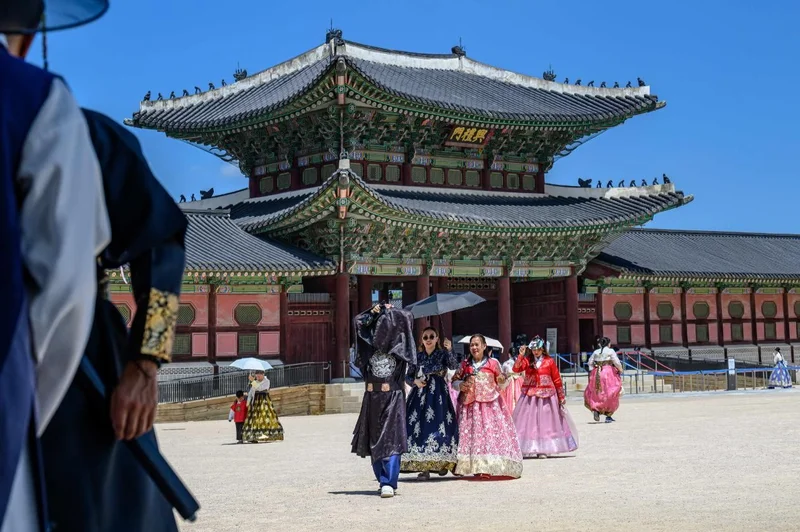
Long before machine looms and mass production arrived in East Asia, a Korean hanbok was built to tell a story through every stitch, from the precise weight of its silk to the gold leaf stamped onto its cuffs. For 120 years, the epicenter of that painstaking labor has been Seoul’s Gwangjang Market, where generations of tailors have quietly kept the craft alive.
This week, that living heritage is being brought into full view at 2026 Hanbok Sangjeom, which translates to hanbok store, inside the Dongdaemun Design Plaza. Centered on the theme "The Market That Crafts Hanbok," the annual fair features an immersive pavilion recreating Gwangjang Market’s historic workshops — offering visitors a rare, step-by-step look at how raw textiles are transformed into wearable art by master embroidery and tailoring artisans.
The four-day event gathers 149 vendors and showcases the full ecosystem of traditional garment-making. At its core is a specially curated pavilion dedicated to Gwangjang Market’s historic silk district. Visitors can trace the journey of a single garment — from raw silk selection and intricate hand-embroidery to the delicate application of gold leaf and final tailored stitching. Six historic merchants from the market will host pop-up booths, offering a rare glimpse into the living heritage of Korean textile culture.
For the first time, the fair is also introducing a dedicated business-to-business matchmaking program. Organizers have invited domestic and international buyers, distributors and retail representatives for one-on-one deal-making sessions designed to help independent hanbok designers scale up, secure boutique placements and access overseas markets.
"Hanbok is both a quintessential treasure of our traditional heritage and a vital driver of K-culture that resonates worldwide," Culture Minister Chae Hwi-young said. "This gathering serves as both a cultural festival for the public and a commercial launchpad for designers to tap into international distribution networks."
The exhibition hall offers a stark contrast between ancient heritage and contemporary adaptation. Beyond deep discounts of up to 80 percent on traditional and modernized, everyday hanbok, the fair features an array of modern applications. A dedicated promotional hall highlights Hanbok Workwear — functional, stylish uniforms developed for corporate, hospitality and public service sectors, blending traditional aesthetics with daily utility. Interactive workshops allow visitors to try their hand at custom tailoring, while fashion showcases reinterpret ancient silhouettes for modern wardrobes.
To preserve consumer trust amid rising interest, organizers have even instituted a team of quality inspectors to verify fabric authenticity and manufacturing origins across all 133 retail vendors.
The fair runs through Aug. 16, offering free admission to anyone who arrives wearing a hanbok — a fitting invitation for a country currently busy rethreading its past into the fabric of modern global culture.
This article was published with the assistance of generative AI and edited by The Korea Times.