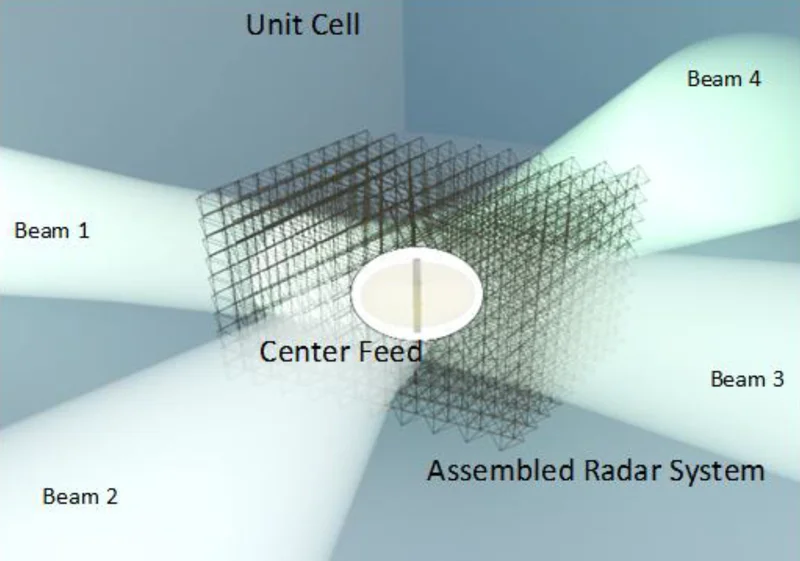
Tracking the debris orbiting at high velocity in space is only going to get harder over time. We have ground-based radar systems, such as the Space Fence, designed to detect pieces down to around 10 cm. But finding objects smaller than that, which can still cause a lot of damage traveling at 17,000 miles per hour, requires completely new thinking. One potential solution is a new idea from Dr. David Smith of Duke University, who was recently funded for a NASA Innovative Advanced Concepts (NIAC) Phase I grant to build robotically assembled electromagnetic metamaterials for long-range space situational awareness.
Ideally, putting an antenna in space to track debris that is also in space makes intuitive sense. The closer you are to the object youâre trying to detect, the less power you need to do so. However, space antennas are limited by a major constraint - space.
Traditional space antennas are subject to the tyranny of the fairing - basically they have to be able to fit inside the fairing space (i.e. the nosecone) of a modern rocket. This limits even the âdeployableâ ones specifically designed to deploy to a larger size to get around this constraint to around 100m in diameter. Not bad, but not large enough to find even the smallest pieces of debris. One capable of that would be much larger.
Dr. Smithâs idea was very simple - instead of fitting the antenna in the fairing at all, why not just build it in space? That would allow you to create a theoretically infinitely large antenna, assuming the modular pieces used to build it could fit inside a fairing, and you had the assembly technology necessary to piece them together like advanced Lego bricks.
Letâs focus on the modular pieces first, since they are Dr. Smithâs specialty. Heâs most famous for his work on electromagnetic metamaterials and was part of the team that created the first functioning "invisibility cloak" for microwaves. Metamaterials are artificially created materials that can control electromagnetic waves (such as microwaves) in ways that natural materials canât. In this particular case, the metamaterials would act like a programmable lens for radar wavesâand each individual âunit cellâ could act as a separate antenna, but combine to integrate into a larger structure as necessary.
Combining them offers the second engineering challenge though. Luckily, NASA itself is working on a solution. The Ames Research Center is working on a project called the Automated Reconfigurable Mission Adaptive Digital Assembly Systems (ARMADAS). Think of an inchworm-like robot (or a fleet of them) that crawls around a structure snapping geometric blocks (called voxels) together, similar to a large Lego set. Just in this case, the âvoxelsâ would be the unit cells of metamaterial designed to send and receive radar waves.
Another major advantage of this system is its omnidirectionality - in theory at least, the metamaterials could be designed so that the radar could sweep its massive field of view over any segment of the sky without requiring any moving parts, which notoriously break down when exposed to space. This is enabled by the fact the voxels can be assembled in a three dimensional shape - thereâs no constraints on the shape or volume the ARMADAS robots could build using the fundamental building blocks.
However, one thing the proposal description doesnât discuss is the vulnerability of such a system to the very debris it's supposed to track. How easy is it to replace an internal voxel that happens to be struck by a flying piece of metal shrapnel? Does the entire structure fall apart if one link in the chain is broken?
Answering those types of practical questions isnât the focus of a NIAC Phase I grant though. They are specifically for almost fantastical sounding ideas that might or might not be practically feasible - thatâs what the funding is there to help find out. And if a giant radar antenna assembled out of advanced electromagnetic materials in space by robots doesnât sound like a fantastical idea, it's unclear what would be.
Learn More:
David Smith - Robotically Assembled Electromagnetic Metamaterials for Long-Range Space Situational Awareness