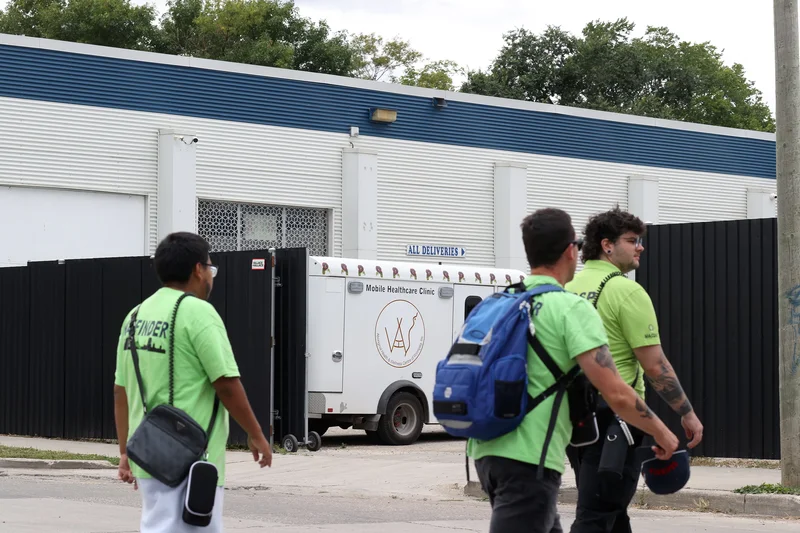
The Manitoba government opened its first supervised drug-use site on Tuesday after a lengthy delay and community pushback, charting a path opposite to other Canadian provinces.
It is the first Indigenous-led drug-use site in Canada where people can inject or inhale drugs under medical supervision. The site is located in an industrial-commercial area of Winnipeg’s inner-city and will be open during limited hours.
The provincial NDP government partnered with non-profit Aboriginal Health and Wellness Centre to establish the facility, which was originally planned to open in 2025. Political opposition, as well as concerns about the location of the site and its impact to the surrounding community, led to its delay.
In an interview on Tuesday, Bernadette Smith, Minister of Housing, Addictions and Homelessness, said her government’s decision to open the facility is based on scientific research and input from medical experts.
“This is going to be a life-saving measure,” Ms. Smith said. “We have open drug use happening and nowhere for these folks to go and use in a safe way. This is going to provide that support.”
Supervised drug-use sites have become a major flashpoint in the debate across Canada on how to address the toxic drug crisis, particularly in conservative-leaning provinces. Both Alberta and Ontario have recently shuttered drug-use sites, shifting from harm reduction to recovery-focused supports.
Critics of the sites argue that they facilitate drug use and are a public safety concern, impacting neighbouring businesses and residents. Advocates for this service say it is a critical resource that keeps people alive and offers a pathway to other social supports, including recovery.
Last year, nearly 400 people died in Manitoba from drug poisonings, a 32-per-cent decline from the previous year, echoing a broader national trend. Experts have pointed to changes in the illicit drug supply, widespread distribution of overdose-reversing medications and changes in the drug-using population as potential reasons for the decline.
The province first proposed that the Winnipeg drug-use site be near the Disraeli Freeway, but scrapped the idea after locals voiced concern over its proximity to schools and a child care centre. Protest continued over the location of the new site at 366 Henry Ave., but Manitoba pushed forward.
Monica Cyr, chief executive of Aboriginal Health and Wellness Centre, hopes residents give the new site a chance, adding that her organization is dedicated to being a good neighbour and values community input.
“During a time of crisis, you want to put supports into a system, not take them out,” said Ms. Cyr in a joint interview with Ms. Smith.
She said local residents can report concerns related to the drug-use site through the centre’s website, and that her organization will respond, “as any good neighbour would.”
Ms. Smith said that observing fewer people using drugs in the street and helping move individuals into recovery would be measures of success for the highly debated service. “It’s about keeping people alive long enough to get them to a path of recovery,” she said.
In addition to having trained staff on-site who can respond to overdoses, sterile equipment, drug testing, wound care and some primary-care supports will be available, including HIV testing and prevention.
Jeff Bereza, deputy leader of the Progressive Conservative Party of Manitoba, said the NDP is making the wrong move. He said the drug-use site will benefit drug dealers, keep people in the cycle of addiction and add to public safety concerns in the area.
“We have to concentrate on the recovery,” he said in an interview on Tuesday. “We’re not doing anything to help the problem. All we’re doing is creating a circle. We’re not helping anybody out of that circle. We’re just keeping them concentrated in that circle.”
Winnipeg’s drug-use site will operate between the hours of 11 a.m. and 6:45 p.m. from Tuesday to Saturday. People who use the site must be 18 or older and bring their own substances to consume.
The hours were determined after consulting people with lived experience of drug use. They also coincide with the times of day when hospitals were seeing the largest volume of overdose-related visits, Ms. Cyr said.
Sunshine House, which operates a mobile overdose prevention site in Winnipeg, will help to fill service gaps. Their mobile site has seen tens of thousands of visits since opening in 2022.
Ms. Cyr commended the government for its “courage” to open the site and said the Indigenous-led model will lead to better outcomes because it is culturally grounded.
“We have such a high concentration of Indigenous peoples living here in Winnipeg, in Manitoba, and so to have a service that meets the representation of the population, that makes good sense,” she said.
“We are looking at decolonizing the health space because this is what our society needs. Western services can only get us so far.”