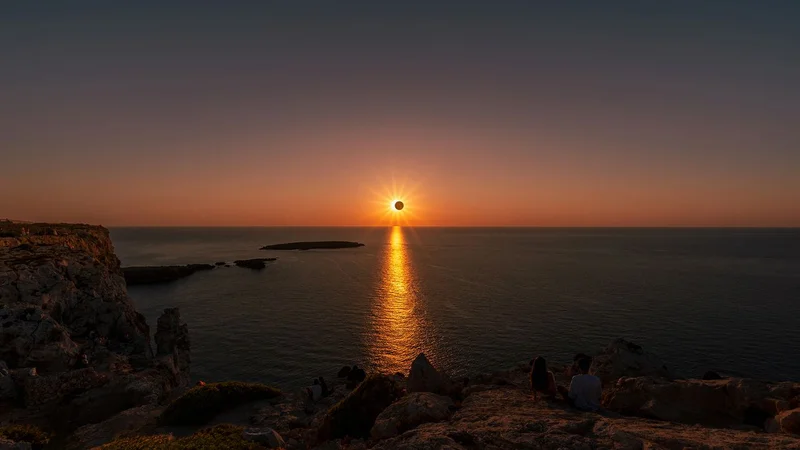
Though the spectacular sight of a total solar eclipse feels like a rare experience, on a planetary scale, the average time between two such events is just 18 months, with some occurring much closer together. Now, thanks to centuries of studying the orbit of the sun and moon, we are able to correctly predict when and where the next eclipse will be far into the future. But for thousands of years of human culture, the lunar crossing of the sun remained as mysterious in cause as it did in location.
In his book "Solar Eclipses" (Reaktion books, 2026), writer and historian of astronomy William Sheehan goes back to ancient times to discover what impact this awe-inspiring celestial dance between the sun and the moon had on ancient civilizations, and how over time we began to understand the science choreographing it.
This excerpt from the book goes as far back as ancient Greece, where we learn of the "immoral, foul-mouthed and violent" soldier and poet Archilochus, who gave us the first written account of a total solar eclipse.
Today, with the ability to predict the paths of eclipses to extremely high accuracy, to make quite successful long-range (ten days or more) weather forecasts, ease of travel and for many, plus a significant amount of discretionary income that never existed in previous times, seeing eclipses has become a passion for thousands of global eclipse-chasers. People seek out a connection with the larger universe that includes a huge rush of adrenaline and life-transforming emotions that have been described as "spiritual" in nature. Of course, eclipses have occurred since time immemorial, but until recent times people have experienced them on a somewhat haphazard basis. This is emphatically the case with total solar eclipses, which, despite being the most stunning, are rare from any given place and could hardly be expected (before eclipse prediction and travel became more convenient) to be seen in a human lifetime.
The reason for this is that the central (umbral) shadow of the Moon that creates the totality zone is so narrow —– only 200 kilometres (124 miles.) on average —– so that it mostly falls on uninhabited portions of Earth's surface. From any one location, totality might not occur at all during a person's lifetime. The 30 June 1954 total eclipse, for instance, was the last visible from Minneapolis until that of 14 September 2099; the 22 July 2028 eclipse visible from Sydney will be the last visible from there until 3 June 2858 (!) and so on.
The actual width of the direct path of the shadow (known as the antumbra at annular and umbra at total eclipses) can vary from 0 kilometres to more than 1,000 kilometres (620 miles). It reaches the latter figure if it strikes Earth obliquely as it did, for example, during the annular eclipse of 12 September 489 B.C.E. (which occurred, incidentally, a year to the day after the usually accepted date of the Battle of Marathon, in which the Greeks defeated the Persians); the antumbral width was then 1,132 kilometres (703 miles).
Even to be aware of the partial phases of a solar eclipse is difficult unless the eclipse is very deep — marked changes in the intensity of sunlight occur only minutes before totality. And in general, people working in fields or hunting and fishing have little incentive to stare at the Sun. Thus, for untold ages, partial solar eclipses must largely have been simply missed. Lunar eclipses, on the other hand, are much more frequent from any one location, since a total lunar eclipse is visible anywhere within the night hemisphere of Earth. Lunar eclipses are also highly impressive, involving as they do the Moon's light being encroached upon and swallowed in shadow as well as the colour of the Moon turning to blood red.
That having been said, even without being able to make specific predictions, people from earliest times certainly took a keen interest in the vast pageant taking place overhead — Sun, Moon and stars, as well as clouds and other meteorological phenomena. The universe seems replete with powers more than human, powers mysterious and largely beyond our ken. The sense of this underlies the origin of religion, which in the first instance may have consisted in the apprehension of "something, indicated by terms such as the holy, the numinous, or the sacred … transcendent and irreducible." Our first response to the strange universe around us is deep, primal, pre-verbal.
Until the second century B.C.E. (and then first in Babylonia after millennia of recording celestial phenomena and their associated omens), it was impossible to predict with any accuracy when a total solar eclipse would occur. The best one could do was to suggest that on such and such a date it was somewhat probable that an eclipse might occur, though whether partial or total — or no eclipse at all — could not be determined. Thus any supposed prediction of an eclipse would have been a matter of sheer luck. No one yet had a clear idea of what caused an eclipse. Moreover, at a time when the Sun and Moon were regarded as gods, who could possibly know the minds of deities, or set limits to their arbitrary sway?
Even in modern times, an eclipse, for which the circumstances have been predicted fully and in detail, elicits an overpowering emotional response. What kind of response would a completely unexpected event have elicited?
We are lucky to have one very vivid first-hand account from an eyewitness of such an event. He was the Greek soldier and poet Archilochus, who lived on the island of Paros during the seventh century B.C.E., a century or so after Homer and Hesiod. Much of what we know about him (or think we know) is based on what he recorded in his poems. Thus without his poems, "we would never have found out that his mother Enipo was a slave … nor that he was an adulterer, that he was licentious and violent, and, most disgraceful of all, that he threw away his shield [during a battle]."
For all that, Archilochus' poems don't show him in a very flattering light. He appears to have been immoral, foul-mouthed and violent. It was said that after his engagement to one Neobule was broken off by her father, he wrote a series of songs so scurrilous (only fragments remain) that Neobule herself, the father and her younger sister all hanged themselves for shame. Throwing away his shield was even worse, by the standards of the time, than his lewd remarks towards women — it was the ultimate faux pas for a member of the warrior class of seventh century B.C.E.. He justified doing so on the grounds, already a cliché at the time, that it allowed him to fight another day. And so he did, being killed in a battle between Paros and Naxos by a Naxian warrior named Calondas, at the age of 35.
Related stories
All very interesting, but the only reason that Archilochus is mentioned here is because he is something of a hero to eclipse watchers, because of a chance event that occurred on 6 April 648 B.C.E.. On that date (as determined from modern eclipse calculations) a total eclipse occurred; the Moon, like a shield thrown away in battle, covered the Sun. The path of totality began in the Atlantic off the western coast of Africa, ran just south of the boot of Italy, crossed Greece and the Black Sea, then veered north across Siberia. We can’t be exactly sure of Archilochus' location; it might well have been in Paros itself, which was exactly on the centre line (where the duration was some five minutes). Nevertheless, we do know exactly what he thought and how he felt:
Nothing is surprising anymore, nothing is deniable on oath;
No longer will anything seem impossible or marvellous, since
Zeus, father of the Olympians, has turned midday into night,
veiling the radiance of the sun, and turning mankind slack
with fear.
Hereafter all things become credible, they are to be expected,
There is no longer any reason for amazement, even if you see
The wild beasts changing places with dolphins,
making the oceans their pasture, and taking joy
in the sonorous murmur of the sounding sea,
while the dolphins, for their part, think better of the wooded
mountain.
(Translated by Michael Armstrong)
Archilochus achieved immortality with this poem: he became the first person we know of by name to have seen a total eclipse of the Sun, and to have recorded his stunned reaction.
Excerpted from "Solar Eclipses" (Reaktion books, 2026) by William Sheehan.
William Sheehan's book is a fascinating insight into the history of solar eclipses and the impact it had on civilizations long before we understood what was happening in the skies above us. From ancient history to the modern day, the book is filled with incredible stories of the people that furthered our knowledge of one of the most extraordinary celestial events. ** — AM**
William Sheehan is a noted historian of astronomy and a writer. His books include "Mercury" (2018), "Saturn" (2019), "Venus" (2022) and "The Solar System" (2025) in Reaktion's Kosmos series. He lives in Arizona, and asteroid 16037 is named Sheehan in his honour.