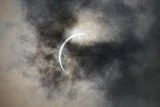
Imagine being an eclipse chaser or casual viewer getting excited to see the upcoming total solar eclipse on Aug. 12, 2026. Perhaps you’ve traveled a long way, or found that you don’t live too far away from the path of totality. So, you check a quick map and head out to find a good spot to watch the eclipse.
Only, when you get to your spot, you find out the map you followed was slightly inaccurate, and you don’t get to experience totality. So how is it that the map was less than accurate? Many eclipse maps, while accurate about the location of the eclipse, do not incorporate local terrain when determining how the eclipse will appear from a specific viewing location, particularly near the edges of totality.
Besselian Elements, a team of eclipse chasers and researchers, created a much more detailed map that can help viewers at the edge of totality know the best places to see the eclipse.
Read More: The 2026 Total Solar Eclipse Is Here — How and Where to See It, and Why Totality Is a Rare Event
Calculating the Path of Totality
During a total solar eclipse, the moon passes directly in front of the sun, casting a shadow and blocking out its light for several minutes. If you’re within the path of totality, you'll see and experience the full effects of the eclipse. If you’re not in the path of totality, it’s still possible to see a partial eclipse while wearing the proper protective eyewear or using other safe eclipse viewing methods.
However, being on the edge of the path of totality could impact the chance to see the total solar eclipse, as maps may not always be accurate. This happened during the April 8, 2024 total solar eclipse that crossed through parts of North America.
Shortly before the April 8, 2024 eclipse, researchers updated eclipse-path calculations using a refined solar-radius value and found that some published maps were off by as much as 2,000 feet (610 meters) near the edges of totality, according to EarthSky.
Read More: 5 of the Longest, Shortest, and Most Important Solar Eclipses Ever Recorded
Astronomers calculate eclipse paths using solar and lunar ephemerides. From those calculations, they derive Besselian elements (the namesake for the organization), a set of mathematical parameters used to model how the moon's shadow moves across Earth.
While these calculations are relatively accurate, there is still some margin of error, as scientists continue to refine measurements of the sun's visible edge, which can slightly affect eclipse-path calculations according to EarthSky. Besides these calculations, there are other factors that eclipse map makers don’t always take into account while building these maps.
It's important to note that eclipse maps created by NASA and other organizations are highly accurate. The calculations highlighted by Besselian Elements are generally more important for eclipse viewers located much closer to the edges of the path of totality.
Read More: Not Every Solar Eclipse Brings Darkness — Here's Why Every Eclipse Is Unique
Creating a More Detailed Eclipse Map
As the Aug. 12, 2026 total solar eclipse arrives, the Besselian Elements team released a new and updated map of the eclipse path. It’s not as smooth as many may think. Instead, it’s rather jagged and snakes across the landscape like a river.
In other models, the lines appear smooth. This may be because the model treats the moon and Earth as smooth. In reality, the moon and the Earth’s surface are far from smooth, and Earth’s terrain could have an impact on how a viewer sees the eclipse, according to the Besselian Elements team.
The team then applies these factors to their mapping model, compares it to other smooth-lined eclipse prediction maps, and finds a few discrepancies.
Terrain is a major factor in this eclipse, as it will occur in some regions close to sunset. In parts of Spain and Portugal, the mountains may block the view and the eclipse, so finding a spot where they will not be an obstruction will increase the odds of seeing it.
Read More: A Total Solar Eclipse and the Perseids Meteor Shower Will Share the Sky in August 2026
Article Sources
Our writers at Discovermagazine.com use peer-reviewed studies and high-quality sources for our articles, and our editors review for scientific accuracy and editorial standards. Review the sources used below for this article:
- This article references information from EarthSky: April 8 solar eclipse maps are wrong along the edges
- This article references information from NASA: Total Solar Eclipse FAQ
- This article references information from Besselian Elements: Eclipse Limits and Centreline are jagged lines
- This article references information from NASA: Besselian Elements of Solar Eclipses