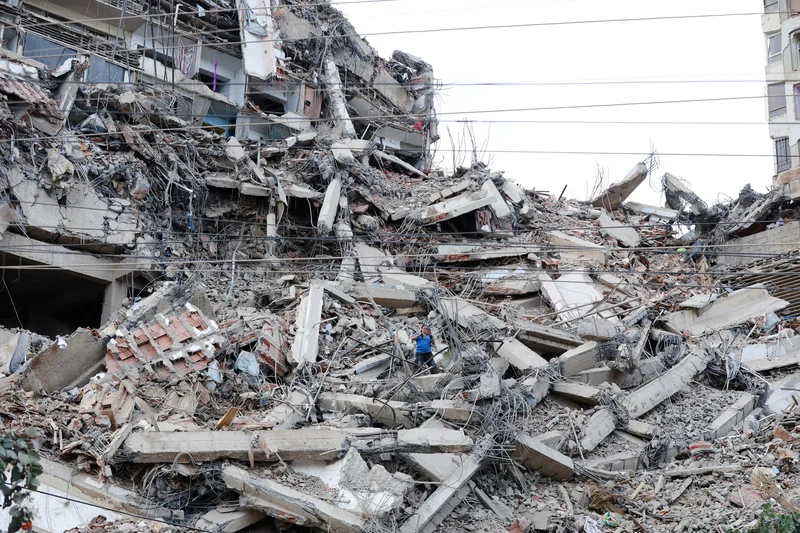
Norellys Marrero left a copy of the book Life by Paulo Coelho on her daughter Liz’s bedside table the day before she left Los Angeles. She was traveling back to Venezuela after living with her for three years and waiting on an asylum request that had been denied. “I’ll leave it here so you never forget that, whatever happens, you can never lose the hope of living until the end,” she told her. Two months later, Norellys died alongside her other daughter and her son-in-law in La Guaira during the double earthquake of June 24 in Venezuela.
Liz experienced the tragedy over a video call. She was about to teach a class at the dance school where she has worked for 11 years when her best friend — an artist who lives in Turkey — called to say there had been a catastrophic earthquake and to check on her family. “Everyone showed up online except my immediate family. And then, when I saw that everyone was answering and writing and I couldn’t hear from mine and I called, called, called… I automatically knew,” Liz says.
From Los Angeles, the dancer contacted motorbike couriers in La Guaira to check the condition of the building; she also called her aunt Maribel, who lost her car and house but still went to help with rescue efforts. Liz was even shown her sister’s corpse’s hands over video so she could identify them. “But why would I identify hands? I wanted to see my sister’s whole body, which was found under her husband. I think they were still alive and, with the strength they had left, pushed their son so he could get out, because they were found with their arms pushed up and Samuel was on top of them,” Liz describes.
Her nephews survived. Sebastián, 16, was at Macuto beach celebrating the San Juan festival and watched everything collapse around him. Samuel, 11, was trapped with his family but a tourist rescued him 24 hours later after seeing his head protruding from the rubble. Samuel now has four fractures and facial paralysis. “He’s in the hospital, still in a very delicate state. He can’t speak, can’t move his face, needs speech therapy and occupational therapy, and is being treated by physiotherapists, neurosurgeons and intensive care specialists. A nurse is with him around the clock, and he can’t be discharged because when they tried, he had seizures,” Liz explains.
She was the one who figured out how to tell her other nephew that his parents had died. Again, by video call: “I contacted a psychiatrist and my nephew went with the whole family to his office. His grandfather gave Sebastián the news and that was the hardest moment of my life: seeing Sebastián throw himself on the floor and scream through the screen. Because I feel that pain too — I also lost my mother at the same moment he did,” Liz recalls.
Since then, her nephews have been in the custody of their paternal grandfather, while Liz has organized a GoFundMe campaign to support their future as professional baseball players, a career she dreams of managing. “Thanks to dance I raised more than $70,000 in a month. I already have 13 confirmed cities where dance workshops will be held to donate to the children. There’s also a festival in the city called Next Fest LA and, thanks to social media, they saw what I’m doing and invited me to sponsor a stage for my family’s benefit,” she explains.
Neighbors rescue survivors
Crismar Chacín’s case is similar. She has lived in Los Angeles since 2021 after receiving a scholarship to The American Academy of Dramatic Arts. Since then she has not returned to La Guaira. Her father took his own life four years ago, after Crismar was already living abroad, and her 19-year-old brother Cristian died inside one of the buildings that collapsed in Los Corales on the day of the earthquake.
“My daughter, there was an earthquake,” her mother told her over the phone while Crismar was in a library. “The first person who told me was my mother, who called to say everything had fallen down. The call lasted less than five minutes and I felt like the world was ending. I heard her when she finally reached the building, screaming for Cristian and getting no response,” she remembers.
Rescuers didn’t reach the building until the next day, and at that time they were prioritizing rescue only where signs of life could be heard: “They were neighbors trying to save people with their bare hands. My uncle set off on a trip from Catia La Mar to Los Corales because the police had ordered people not to enter the buildings, but my uncle said he would go in. That’s how they found Cristian and other neighbors on Friday, June 26,” she explains.
Crismar was on the call with her mother when they identified her brother. “Even from a distance something told me to try calling her to see if the signal would come through, and it was just at the moment they identified him by his tattoo,” she says. However, they couldn’t recover him then and had to pour lime on the body to preserve it. “The third floor ended up at ground level and all the weight of the building was on our relatives. So it wasn’t possible to get them out without the proper help, which arrived four days later thanks to the Mexican search-and-rescue teams,” she explains.
That is why Liz highlights the sense of community she experienced at that moment: “The worst happened in La Guaira, and the only reason my nephews are alive is because there was a community in that moment. The only one who can save you when there’s no power, no water, no internet, is the person who loves you,” she says.
Crismar faces a long wait for legal status in the United States, which prevents her from leaving the country to be with her mother, who is now alone. “The worst part has been being glued to the phone talking to my mother and feeling completely useless because I can’t go there or bring her here, because we Venezuelans have certain limitations. This isn’t the first loss I’ve experienced from afar since leaving Venezuela, and it’s not the first time I can’t go and hug my mother immediately,” she says.
Liz, meanwhile, is waiting for permanent residency in the United States and the process does not allow her to leave the country. “But the moment my green card is resolved, which should be in a couple of months, I’ll be flying to Venezuela to see my nephews,” she says.
Liz Marrero and Crismar Chacín are two examples of the nine million Venezuelans who emigrated between 2014 and 2024 because of the country’s complex humanitarian crisis. Both are trying to figure out how to legally move closer to their loved ones. “I have to prove to the United States and Venezuela that I am a hard-working person who does good in the community, who has always been generous, professional and very successful. But it’s very hard, because you have to deal with your emotions and, at the same time, handle legal paperwork and hold your heart back a little,” Liz says.
Both ask themselves questions to help ease the grief, but the answers don’t come easily. Crismar sums it up: “I don’t know why this is happening to Venezuelans and it’s a very specific, indescribable feeling that you’re looking for a better future and working for your family abroad but can’t be there when these things happen.” Liz, for her part, leaves it to faith: “Why do these things happen to us? I got angry with God and I forgave him. Now I have to keep going.”