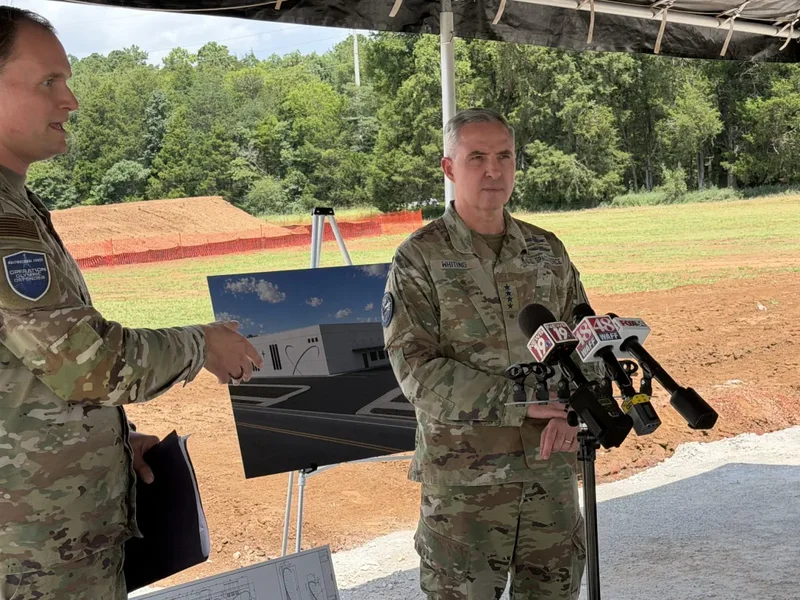
HUNTSVILLE, Ala. — Five years after a bruising political fight over where U.S. Space Command headquarters should be located, the debate is giving way to bulldozers, construction contracts and the practical challenges of moving one of the U.S. military’s most complex commands.
At Redstone Arsenal, where a 64-acre site has been cleared for U.S. Space Command’s future headquarters, Gen. Stephen Whiting now works from a temporary office roughly once every six weeks as he divides his time between Alabama and Colorado Springs, where the command continues to operate.
The arrangement will continue for years.
If the current schedule holds, roughly half of the headquarters staff will be based in Huntsville by 2028, with the permanent facility completed in 2031 and the full workforce of about 1,800 personnel moving into the building the following year.
“We have been moving with speed and with enthusiasm to get established,” Whiting said during a news conference at the construction site.
Since President Trump ordered the headquarters relocated to Huntsville last September, more than 100 Space Command personnel have begun working permanently at Redstone, most of them intelligence analysts based in a Defense Intelligence Agency facility on the installation. The command expects that number to reach 200 by the end of 2026 before accelerating the move as construction progresses on a new headquarters complex known as the Command and Control Facility, or C2F.
The Pentagon’s fiscal 2027 budget requests $951 million for the relocation, covering design, military construction, information technology and other aspects of the move. Space Command expects to announce a major construction-support contract soon, followed by a request for proposals for the company that will build the headquarters itself.
Whiting said contracting authorities approved by Congress will allow the project to be managed more like a commercial development than a traditional Pentagon construction effort, with the goal of shortening schedules and reducing costs.
The relocation represents the latest chapter in a long-running political dispute.
The Air Force selected Redstone Arsenal in January 2021, during the final days of President Trump’s first administration, after a nationwide basing competition. Colorado officials immediately challenged the decision, arguing that Peterson Space Force Base, where the command was already operating, offered greater military value and avoided the cost and disruption of a move.
The Biden administration suspended implementation while multiple reviews were conducted by the Pentagon inspector general and the Government Accountability Office. In 2023, the administration announced the headquarters would remain in Colorado Springs, prompting Alabama lawmakers to accuse the White House of overriding the Air Force’s original selection for political reasons.
The issue remained unresolved until Trump returned to office and directed the Pentagon last September to proceed with the relocation to Huntsville, ending years of uncertainty that had complicated long-term planning for the command.
The command’s Joint Operations Center — the principal command-and-control hub responsible for directing military space operations worldwide — will remain in Colorado Springs until the permanent headquarters is complete. As a result, Space Command will operate as a split headquarters for much of the next decade.
“My position needs to be tied to that Joint Operations Center,” Whiting said, explaining why he continues to spend much of his time in Colorado even as construction advances in Alabama.
While the Space Force is a military service responsible for organizing, training and equipping space forces, U.S. Space Command is the Pentagon’s unified combatant command responsible for conducting military operations in space, protecting U.S. and allied space systems, and ensuring the Joint Force can rely on satellite communications, navigation, missile warning and other space-enabled capabilities during conflict.
Space Command is designed as a joint headquarters. It draws personnel from across the armed services because its mission extends beyond operating satellites to integrating space capabilities into military operations on land, at sea and in the air.
Whiting said roughly one-quarter of the command’s military personnel come from the Space Force, one-quarter from the Army, one-quarter from the Air Force and the remainder primarily from the Navy, with a smaller Marine Corps contingent.
“That mix is pretty powerful for us,” he said.
About half the workforce brings deep space expertise, he said, while the other half contributes operational experience from other military domains — pilots, ground commanders, naval officers, logisticians and planners who understand how military campaigns are fought and how space capabilities support them.
That blend reflects the command’s mission. Planning how satellites support an Army brigade under missile attack, protect a carrier strike group from space-based targeting or integrate missile-warning satellites with air-defense networks requires officers who understand those operations firsthand, not solely specialists in orbital mechanics.
Whiting acknowledged that convincing civilian employees to relocate from Colorado remains one of the command’s biggest management challenges. While officials hope many current employees will move to Alabama, the command has already begun advertising new positions at Redstone to help fill vacancies if some workers decide not to relocate.
“Our mission has unique security and communications requirements, and so as this new facility is being built, we’re working with the Army to make sure that the installation can provide those capabilities,” Whiting said.
The headquarters itself, he said, represents more than a change of address.
Today, Space Command operates from four facilities in Colorado Springs and three buildings at Redstone. Whiting said the Huntsville project will give the command something it has never had — even during its original existence from 1985 to 2002 — a headquarters designed specifically for military space operations, centered on a purpose-built Joint Operations Center capable of supporting around-the-clock command and control while accommodating allied officers working alongside U.S. personnel.