The State Department issues a stark warning, revealing Cuba's decades-long influence and espionage campaign targeting US politics and national security. Spokesperson Tommy Piggott details how the Cuban regime supports far-left extremist groups in the United States, fomenting protests and violent activity. The report documents Cuban agents infiltrating top levels of US government, highlighting a pervasive threat.
NEWYou can now listen to Fox News articles!
Cuba spent decades waging a covert campaign to infiltrate the United States through espionage and ideological influence, according to a new State Department report that calls Havana the "capital of 21st century communism."
Secretary of State Marco Rubio said the report is intended to expose what he described as Havana's decades-long campaign against the United States.
"For more than six decades, the Cuban regime has been the leading sponsor of radical leftism and Third Worldism in the United States," Rubio wrote on X. "The State Department is exposing the full history of Cuban espionage and subversion in our country. The American people deserve to know."
TRUMP EXPANDS CUBA SANCTIONS BEYOND US COMPANIES IN MAJOR CRACKDOWN ON FOREIGN ENABLERS
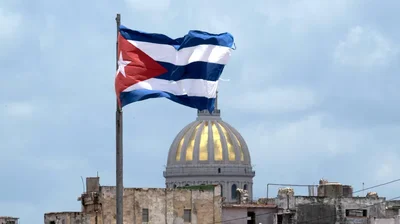
The Cuban flag flutters along the Malecon in Havana, with the Capitol seen in the background, on June 18, 2026. A tate Department report accuses Cuba of waging a covert campaign to infiltrate and influence the U.S. (Pablo PORCIUNCULA/AFP via Getty Images)
Cuba's foreign minister, Bruno Rodríguez Parrilla, dismissed the report as political propaganda.
In a statement posted on X, Rodríguez called it the State Department's "latest fallacy" about Cuba and accused the Trump administration of manufacturing a pretext to continue what he described as Washington's "cruel and criminal economic war" against the island. Without naming Rubio, he accused "that U.S. politician from South Florida" of concocting a "macabre plan" that advances only the interests "of those who have always paid him."
The 100-page report argues that Cuba's campaign reached far beyond traditional espionage. It alleges that Havana cultivated American activists, recruited spies, supported revolutionary movements and built relationships with universities and advocacy groups as part of a long-term effort to undermine U.S. interests and spread communist ideology.
"For nearly seven decades, the Cuban regime has waged a sustained campaign of subversion against the United States," the report says. It alleges Cuban intelligence infiltrated "the top levels of the State Department, the National Security Council, and the Pentagon," while also helping shape generations of left-wing political movements.
An aerial view of Havana, Cuba on Aug. 2, 2017. (Frédéric Soltan/Corbis via Getty Images)
The report further alleges that Havana spent decades cultivating ties to American revolutionary and activist groups, including the Weather Underground, the Black Panthers, the Black Liberation Army and Puerto Rican militant organizations. The report claims that this network later expanded to include connections with Antifa, anti-ICE organizations, socialist groups and left-wing nonprofits.
The report argues that Cuba's greatest success came not through military force but through influence. It says the communist government built an international network of activists, academics, nonprofits and political organizations that continued spreading its revolutionary ideology long after the Soviet Union collapsed.
The report points to several high-profile espionage cases, including convicted spies Victor Manuel Rocha, Ana Belén Montes, Walter Kendall Myers and members of the Wasp Network.
ALLEGED CUBAN INFLUENCE OPERATIVE, FAMILY IN FEDERAL CUSTODY AFTER RUBIO REVOKES LEGAL STATUS
It also cites former CIA counterintelligence chief James Olson, who called Cuba's intelligence service "probably the most aggravating intelligence service I've ever worked against," and warned, "The Cubans have penetrated our government.... We only know the tip of the iceberg."
The report also claims Cuba viewed American colleges and universities as recruiting grounds, identifying politically sympathetic students who could later move into influential jobs in government or the private sector. It suggests the partnerships between the University of Havana and dozens of U.S. universities are examples of what it describes as long-term influence efforts.
It also revisits Cuba's ties to revolutionary movements across Latin America and says Havana provided sanctuary to American fugitives tied to militant groups. The report names organizations including the Venceremos Brigade, ICAP, the National Network on Cuba, the Democratic Socialists of America, Code Pink and the National Lawyers Guild, arguing they helped maintain pro-Cuba activism in the United States for decades.
Secretary of State Marco Rubio looks on during a dedication ceremony for an annex building at the U.S. embassy in New Delhi on May 23, 2026. (Julia Demaree Nikhinson/AFP)
The report concludes that Cuba evolved from a Soviet ally into what it calls "the ideological capital of the modern radical left," arguing the regime increasingly relied on espionage, political organizing and influence campaigns instead of conventional military power.
Fox News Digital reached out to the Cuban Embassy in the U.S. for further comment but did not immediately hear back.
CLICK HERE TO DOWNLOAD THE FOX NEWS APP
Earlier this month, U.S. Ambassador to the United Nations Mike Waltz appeared on Fox News to warn that Cuba remains a national security threat and accused China and Russia of collecting information around U.S. military bases in Cuba.
"The Cuban regime is not only a threat to its own people, it's a national security threat, and this administration is not going to stand for it any longer," Waltz said.