More than a year after a major review of the functions of the Waitangi Tribunal was announced, the completed review has yet to be released publicly with government Ministers still considering how to respond.
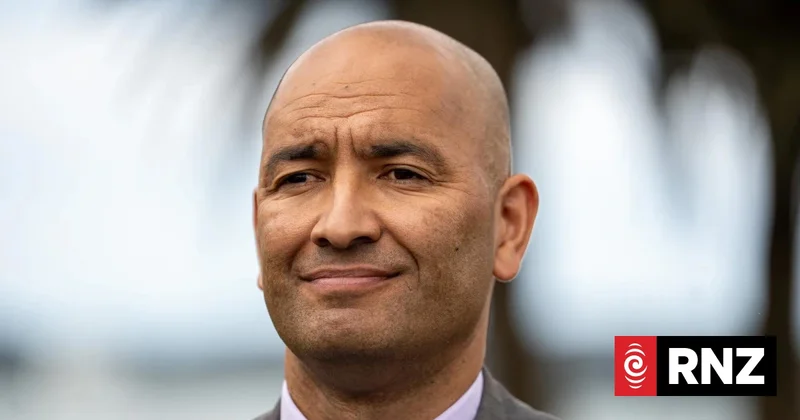
Minister for Māori Development Tama Potaka said the findings and recommendations of the review were before Ministers and being actively considered.
"This is significant work and we are focused on getting the government's response right. Decisions on the release of the Independent Technical Advisory Group's report will be announced once that consideration is complete."
The review was part of the coalition agreement between New Zealand First and National, which promised to refocus the "scope, purpose and nature" of the Tribunal's inquiries back to the "original intent" of the legislation.
Lecturer for Māori Laws and Philosophy at Te Wānanga o Raukawa Carwyn Jones (Ngāti Kahungunu ki te Wairoa) has worked at both the Waitangi Tribunal and the Māori Land Court, he told RNZ it was a bit unclear exactly what "original intent" meant, because by examining contemporary issues the Tribunal was focused on what the original legislation intended.
"When the Tribunal was first set up in 1975, it didn't have any historical jurisdiction. It couldn't look at historical claims. It could only look at contemporary policy issues or those matters from 1975 onwards. So it was kind of difficult to understand what was being sought there."
The Tribunal is often thought of as being engaged in the historical claims process, partly because that has been an area of focus from 1985, when its jurisdiction was amended to allow for retrospective claims, he said.
"The historical claims are, of course, winding down, and in fact, the Tribunal can no longer accept claims which relate to historical matters. So the Tribunal, when it was originally set up, was designed precisely to assess contemporary Crown policy, law, action, through the lens of the principles of the Treaty."
'Tribunal suffers mission creep'
New Zealand First deputy leader Shane Jones told RNZ he appreciated there were a lot of contested ideas as to what should the Tribunal do.
"I'm of the view that the Tribunal suffers mission creep. Too many of the Māori Land Court judges, in my view, are embroiled in claims that are not actually going to achieve very much of anything because they pertain to matters that the parties campaigned on."
Shane Jones said the full range of Māori development goals that NZ First plans to campaign on will be revealed in their manifesto.
"Just because a noisy namu, sandfly, arrives in front of the Waitangi Tribunal, that's not a reason to breathe life or spend money on their allegations of the principles have been violated. I just don't think it's tolerable."
Shane Jones acknowledged that the historical claims were coming to an end, but said the Tribunal needed to "exercise a greater level of restraint" in examining government policy lest they end up losing social licence and public support.
"These kaupapa inquiries, and they pertain to broad public policy issues that are best dealt with through the democratic process. I fail to see how a Māori Land Court judge, as much as I like them, have a level of knowledge or competence beyond what the democratic process throws up."
Kaupapa or thematic inquiries focus on issues that affect Māori as a whole, currently the Tribunal has ongoing kaupapa inquiries into Climate Change, Mana Wāhine and National Freshwater and Geothermal Resources among others.
Newsroom has reported the unreleased review does not recommend removing the tribunal's ability to launch kaupapa inquiries.
Potaka said he did not support removing the Tribunal's ability to undertake the current kaupapa inquiries.
Jones said New Zealand First respected the fact that Potaka had the leadership in this role and that they could only work at the pace their coalition partners felt comfortable working at.
"We realise that over the next 80 to 90 days, our attention will turn to other matters. But I think the key point I'm making, the Waitangi Tribunal has now become a forum where dislocated, aggrieved, small groups of people are making assertions that public policy options we're pursuing that derive their legitimacy from a democratic election somehow should be parked up and surrender to the received wisdom of the Waitangi Tribunal."
'Simply don't stack up'
Carwyn Jones believed what was being sought from the review was a curtailing of the Tribunal's powers.
"We see a government that doesn't want to be held to account, doesn't want to have to explain its reasonings, and ultimately, I think that's because the reasons for some of its actions simply don't stack up. They don't even lead to the kinds of objectives the government says they want to achieve, whether you agree with those objectives or not."
Carwyn Jones said the relationship between the Tribunal and the government this term had been one of the most contested that he had seen.
"The Tribunal, in the past, has undertaken its consideration of government policy just as much as it has now.
"And what you've seen with previous governments is that they understand that the Tribunal is providing recommendations and information and analysis, and has sometimes chosen to accept Tribunal recommendations, sometimes chosen to ignore them. But I've never seen a government respond in a way that's kind of quite so insecure as this government."