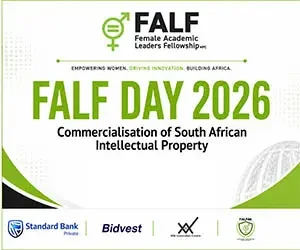
The Female Academic Leaders Fellowship (FALF), proudly sponsored by Standard Bank Private Banking, hosted her flagship annual gathering, bringing together academic leaders, researchers, innovators, policymakers, industry partners and stakeholders from across South Africa. The event provided a platform to advance dialogue, collaboration and action on research commercialisation, innovation and inclusive economic growth.
This year's event coincided with two significant milestones in South Africa's history which are the 70th anniversary of the 1956 Women's March and the 50th anniversary of the 1976 Youth Uprising. These commemorations served as a powerful reminder of the transformative role that education, leadership and innovation continue to play in building a more equitable society.
FALF Day was conceived by Dr. Motlalepule Nathane, a member of the FALF Alumnae Association (FALFAA), with the vision of creating an annual platform to engage with themes central to FALF's mission of advancing women's leadership in higher education and research.
The inaugural FALF Day, held in 2025, co-incided with the fifth anniversary of the organisation and also marked the launch of FALF's first Research Chair at the University of the Witwatersrand, led by Professor Relebohile Moletsane on scholarship on addressing Gender-Based Violence and Femicide (GBVF). FALF acknowledges the National Research Foundation and the Ford Foundation for funding the Chair, as well as the FirstRand Empowerment Foundation (FREF) for supporting the event.
In 2026, FALF will launch her second Research Chair, focused on Entrepreneurship and Financial Inclusion, hosted by Nelson Mandela University and funded by FREF. In recognition of this milestone, this year's FALF Day was dedicated to the commercialisation of research from South Africa's public universities. The theme also honoured the legacy of the inaugural Chairholder, the late Professor Keolebogile Motaung, whose commitment to research, innovation and entrepreneurship continues to inspire future generations. FALF also welcomed Professor Thobeka Ncwana, who has assumed the role with remarkable energy and purpose.
A key highlight of the event was the signing of a Memorandum of Understanding (MoU) between the Technology Innovation Agency (TIA), an entity of the Department of Science, Technology and Innovation (DSTI), and FALF. The partnership will support the establishment of a Women in Innovation Hub, providing female academic leaders, researchers, postgraduate students and entrepreneurs with access to innovation infrastructure, mentorship, commercialisation support, investment-readiness programmes and strategic partnerships.
The initiative forms part of a broader vision to transform research outputs into commercially viable technologies, businesses and solutions that contribute to South Africa's socio-economic development.
Speaking at the signing ceremony, Dr. Titus Mathe, Chief Executive Officer of TIA, said:
"Innovation only creates value when it reaches society. This partnership with the Female Academic Leaders Fellowship represents an important step towards ensuring that more South African research, particularly innovations developed by women researchers and academic leaders, is translated into technologies, enterprises and solutions that address real societal challenges. As TIA, we are proud to partner with FALF in building an inclusive innovation ecosystem that supports the commercialisation of intellectual property, nurtures entrepreneurship and contributes to South Africa's economic growth."
Under the theme "Commercialisation of South African Intellectual Property from Universities," the gathering explored how research and innovation generated within higher education institutions can be translated into real-world impact, sustainable enterprises and inclusive economic growth. The keynote address and masterclass were delivered by Tom Hockaday, internationally renowned technology transfer expert, author of University Technology Transfer, and former CEO of Oxford University Innovation.
The programme also featured a thought-provoking panel discussion on strengthening South Africa's innovation ecosystem, titled "Beyond the Paper: Building, Protecting and Funding Your Innovation." The session brought together experts from academia, industry and the innovation sector to explore the critical steps required to move research from concept to market, including intellectual property protection, access to funding and the development of sustainable innovation pipelines.
Another highlight of the day was ‘From Thesis to Enterprise,’ an inspiring conversation led by Laduma Ngxokolo, Founder and Chief Creative Director of MAXHOSA AFRICA. Renowned for transforming traditional Xhosa aesthetics into bold, contemporary designs celebrated locally and internationally, Ngxokolo shared insights from his entrepreneurial journey and reflected on how innovation can be rooted in cultural heritage. His work exemplifies how creativity, intellectual property and entrepreneurship can converge to build globally recognised brands while preserving and celebrating African identity.
The event also marked the launch of FALF's first Postgraduate Innovation Competition, providing postgraduate students with an opportunity to showcase and pitch their innovative research and business ideas. The competition highlighted the next generation of South African innovators and entrepreneurs while encouraging the commercialisation of research-driven solutions.
The debut competition was won by Dr. Khanani Machumele, founder of CXC Biosciences, whose innovation focuses on the development of a novel patch for targeted tendon surgery designed to improve the delivery and sustained release of natural healing agents. The technology aims to enhance recovery outcomes by supporting the body's natural healing processes, showcasing the potential of university-based research to translate into impactful healthcare innovations.
Commenting on the significance of the event, Dr. Judy Dlamini, Founder and Chairperson of FALF, said:
‘This event celebrates the researchers, innovators, entrepreneurs, community partners, industry specialists, funders and institutions whose collaboration transforms ideas and discoveries into practical solutions that improve lives, strengthen communities and contribute to sustainable social and economic development.
We acknowledge and commend all researchers, funders, industry partners, community representatives, incubators and institutions whose continued commitment advances research translation and innovation for the benefit of society.’
Through FALF Day 2026, the organisation reinforced her commitment to advancing women-led research, innovation and entrepreneurship while creating pathways for academic knowledge to deliver meaningful social and economic impact.
Dr. Xolelwa Zulu-Magwenyane, Chief Executive Officer of the Female Academic Leaders Fellowship (FALF), said:
‘FALF Day 2026 was ultimately about strategic alignment, relevance and impact. The event took place in a landmark year that marks 70 years since the 1956 Women's March and 50 years since the 1976 Soweto Uprising, two defining moments that remind us of the power of courage, leadership and collective action in shaping South Africa's future.
Those themes resonated throughout the day. Conversations focused on how research, innovation and entrepreneurship can drive inclusive growth and create meaningful opportunities, particularly for women and young people. The signing of the Memorandum of Understanding between FALF and the Technology Innovation Agency (TIA) was a significant highlight, reflecting a shared commitment to advancing innovation, supporting entrepreneurship and accelerating the commercialisation of research.
FALF Day continues to evolve into a national platform that celebrates women's leadership, scholarship and impact in higher education, while fostering collaboration between academia, industry, government and the innovation ecosystem. The support of our sponsors and partners demonstrates the growing recognition that investing in research and innovation is essential for South Africa's development.
As an organisation, we are particularly inspired by the presence and participation of postgraduate students and emerging innovators. They are not simply attendees; they are the future leaders, researchers, entrepreneurs and changemakers who will carry this work forward. Their ideas, ambition and contributions affirm that the aspirations of previous generations remain alive and continue to inspire progress today.
Partnership, vision and growth defined FALF Day 2026. These principles will continue to guide our work as we create opportunities for academic leaders, strengthen pathways from research to impact, and contribute to a more inclusive, innovative and prosperous South Africa.’