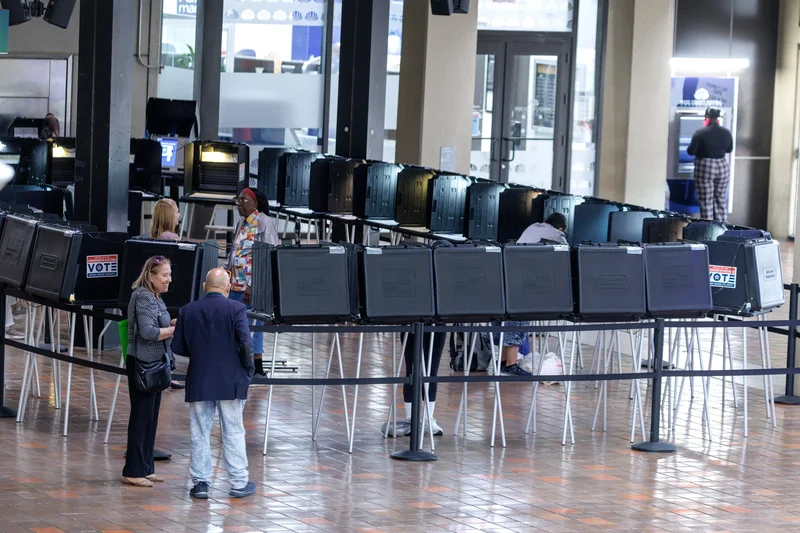
Florida has arrived at the primary elections as a Republican stronghold after decades as one of the nation’s key swing states. The vote is scheduled for Tuesday, August 18, but early in-person and mail voting has already begun to choose the candidates for governor, the Senate and the House of Representatives who will compete in November, along with other local contests.
The state’s political shift is partly due to a rightward move among a large segment of the Hispanic electorate, especially in South Florida, whose behavior this year remains to be seen, according to experts who say the primaries will act as a thermometer ahead of the November midterms to measure the influence President Donald Trump still holds within his party.
“Although Florida has become a Republican state, Democrats may remain competitive in some of these primaries,” says Aubrey Jewett, a political science professor at the University of Central Florida (UCF) and an elections expert.
“One of the main reasons Florida has become more clearly Republican is that the Hispanic vote shifted substantially toward the party in recent years,” Jewett says. “The primaries could provide clues about whether Hispanic voters are shifting again toward the Democratic Party, whether some Florida Hispanics who supported Trump are beginning to have doubts and change their minds.”
The immigration policies the president promised during his campaign resonated with many Hispanic voters, Jewett notes, but in practice they have encountered an anti-immigrant offensive that has wreaked havoc among the large Latin American diaspora communities in the state. The Trump administration has pushed mass arrests in immigration courts, workplaces and traffic stops, and has left hundreds of thousands in limbo by eliminating humanitarian and temporary protection programs. “It appears that many Hispanic voters in Florida may be reconsidering their choice,” the expert adds.
Florida’s Republican primary for governor is seen by analysts as an opportunity to measure the influence Trump still holds in his party. Republican Ron DeSantis, a key ally of Trump’s immigration push, is finishing his second term and cannot seek a third. The leading Republican to succeed him is Congressman Byron Donalds, who has received Trump’s endorsement. On the Democratic side, former Republican congressman David Jolly has emerged as the frontrunner to win the nomination after Orange County Mayor Jerry Demings withdrew from the race following a cancer diagnosis.
Although Trump’s backing helped make Donalds the favorite, the president enters these elections with low approval ratings. “In American politics, the president’s party almost always loses seats in Congress during midterm elections. We also know that an unpopular president loses more seats,” Jewett explains. “Trump is unpopular right now across the country. Several polls have found his disapproval ratings are higher than his approval ratings. Even in Florida.”
An AP-NORC survey from late July found Trump had just 32% approval for his handling of the economy and 39% approval on immigration policy.
As for Congress, the Democratic primary to choose who will run for the Senate seat vacated by Secretary of State Marco Rubio could serve as a barometer of whether the party is moving toward the more progressive wing or closer to the establishment, an uncertainty that has marked contests nationwide. The seat is currently held by the Republican Ashley Moody, appointed by DeSantis after Rubio’s departure, and she will seek to keep it in November. Democrats are deciding between state Rep. Angie Nixon of Jacksonville and Alexander Vindman, a retired lieutenant colonel who was a key witness in Trump’s first impeachment trial.
Nixon has campaigned on positions associated with the party’s left wing, such as taxes on the wealthy and universal childcare, while Vindman has rejected labels; his background as a former official is more institutional, with emphasis on accountability and the cost of living, and he aims to capture independent voters and moderate Republicans. Of the two, he is the best-funded candidate.
“The outcome of that primary can help us understand how that battle within the Democratic Party is unfolding nationally,” Jewett says.
Unlike general elections, where different parties face off, primaries decide the candidates who will represent each party in the November midterm elections. Florida’s primaries are closed, meaning voters must be registered with a party to vote, although there are some nonpartisan contests, such as judicial elections, where voters may participate without party affiliation.
The Florida primaries are also the first test of DeSantis’ new electoral map, which redrew the boundaries of several districts to dilute Democratic voters and favor Republicans in a bid to gain more seats in Washington. Republicans hold 20 of Florida’s 28 seats in the House of Representatives, and with the new map they aim to win four more.
“What happens in some of these Florida primaries could affect control of the U.S. Congress,” Jewett says. “Republicans have a very slim majority in the House. If Democrats can pick up three or four more seats, it would be enough to retake control,” he explains.
In South Florida, some Democratic primaries show the impact of the new map. In District 24, for example, seven candidates are competing in a close race to succeed Frederica Wilson, led by state Senator Shevrin Jones and Miami-Dade Commissioner Oliver Gilbert III.
The redistricting left veteran Democratic congresswoman Debbie Wasserman Schultz without a seat in District 25 and pushed her to run in District 20, a historically Black district, which has sparked internal disputes.
From purple to red state
The current political landscape would have been hard to imagine a few years ago, when Florida was considered a purple state. The Republican George W. Bush won the state in 2000 by a razor-thin margin of just 537 votes. The Democrat Barack Obama won the next two elections, and Trump won the last three. DeSantis won the governorship by a narrow margin in 2018 but was reelected by a crushing margin of nearly 20 points in 2022.
“For more than 20 years, Florida was considered the country’s most competitive swing state, but in the last five years it has gone from a purple state to a red state. It is definitely a Republican state now, but it’s not as Republican as some others. We are not Wyoming,” Jewett says.
The voter rolls show the change. Four years ago there were 5.1 million registered Republicans and 4.9 million registered Democrats. Now there are 5.6 million Republicans and 4 million Democrats. The gap, which widened from 229,000 to 1.5 million, is due more to the loss of about 900,000 Democratic registrants than to roughly 409,000 new Republican registrants. More than 28% of voters on the rolls have no party affiliation or belong to one of the other 15 registered parties.
As of Thursday afternoon, more than 1.3 million people had already voted early or by mail. Republicans have cast 38,744 more ballots, while Democrats continue to show a higher turnout rate.
Sign up for our weekly newsletter to get more English-language news coverage from EL PAÍS USA Edition