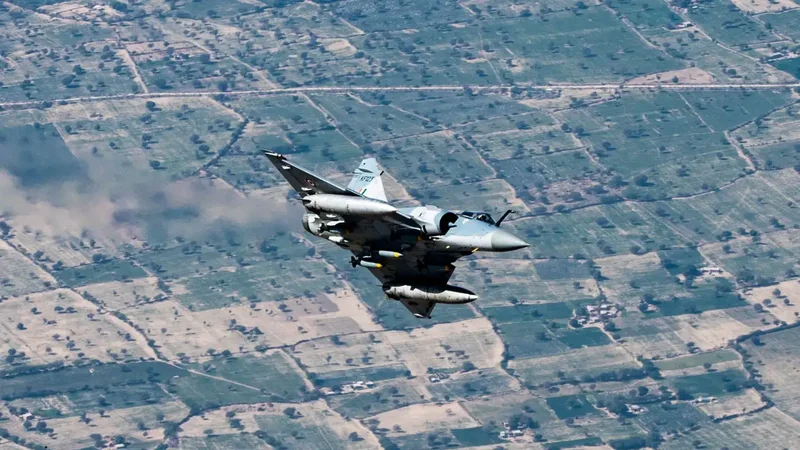
The Netflix series Operation Safed Sagar has drawn widespread attention in India. It tells the story of the
Indian Air Forceâs (IAF) high-altitude campaign during the 1999
Kargil War. The story weaves around the exploits of number 17 Squadron of the IAF, famously knows as the Golden Arrows, with snippets mentioning operations by other squadrons. Reviews range from critical to glowing, yet popular cinema often shapes collective memory more powerfully than official histories. Just as Border etched the Armyâs 1971 story into public consciousness, this series does the same for the IAF.
Kargil was a hard-won victory, against overwhelming odds; it remains imprinted in our collective national memory. While we blame Pakistan for deceit and rightfully celebrate the courage, fortitude and sacrifice of the valiant airmen and soldiers; we must not lose sight of the fact that the victory came at a terrible cost in blood and treasure. Former Army Chief General VP Malik captured this reality in his book âKargil: From Surprise to Victoryâ. Unpreparedness extracted from us a heavy price in lives and resources. The generation of leaders who planned and executed
Operation Sindoor in May 2025 will hopefully write their own accounts without âsurpriseâ or âshockâ in the title.
Constraints of Safed Sagar
In the summer of 1999, the IAF operated under severe constraints. Aircrew struggled in identifying and striking targets located above 15,000 feet; a job made more difficult due natural camouflage available to the intruders in snow covered mountains.
Precision-guided munitions were scarce; only a handful of laser-guided bombs were available. Intelligence on enemy positions was limited and grossly inaccurate. Aircrew had to invent high-altitude close air support profiles never practised in peacetime. Ballistic tables for those altitudes did not exist. The terrain complicated target identification, while the proximity of own troops demanded extreme accuracy. The friction between the Army and the IAF was noticeable in the early phases of war. Political direction forbade crossing the Line of Control, ruling out the most effective attack profiles.
Despite these limitations, the IAF delivered. When technology lacked, skill and ingenuity filled in. The destruction of the major Pakistani logistics base at Muntho Dhalo in the Batalik sector proved decisive. A combination of precision strikes and accurately delivered unguided bombs crippled enemy encampment and supply lines and altered the course of the battle. Success, however, came after improvisation, limited stocks of guided weapons, and the gradual refinement of joint Army- IAF procedures.
Operation Sindoor: Fire and Fury
The context in May 2025 was entirely different. Following the 22 April Pahalgam terrorist attack that killed 26 civilians, India launched Operation Sindoor on the night of 6/7 May. Initial strikes targeted nine terrorist infrastructure sites linked to Lashkar-e-Taiba and Jaish-e-Mohammed in Pakistan and PoK. Great care was taken to avoid collateral damage and civilian casualties. Attack profiles and weapon-to-target matching was selected in a manner to avoid inflicting damage on unrelated military targets as well. The aim was to deliver fire and fury in a calibrated & responsible manner.
Pakistan chose to escalate with drone, missile and air attacks. The IAF responded with counter strikes. Military targets were struck across the length and breadth of Pakistan. There was no safe haven. Air bases, air-defence systems, aircraft hangars housing critical assets, radars and command nodes were neutralised. The entire campaign lasted less than 90 hours and took less than 50 (air delivered) weapons. Unlike Kargil, the violence that we unleashed on the enemy, was neither improvised nor piece-meal. It was deliberate and calibrated aggression- precise, proportionate and decisive.
By the morning of 10 May, Pakistan requested ceasefire.
Unlike the hastily planned military campaign of 1999, Sindoor was deliberate, proportionate and decisive. Political restrictions were minimal. Crews were trained, suitable stand-off weapons were available in adequate numbers, and the IAF retained control of the escalation ladder. Army and Air Force operated from a single joint plan. Synergy was evident from the very first mission.
The Pillars of Transformation
Four interlinked factors explain this renaissance.
Equipment
Force projection through the medium of air depends on the relevance of platforms and munitions. In 1999, precision stocks were thin and advanced targeting systems were still entering service. By 2025 the inventory included multi-role fighters (notably Rafale with SCALP missiles and Hammer bombs), Su-30MKI integrated with the indigenous BrahMos supersonic cruise missile, layered air-defence systems (S-400, Akash, MRSAM and Spyder), and networked command-and-control through the Integrated Air Command and Control System (IACCS), which was suitably backed up by Army operated Akashteer. Indigenous systems such as Akash and the BrahMos performed creditably under combat conditions.
Training
Combat units can now generate sorties irrespective of weather or time of day. High-fidelity simulators, realistic multi-domain exercises and regular participation in international war games have made night operations, stand-off delivery and contested-environment tactics routine. The old dictum holds: the more one trains in peace, the less one bleeds in war. The ability to absorb setbacks, learn lessons quickly and rebound with increased ferociousness is all an outcome of structured training.
Doctrinal maturity and jointness
Kargil exposed the difficulties of coordinating warplans and conducting joint fires across services. Procedures for close air support and joint targeting had to be refined while operations were under way. In Sindoor, joint fires functioned seamlessly from the outset. Although unified structures under theatre commands remain a work in progress, the IAF demonstrated the ability to synchronise actions under âunified intentâ. Air power operated as a decisive instrument that shaped the campaign rather than merely supporting ground forces.
Political resolve
The decision not to cross the LoC in 1999 was deliberate and prudent at the time. Changing adversary behaviour required a different mindset. The 2019 Balakot airstrike marked the first clear break with earlier hesitation, proving that calibrated air power below the nuclear threshold was feasible. That resolve, further refined by 2025, enabled Sindoor to be authorised swiftly and executed without ambiguity.
Heretofore. Pakistan followed the strategy of bleeding India through repeated terror attacks, while denying India the option of conventional military response. That dynamics changed in recent years. It is a settled fact that- the psychological and material effects of precision strikes at depth have raised the cost of proxy warfare for Pakistan. The ability, displayed by the IAF, to hold high-value targets at risk across Pakistanâs geographical expanse, while maintaining escalation dominance, has redefined deterrence in our region.
Conclusion
From the spontaneous, high-altitude improvisations of Operation Safed Sagar to the deliberate, large-scale precision campaign of Operation Sindoor, Indian air power has undergone a genuine renaissance. It is no longer an instrument of last resort or limited battlefield support. It is a mature, ready and decisive force capable of shaping strategic outcomes at the speed of relevance. Hopefully, a suitable OTT series in the future would capture this essence.