Rio Times · Analysis
Key Facts
—A record number of Latin American conflicts The Council on Foreign Relations’ 2026 Conflict Risk Assessment includes a record number of Latin American contingencies, reflecting the Trump administration’s renewed focus on the Western Hemisphere.
—Venezuela escalation tops the list The most prominent new contingency is a potential US–Venezuela confrontation; the US has already conducted at least 64 strikes on alleged drug-smuggling boats in the Caribbean Sea and eastern Pacific since September.
—Cartels enter US strategic doctrine US national security strategy now explicitly treats the fight against transnational organised crime and mass migration as top-tier priorities, reframing cartels as national-security threats rather than law-enforcement problems.
—Multilateralism is eroding fast The International Crisis Group warns that lasting peace agreements are rare, violence is normalised as a policy tool, and US hostility to collective institutions is weakening the global conflict-management architecture.
—Criminal finance is systemic, not marginal Brazilian investigators traced R$7.6 billion (US$1.48 billion) through a single fuel-station money-laundering network over six years—revealing how deeply organised crime has penetrated the formal economy.
—The Global South’s security paradox Rising economic weight and expanding demands for a voice coexist with limited leverage on security norms, as Latin America finds itself caught between great-power conflict, internal violence, and institutional decay.
A map of global conflict risk today places Latin America not on the periphery but squarely inside the perimeter—a shift in strategic thinking that is quietly redrawing the region’s relationship with the United States, China, and the crumbling architecture of international order itself.
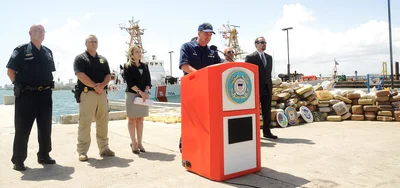
A US Coast Guard vessel interdicting a suspected drug-smuggling boat in the Caribbean Sea, representing the new security perimeter drawing Latin Ameri (Photo internet reproduction)
One-stop reference
Company Intelligence
Every listed company in Latin America — financials, ownership and structure for 1,450+ companies across 26 exchanges, in one place.
RTAsk Rio TimesMarkets, currencies and the economy›
RT
Ask Rio Times
Latin American markets, currencies and companies.
×
Markets todayThe currencyRates \& inflationEconomy outlook
The Dossier That Changed the Map
Open the Council on Foreign Relations’ 2026 Conflict Risk Assessment and scan the list of top-tier contingencies: Ukraine, Gaza, the Strait of Hormuz, the Sahel, and, for the first time in a prominent position, Venezuela. The inclusion is not a clerical error. It reflects a deliberate recasting of Latin America’s security challenges as part of a single, globalised conflict landscape rather than a separate category of regional problems.
Paul Stares, the CFR’s lead author, noted in his five key takeaways that the 2026 survey includes a record number of Latin American conflicts, a direct consequence of the Trump administration’s renewed emphasis on the Western Hemisphere. The implicit message is that the old mental map—in which the Middle East, Europe and East Asia were the zones of serious strategic risk while Latin America was a secondary theatre—is being torn up.
The shift is not solely American. The Council on Foreign Relations’ 2026 Conflict Risk Assessment places Venezuela among the top five scenarios to watch worldwide, alongside the West Bank, Gaza, Russia-Ukraine, and U.S. political unrest. A Latin American crisis has been promoted to the global dashboard of major conflict risks, and that promotion changes everything about how security is discussed, funded, and potentially militarised. Yet as The Rio Times has documented across its archive, this elevation is not merely a US doctrinal pivot—it is the latest phase of a deeper structural transformation in which Latin America, long insulated by geography from great-power conflicts, is being pulled into a contested global order where the sea lanes, critical mineral supply chains, and diplomatic alignments it depends on are no longer guaranteed.
The dossiers arriving from Asia and Europe this morning reinforce the pattern. US bombs are falling on Iranian soil, Iranian missiles are hitting American bases, and shipping in the Strait of Hormuz has ground to a near-standstill with roughly 6,000 seafarers stranded. The world is re-learning that conflicts are connected—that a crisis in the Gulf changes the oil price that determines Venezuela’s budget, which alters the migration pressure at the US southern border, which feeds the political dynamic in Washington that drives sanctions and strikes.
For Latin America, this interconnectedness is both a vulnerability and, potentially, a source of leverage. If the region’s stability is now treated as integral to US and global security, then investments in that stability become harder for Washington and its allies to ignore. The question is what kind of ‘stability’ is being sought—and at whose expense.
Venezuela: The Trigger Point
The most prominent new contingency in the CFR assessment is a potential US escalation against Venezuela, and it is worth understanding precisely what that means. Since September of the previous year, the United States has conducted at least 64 strikes on alleged drug-smuggling boats in the Caribbean Sea and eastern Pacific, operations that blur the line between law enforcement and low-intensity military action.
Experts surveyed by the CFR see a serious risk that these maritime interdictions could escalate to direct US strikes on Venezuelan territory, a threshold that, once crossed, would trigger a diplomatic and potentially military cascade. The legal justifications being prepared in Washington—centred on counter-narcotics and transnational organised crime—would, if tested, set precedents that could be applied elsewhere in the hemisphere.
Venezuela’s regime, for its part, has deepened its alignment with Russia and Iran, accepting military and intelligence support that complicates any US calculation. Caracas has also leveraged its energy relationships with European and Asian buyers to create a web of interests that makes straightforward American coercion more difficult. The result is a standoff in which both sides have escalatory options but neither has a clear path to a sustainable outcome.
The economic backdrop is catastrophic. US intelligence assessments describe Venezuela as trapped in a cycle of ‘economic mismanagement, humanitarian privations and repression,’ with the potential for further slide into ‘dismal conditions and instability.’ For neighbouring Colombia, Brazil, and the Caribbean islands, the resulting migration flows—already numbering in the millions—represent an ongoing humanitarian and political stress test.
The wider strategic context matters. With the US engaged in open hostilities with Iran in the Gulf and the Strait of Hormuz, the bandwidth for a serious Venezuelan confrontation is constrained. Yet the doctrinal logic of the Trump administration’s National Security Strategy, which explicitly prioritises curbing mass migration and combating organised crime in the Americas, pushes in precisely the opposite direction. Venezuela sits at the intersection of multiple US strategic priorities, which is precisely why it has moved up the risk map. Our reporting has shown, however, that this intersection is also where Chinese and Russian interests converge—Beijing has woven deep commercial and financial threads through Venezuela’s energy sector and now accounts for an estimated 12.3% of Latin America’s goods exports, while Moscow provides military and intelligence support that complicates any unilateral US calculus. The result is not a bilateral standoff but a multipolar contest in which Caracas has learned to play great-power patrons against one another, a dynamic that the CFR’s risk framework captures only partially.
Cartels as National-Security Threats: The Doctrinal Shift
Beneath the specific Venezuela contingency lies a broader doctrinal shift that affects the entire region: the reclassification of transnational organised crime from a law-enforcement problem to a national-security threat. The Trump administration’s National Security Strategy makes this explicit, listing the fight against cartels and the curbing of mass migration among its top-tier priorities—a notable elevation from previous frameworks that treated them as secondary concerns.
This shift has practical consequences. It opens the door to the use of military assets, intelligence capabilities, and sanctions authorities that were previously reserved for state-based adversaries. The at-least-64 maritime strikes on suspected drug-smuggling vessels are a case in point: operations that would once have been conducted by coast-guard cutters are now drawing on Pentagon resources, with rules of engagement that have been progressively loosened.
The CFR assessment notes that a potential US–Mexico conflict framed around strikes on cartels fell from its typical top-tier priority only because of a ‘low likelihood rating’ in the current cycle, not because the scenario has been de-escalated in strategic thinking. The planning is there; the political trigger has simply not been pulled.
The recent Lula–Trump White House meeting, as reported by The Rio Times, has brought this doctrinal shift directly into Brazilian politics. The agenda reportedly included discussion of possible terror designations for Brazil’s two largest criminal organisations, the PCC (First Capital Command) and CV (Red Command). Placing Brazilian criminal groups on US terror lists would have profound consequences for Brazil’s financial system, its ports, and its diplomatic room for manoeuvre in addressing organised crime on its own terms.
For the wider region, the cartel-as-threat framing creates a tension between the sovereignty claims of Latin American states and the security claims of the United States. Governments in Mexico City, Brasília, Bogotá and elsewhere are caught between the need to combat criminal violence and the fear that accepting US security assistance on Washington’s terms will erode their control over their own territories. It is a tension that has been building for decades and is now reaching a breaking point.
The Criminal Finance Tangle: Brazil’s Unha e Carne as a Case Study
No analysis of Latin America’s place on the conflict map can ignore the financial dimension. Organised crime has penetrated the region’s formal economy to a degree that makes it a systemic factor, not a marginal one, and the evidence is increasingly impossible to ignore.
The Rio Times’ detailed coverage of the ‘Unha e Carne’ investigation in Rio de Janeiro provides a grimly perfect illustration. Over six years, investigators traced approximately R$7.6 billion—roughly US$1.48 billion—through a network of fuel stations in Greater Rio, a money-laundering operation whose sixth law-enforcement phase was launched on 7 July 2026. The numbers are staggering because they reflect not a single spectacular heist but the steady, daily flow of criminal proceeds through the same commercial infrastructure that the formal economy uses.
Similar patterns repeat across the continent. The fuel-smuggling probe in Mexico that ensnared a former governor, reported in The Rio Times’ Latin American Pulse, points to the same phenomenon: criminal networks have embedded themselves in the energy sector, port logistics, and local government to a degree that makes them structural players in the economy, not external predators upon it.
For the global conflict risk map, this criminal-finance dimension changes the calculus. When the US or other powers consider direct action against cartels—strikes, sanctions, designations—they are not confronting isolated criminal groups but tangled webs of legal and illegal enterprise that stretch from fuel stations in Rio’s suburbs to the ports of Manzanillo and Guayaquil to the financial centres of Panama and Miami.
The result is that any serious security intervention in Latin America carries economic ripple effects that are difficult to predict and impossible to contain. Shutting down a money-laundering network also shuts down legitimate businesses, disrupts local employment, and can provoke political backlash. It is this entanglement, as much as any claim of sovereignty, that makes the cartel-as-threat doctrine so difficult to operationalise cleanly.
The Erosion of Multilateralism and What It Means for Latin America
The International Crisis Group’s 2026 global conflict outlook, authored by Comfort Ero and Richard Atwood, identifies three structural patterns that define the current moment, and each has direct implications for Latin America. The first is the difficulty of reaching lasting peace agreements, with conflicts in Ukraine, Sudan, Myanmar and elsewhere prolonged by external patrons. The second is the normalisation of violence as a policy tool and a renewed great-power ‘spheres of influence’ mentality. The third, and perhaps most consequential, is the weakening of multilateralism and international legal norms.
On this third point, the Crisis Group is explicit: the Trump administration’s hostility to collective institutions, its cuts to peacekeeping and humanitarian funding, and its reduced cooperation with allies are reshaping the global security landscape. The UN Security Council is paralysed on most major conflicts, peacekeeping missions face funding crises, and the International Criminal Court is under direct pressure from major powers.
For Latin America, this erosion is acutely dangerous. The region’s post-Cold War security architecture was built on multilateral mechanisms: UN peacekeeping and mediation missions, OAS election observation and conflict-resolution procedures, Inter-American human-rights bodies, and the framework of international legal norms that constrained great-power intervention. If those mechanisms are hollowed out at the very moment that Latin American conflicts are moving up the global risk map, the region is left dangerously exposed.
Haiti is the most vivid illustration. The CFR assessment rates worsening violence among gangs, security forces and other armed groups as ‘highly likely’ in the next twelve months but assesses the impact on US interests as ‘low’—a downgrade from 2025. The message is brutal: Haiti’s crisis, however severe, does not cross the threshold of strategic concern, and the multilateral tools that might address it—UN missions, development funding, regional mediation—are being systematically weakened.
This is the security paradox for the Global South in 2026. Rising economic weight, expanding trade volumes, and growing assertiveness in forums like BRICS coexist with sharply limited leverage over the security norms that govern intervention, sanctions, and the use of force. Latin America’s governments can demand a greater voice in global economic governance and expect to be heard; on security matters, the great powers are making the rules unilaterally, and the multilateral infrastructure to constrain them is eroding by the month.
The Global South’s Security Voice—and Its Absence
The gap between Latin America’s economic clout and its security influence is becoming a defining feature of the emerging order. The UNCTAD figures are unambiguous: the Global South already accounts for roughly 40% of world trade in goods and 30% in services and is projected to generate more than 70% of global growth in the coming five years. Latin America’s share, at around 5–6% of global trade, is significant and concentrated in sectors—food, energy, critical minerals—that give it structural leverage.
Yet that leverage does not translate into a seat at the table when the security framework is drawn. The US CFR survey is conducted by American experts and reflects US priorities; the Crisis Group’s conflict outlook, however global in scope, is shaped by the perspectives of Western-centred institutions. The Global South’s own security doctrines—the African Union’s approach to sovereignty, Brazil’s tradition of non-intervention, the ASEAN model of consensus—have limited traction in the forums where intervention decisions are actually made.
The Latin American Pulse reported by The Rio Times this Tuesday captures the everyday texture of this security gap: Brazil convulsed by a major Rio graft scandal involving R$86 million, Mexico tangled in a fuel-smuggling probe that has ensnared a former governor, Colombia managing Independence Day protests clashing with Fecode-led demonstrations, Chile reeling from storms that left at least five dead and nearly 18,000 homeless. These are the chronic, grinding security challenges that consume governments’ attention but rarely register on global risk dashboards unless they trigger great-power intervention.
Part of the difficulty is the region’s own fragmentation. The academic analysis published in Frontiers in Political Science identifies the core problem: Latin America has the strategic assets to be a significant global actor—resources, geographic position, a rare absence of inter-state war—but is held back by ‘governance weaknesses, inequality, ideological divides and organised crime.’ A region that cannot coordinate its own security policies will struggle to project influence in global security debates.
The coming months will test whether this pattern can shift. The Seville financing conference and COP30 in Belém are opportunities for Latin America to articulate a collective position that links security, development and climate in a way that great-power discourse—fixated on military contingencies and sanctions—has largely failed to do. But the temptation for each capital to cut its own bilateral deal with Washington or Beijing remains powerful, and collective action is always harder than bilateral transactionalism.
Brazil and Mexico: The Criminal-Security Nexus at Home
The security picture is not only about external threats and great-power competition; it is fundamentally about domestic capability. Brazil and Mexico, the region’s two gravitational centres, both face a nexus of criminal finance, political corruption, and institutional stress that shapes their vulnerability to external pressure and their capacity to set their own security agendas.
The Lula–Trump White House meeting, as detailed by The Rio Times, laid the tension bare. On the table were Section 301 tariffs, the Pix payments system, ethanol, deforestation—and the possible designation of the PCC and CV as terrorist organisations. Such a designation would have immediate and drastic consequences: Brazilian banks clearing dollar transactions would face new compliance obligations; Brazilian ports handling cargo to US destinations would come under enhanced scrutiny; Brazilian politicians with any alleged link to designated groups would risk visa revocations and asset freezes.
The Unha e Carne investigation shows why this matters. The R$7.6 billion (US$1.48 billion) that flowed through Rio’s fuel-station network over six years is not an isolated case; it is one node in a continental system of criminal financial intermediation that links street-level drug sales to high-level political campaigns. Law enforcement can chip away at individual nodes—the sixth phase of Unha e Carne was duly launched on 7 July—but the system as a whole is resilient precisely because it is embedded in the infrastructure of everyday commerce.
Mexico faces its own version of the same challenge. The former governor ensnared in the fuel-smuggling probe is a reminder that criminal penetration reaches to the highest levels of the state, and that the line between the political class and organised crime is often a matter of degree rather than kind. The US negotiations on steel and autos that coincide with this probe create a bargaining dynamic in which security cooperation and trade access are inextricably linked.
For both Brazil and Mexico—and for the region as a whole—the domestic criminal-security nexus is not a separate file from the global conflict-risk map. It is the mechanism through which external pressure is transmitted. Washington’s willingness to escalate against cartels, designate terrorist groups, or conduct strikes is ultimately a function of its assessment of whether Latin American governments are capable of managing their own security challenges. Capacity at home is the best defence against intervention from abroad.
A Perimeter, Not a Periphery
Take a step back and look at the map that the CFR and Crisis Group assessments are drawing. The conflicts that worry strategists in 2026 are not neatly contained within regional boxes. Hormuz affects Venezuela, because oil prices determine Caracas’s room for manoeuvre. Ukraine affects the Sahel, because diverted Western military aid leaves African states exposed. The Sahel affects Latin America, because the Wagner model tested in Mali influences Russian behaviour in Venezuela and Nicaragua.
In this interconnected landscape, Latin America is no longer a periphery—a place where global conflicts have distant echoes. It is inside the perimeter, a zone where great-power competition, transnational organised crime, climate stress, and institutional fragility converge in ways that can generate crises with global consequences.
The region’s governments can respond to this new reality in two broad ways. They can accept the perimeter logic, negotiating with Washington, Beijing and Brussels on terms that exchange stability and alignment for investment and security guarantees. Or they can attempt to reshape the perimeter itself, building a collective Latin American security doctrine that asserts sovereignty over the definition of threats and the means of response.
The first path is easier in the short term and is already being trodden. The second would require a degree of regional coordination that has historically been elusive, but which the current moment—with its confluence of COP30, the Seville conference, and the documented rise of Latin American conflicts on global risk registers—might just make possible. The morning’s dossiers, with their fires and collapses from Tehran to Tinzaouaten, are a reminder that the luxury of postponing these choices is fast running out.
Frequently Asked Questions
Why is Venezuela suddenly a top-tier global conflict risk?
The CFR’s 2026 Conflict Risk Assessment lists Venezuela as the most prominent new Western Hemisphere contingency due to the Trump administration’s focus on curbing migration and combating organised crime, combined with the US having already conducted at least 25 maritime strikes on suspected drug-smuggling boats. Experts see a serious risk of escalation to direct US strikes on Venezuelan territory.
What does the cartel-as-national-security-threat shift mean?
It means the US is increasingly treating transnational criminal organisations with the same strategic tools—military assets, intelligence capabilities, sanctions authorities—traditionally reserved for state adversaries. This opens the door to direct action, including strikes and terror designations, and puts Latin American governments under pressure to align their own security policies with Washington’s framework.
How does multilateralism’s decline affect Latin America specifically?
The region’s post-Cold War security architecture was built on multilateral mechanisms—UN peacekeeping, OAS procedures, human-rights bodies—that are now being weakened by US cuts, Security Council paralysis, and great-power contestation. As Latin American conflicts move up the global risk map, the tools to manage them multilaterally are eroding, leaving the region more exposed to unilateral intervention.
Sources: riotimesonline.com, riotimesonline.com, riotimesonline.com
Connected Coverage
Explore the cluster: World · North America · Europe and Russia
Read More from The Rio Times