No human activity is free of prejudice. Sport, like politics or business, is society in miniature. That is not an excuse; it is an indictment. The same patterns keep returning: coded slights, lazy stereotypes, jokes that are not jokes and contempt with its mask off. Racism at the World Cup should surprise no one. What should shame football’s authorities is how often they treat it as a public-relations inconvenience rather than a punishable offense. The result is weak sanctions, ritualised outrage, and, soon enough, impunity wrapped in a press release.
Take the old claim that African teams lack the mental stamina to win because they concede late goals. This is not insight. It is folklore with a microphone, often amplified from comfortable seats—and usually by men in suits. Late goals are football’s common currency, part of the drama that keeps supporters in their seats, waiting for the flick that turns a foregone conclusion into a spectacular comeback. They come from tired legs, tactical risk, substitutions, refereeing decisions, defensive mistakes or an opponent’s brilliance. Great football nations have collapsed in the final minutes, in extra time and on penalties. When they do, analysts discuss tactics. When Africans do, too many reach for temperament. That is how old racism survives: not always as abuse but as explanation.
The reflex surfaced elsewhere. Before Côte d’Ivoire played Germany, Bastian Schweinsteiger, working as a pundit for German broadcaster ARD, described the Ivorian style as “a bit African football, a bit unorthodox, a bit wild, a bit perhaps also not so conditioned by tactics.” It was the old compliment with a blade inside it: athletic, exciting, untamed and not quite cerebral.
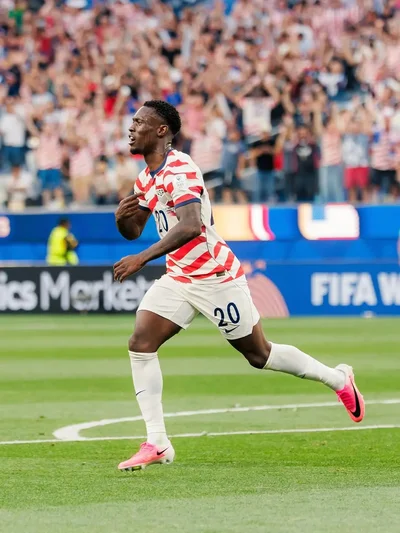
In the United States, the row over Folarin Balogun’s red card exposed another unease: plural identity still sends some people reaching for an asterisk. Balogun was born in the United States, raised in England, is of Nigerian descent and chose to play for America. That should have settled the matter. It did not. Some commentary treated his Americanness as provisional, as if belonging could be granted only on probation.
The dispute mattered. Trump said he asked FIFA President Gianni Infantino to review the decision after Balogun’s dismissal; FIFA later suspended the automatic one-match ban, prompting criticism from Belgium, UEFA and others about football’s rule of law. But the deeper question was older and uglier: who gets to belong without interrogation?
Abuse from the stands is vile but it is at least familiar. Official indifference is worse because it launders prejudice through procedure. The supposed cream of society should not be making crass remarks and football’s answer cannot be another slogan printed on a sleeve. Stadium bans must bite. Broadcasters and federations must punish those who disguise racial insults as analysis. Clubs and national associations should face sanctions that cost more than embarrassment. The usual choreography—outrage, apology, brief suspension, amnesia—has failed. Racism will endure if treated as a nuisance. It will retreat only when it becomes expensive.
Celeste Amarilla, a Paraguayan senator, supplied the cruder version. After France beat Paraguay, she reportedly mocked Kylian Mbappé’s origins, upbringing, appearance and intelligence, called him a “colonised Cameroonian,” and suggested he was pretending to be French. This was not passion. It was bile. Public office is supposed to enlarge civic standards, not shrink them to the size of a sore loser’s insult.
The response was better than the insult deserved. Paraguay’s Senate condemned the remarks as “racist and discriminatory.” The government said they did not represent the country or its people. The French Football Federation denounced them and filed a complaint with French prosecutors. Good. Racism should no longer expect impunity. But the episode also showed how quickly bigotry walks onstage when defeat needs a costume.
Mariano Rajoy, a former Spanish prime minister, offered a more polished version of the same mistake. Ahead of France’s semifinal against Spain, he wrote in a column that France had a top-level team but “does not have any French players.” The prejudice was dressed in a suit but it was still prejudice. Frenchness, in this view, is not citizenship, contribution or shared fate. It is ancestry and appearance. That is precisely the idea modern republics were built to bury. His remarks were an indignity to the French players and to all those who do not fit his narrow definition of citizenship.
France’s team offers a rebuttal in boots. It reflects a country shaped by empire, migration, suburbs, inequality, and ambition. This is not sentimental multiculturalism; France has real failures of exclusion and discrimination, as most countries do. But its football team has shown, again and again, that national identity can be enlarged without being erased. Excellence does not belong to one neighborhood, surname, or skin color. It belongs to citizens—and to those allowed to believe they are part of the nation.
The World Cup makes the modern nation visible. Migration, marriage, work, study and citizenship have changed what countries look like. Football has merely put the evidence under floodlights. The sport need not pretend that slogans can abolish prejudice. It must decide what prejudice will cost. Racism will not recede because administrators denounce it between commercial breaks. It will recede when rules are applied, penalties hurt, and belonging is no longer treated as a favor granted by the narrow-minded. If football claims to be the world’s game, it should stop making some of the world’s players prove they belong to it.
Anthony Ohemeng-Boamah is an expert in development and socioeconomic transformation, with a particular interest in Africa. He writes on related issues, including the political economy of sports.