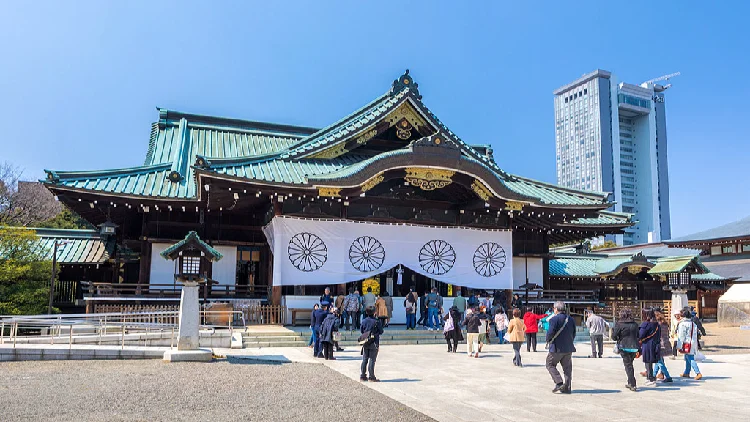
Yasukuni Shrine honors Japan's war dead, including 14 Class-A war criminals, in Tokyo, Japan. /VCG
Japanese Prime Minister Sanae Takaichi made a monetary offering to Yasukuni Shrine on Saturday, a symbol of Japanese militarism and wartime aggression.
Takaichi made a "tamagushi" ritual offering to the war-linked shrine through senior officials of the ruling Liberal Democratic Party (LDP) on the occasion of the 81st anniversary of Japan's unconditional surrender in World War II, Kyodo News reported.
Japanese Defense Minister Shinjiro Koizumi visited the shrine the same day, public broadcaster NHK reported.
It marked the first visit by an incumbent Japanese defense minister to the shrine on the anniversary of the end of WWII since then Defense Minister Minoru Kihara visited the shrine on the same occasion in 2024.
Several senior lawmakers of the ruling LDP likewise paid visits to the controversial shrine on the day, NHK reported.
Chen Xi, spokesperson for China's Ministry of National Defense, said at a press briefing Friday that vigilance is needed against dangers posed by Japan's neo-militarism, in response to a query about the record-high budget Japan's Defense Ministry will submit for fiscal year 2027.
Chen noted that before unconditional surrender, Japanese militarists plunged Asia into an abyss of bloodshed and disaster. Yet after defeat, Japan has long condoned right-wing forces whitewashing and denying crimes of aggression, sought every means to break free from the pacifist Constitution and its defense-oriented principle, and attempted to challenge the post-war international order without truly drawing lessons from history.
"We urge the Japanese side to earnestly reflect on itself, recognize and atone for its crimes, adhere to the post-war international order and stop its dangerous acts of remilitarization. Any return to the wrong path will bring a more crushing defeat and a more complete reckoning," Chen said.
Yasukuni Shrine honors 14 Class-A war criminals convicted after World War II, and it has long been a source of diplomatic tension between Japan and neighboring countries.
Visits and ritual offerings by Japanese officials at the shrine have repeatedly drawn domestic and international criticism, particularly from countries such as China and South Korea, whose people suffered greatly under Japan's wartime aggression.
(With input from Xinhua)