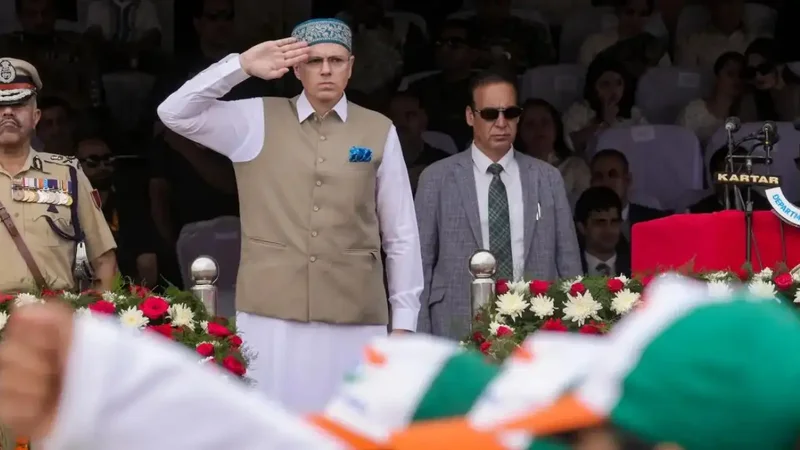
SRINAGAR: Recalling the 1947 National Conference (NC) slogan, âHamalawar Khabardar, Ham Kashmiri Hain Tayyar (Attackers beware, we Kashmiris are ready),â Jammu and Kashmir chief minister
Omar Abdullah on Saturday praised his grandfather and NC founder Sheikh Mohammad Abdullah for fighting the tribal invasion of 1947, saying Kashmiris fought the invaders even before Indian soldiers landed in Kashmir.
Omar also called for strengthening federalism in the country and questioned the establishment of national-level examination systems such as NEET and JEE, saying they had eroded the autonomy of states. He went on to say that had the central government not revoked
Article 370 on August 5, 2019, people in Pakistan-occupied Jammu and Kashmir would have been protesting to join J&K today.
âWhen we talk about the independence of the country, when we talk about August 15 in Jammu and Kashmir, then this occasion will be incomplete without paying tribute to the biggest leader of Jammu and Kashmir, the most respected person, Baba-e-Qaum Janab Sheikh Mohammad Abdullah,â Omar said.
âBefore the Indian Army reached here, it was the people of Jammu and Kashmir who fought the tribal invaders, who fought the infiltrators sent from across, who fought the soldiers sent from across. The slogan âHamalawar Khabardar, Ham Kashmiri Hain Tayyarâ kept echoing in every city, every village, every street and every house. Those who had weapons used them. Those who did not have weapons showed fake guns and fought the intruders.
In thousands, brave people sacrificed their lives,â Omar said.
In doing so, the chief minister sought to reiterate the stature of Sheikh Abdullah, whose legacy has come under attack, particularly from the Bharatiya Janata Party, following the abrogation of Article 370 in 2019.
In January 2020, five months after the abrogation of Article 370, the Lieutenant Governorâs administration removed Martyrsâ Day, observed on July 13, and the birth anniversary of Sheikh Mohammad Abdullah, observed on December 5, from the list of public holidays. Until then, the Jammu and Kashmir government observed Martyrsâ Day every year to commemorate those killed by Dogra forces during protests against the Maharajaâs rule in 1931.
âWhen I see the situation today across the border and across the LoC, I realise that the decision taken by our leaders 80 years ago for us was the right decision,â the chief minister said. âThose who raised the slogan âHamalawar Khabardarâ were right and the sacrifices they made were right,â Omar said.
âToday I remember people like Master Abdul Aziz, a leader of the National Conference, who was brutally killed in Muzaffarabad (PoK) to stop those very attackers, to stop the tribals, to stop those infiltrators,â Omar said. âToday, when we see the condition of that part of Jammu and Kashmir across the LoC, we feel sad, we feel worried. For my part, I feel that perhaps if our situation had not changed in 2019, the people of that part of Jammu and Kashmir would be protesting to rejoin us today,â Omar said.
âThat part of Jammu and Kashmir is ours. We consider those people as our own. No one is a stranger. No one is an outsider. Even today, as per the law of Jammu and Kashmir, seats are reserved for them in the Assembly of Jammu and Kashmir, with the hope that one day those people will be able to use these vacant seats,â Omar added.
On federalism and democracy, Omar said the two biggest strengths of the country were democracy and federalism.
âIt is our huge responsibility to protect democracy under all circumstances and to strengthen democracy under all circumstances.â
âBut along with that, we cannot shy away from the responsibility of saving and strengthening the federalism of this country,â the chief minister said.
Arguing for the restoration of J&Kâs statehood, Omar said, âWhen we talk about federalism, let us start strengthening that federalism from Jammu and Kashmir. Whatever has been snatched from us should be returned to us so that this federalism should not remain only in words; it should be implemented.â
âBut strengthening federalism does not mean just giving status of state to a one Union Territory. Strengthening all the states of this country is to give birth to federalism again and keep it intact. Federalism suffers when central agencies start interfering in the affairs of the states,â Omar said.
âWhen the powers of the state are eroded, federalism suffers. When the powers given to the state are used by central agencies, losses happen and the result is often seen on the streets,â Omar said, adding that the protests that took place at Jantar Mantar were a consequence of it.
âUnder our federal structure, both education and health were the responsibility of the states. But the examination pattern was changed. NEET and JEE exams were created and the right of the states to give admission in medical colleges and engineering colleges was taken away from them,â he added.
âThe result is that there is protest and agitation against it,â he said.
âA national examination is absolutely justified for national institutions, be it IIT, IIM, NIFT or any other national institution. National examination is absolutely right for national institutions but the institutions of the state, which are the educational institutions of the state, should be given their right to conduct exams and grant admissions there,â the chief minister said.
He said his administration would ensure that coordination between the government and the people was maintained.
âIn democracy, the government, the opposition and the media all three play a very important role. The job of the government is to work. The job of the opposition is to make the government accountable. Whether in the Assembly or outside the Assembly, the job of the media is to make both the governments accountable,â he added.