Your support helps us to tell the story
From reproductive rights to climate change to Big Tech, The Independent is on the ground when the story is developing. Whether it's investigating the financials of Elon Musk's pro-Trump PAC or producing our latest documentary, 'The A Word', which shines a light on the American women fighting for reproductive rights, we know how important it is to parse out the facts from the messaging.
At such a critical moment in US history, we need reporters on the ground. Your donation allows us to keep sending journalists to speak to both sides of the story.
The Independent is trusted by Americans across the entire political spectrum. And unlike many other quality news outlets, we choose not to lock Americans out of our reporting and analysis with paywalls. We believe quality journalism should be available to everyone, paid for by those who can afford it.
Your support makes all the difference.
Read more
Homeowners face fresh uncertainty as average fixed mortgage rates have recorded their largest daily increase since spring this year, according to a leading financial information website.
Data from Moneyfactscompare.co.uk reveals the typical two-year fixed-rate residential mortgage climbed to 5.54 per cent on Tuesday morning, a 0.04 percentage point rise from 5.50 per cent on Monday.
This marks the most significant daily jump for this product since 2 April.
Similarly, the average five-year fixed residential mortgage rate saw an increase of 0.05 percentage points, reaching 5.57 per cent on Tuesday, up from 5.52 per cent the previous day. Moneyfacts noted this was its biggest daily rise since 31 March.
The sudden uptick follows a period where mortgage rates had been gradually declining in recent weeks, after an earlier surge linked to the conflict in the Middle East. However, a number of lenders have begun to push their rates upwards again in recent days.
Rachel Springall, a finance expert at Moneyfactscompare.co.uk, said borrowers will “be deeply disappointed to see mortgage rates on the rise again, but this just shows how sensitive our financial markets are to geopolitical tensions.
“As feared, rising swap rates (which lenders use to price mortgages) are a signal for lenders to move quickly to re-price their ranges, as fixed mortgage rates tend to follow these moves.”
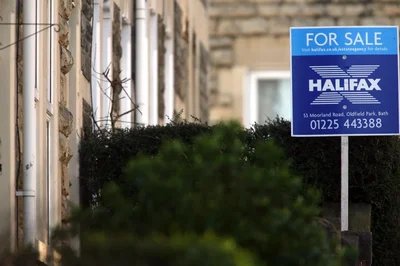
Competition between lenders is still strong, Moneyfactscompare.co.uk said (Joe Giddens/PA Archive)
She added: “Until there is more certainty in the market, mortgage rate moves are unlikely to calm in the weeks ahead, and it will be frustrating for buyers to see that the positive trajectory of rate cuts seen over recent weeks has been thrown off course.”
Adam French, head of consumer finance at Moneyfactscompare.co.uk, said: “At least 25 lenders have increased selected mortgage rates in the last seven days, with only a handful reducing selected products.
Get a free fractional share worth up to £100.
Capital at risk.
Terms and conditions apply.
ADVERTISEMENT
Get a free fractional share worth up to £100.
Capital at risk.
Terms and conditions apply.
ADVERTISEMENT
“The likes of HSBC, Barclays, Nationwide Building Society, Lloyds Banking Group and NatWest were among those making hikes.”
He said that higher funding costs leave lenders “with little choice but to reprice products, even if the Bank of England hasn’t yet changed the base rate”.
Mr French added: “A more volatile world is a more expensive world, and recent months and years are clear evidence that borrowers cannot simply assume mortgage rates will continue moving in one direction.
“Inflation shocks and shifts in market sentiment can alter expectations overnight.
“While competition between lenders is still strong, another bout of volatility has quickly brought the latest rate cutting cycle to a halt.
“In the meantime, it is essential prospective borrowers stay on top of their options and seek independent advice.”