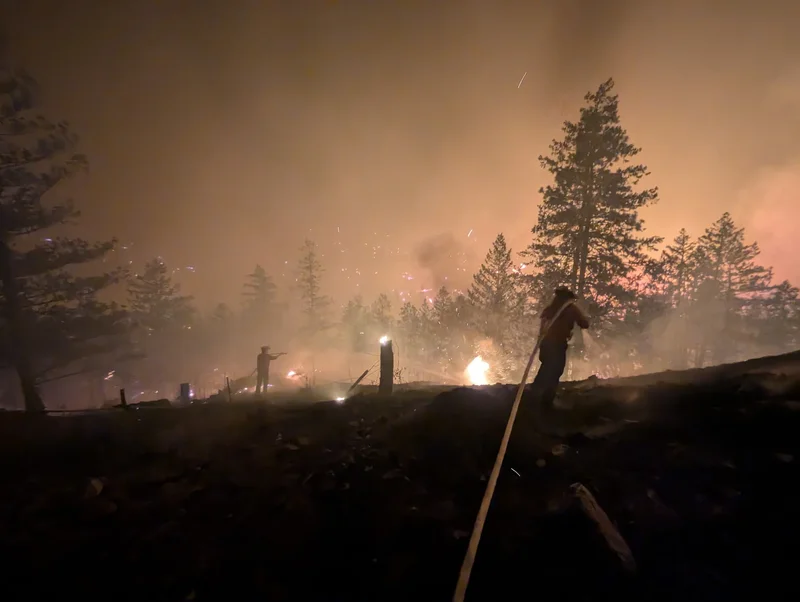
Less than two years after moving into his dream home outside Summerland, B.C., Joel Patan was on the phone with his insurance provider, having long conversations about replacing the house, now destroyed in the still-burning Bald Range wildfire.
Mr. Patan, the owner of an HVAC company, was in nearby Penticton when he realized he had to get back home to meet his wife and their five-year-old and three-year-old daughters as they were preparing to evacuate. He said the fire was fast, moving quickly as it burned through his neighbourhood. The official evacuation order came half an hour after his house was already in ashes.
The next day, he started trying to get in touch with his insurance provider.
“It took me nine hours on Saturday to get through,” he said.
The company told him they’d inspect the damage once the evacuation order is lifted. “And I said, well, that’ll be a pretty quick inspection because there’s nothing left.”
Mr. Patan is one of hundreds of homeowners who have lost their homes this summer because of wildfire in Canada, and who will now need to rely on insurance to cover the cost of rebuilding and replacing the contents of their homes.
Homeowners who have no home insurance will have to bear the burden of costs – from cleaning up debris to repairs or replacement. But some homeowners with insurance could soon discover it won’t be enough to cover the costs of recovery.
Underinsurance, when an insurance policy does not cover the cost to repair or replace a home, poses a significant risk to homeowners because of higher construction and home prices, a Statistics Canada report released in June said. The report also noted rising uninsured costs – for every dollar of insured costs incurred, two to four dollars of uninsured costs are incurred.
In Jasper, Alta., two years after the devastating 2024 wildfire that burned down almost a third of the village, homeowners and business owners are still struggling with paying for their rebuilds.
Jasper Mayor Richard Ireland said many businesses and rental units in Jasper had insurance policies that did not include covering a rebuild, leaving many underinsured for what the cost of their replacement would be.
“The gap between the insurance they have and the cost to rebuild, in some cases, is enormous, and people are now finding out that they are facing huge costs where they thought they had insurance and didn’t,” Mr. Ireland said.
He said many homeowners in Jasper also found that their coverage did not cover the entire rebuild because they had a coverage limit on their policies, as opposed to a guaranteed replacement cost.
A policy with a guaranteed replacement cost clause will pay the cost of rebuilding a home, given that it is properly insured, even if costs go up during construction or repairs.
George Andrew, a homeowner and hotelier in Jasper, said while his hotel is still standing after the 2024 wildfire, his house was completely destroyed by the flames.
“It’s not just the home. It’s all the memories, and the personal possessions, artifacts, things that you know are not replaceable,” he said.
Mr. Andrew had guaranteed rebuild costs in his insurance policy, something that he said many others did not. His home, insured for $1.2-million based on a tax assessment, is costing $3.2-million to replace.
“I just didn’t realize what the cost of rebuilding in Jasper was going to be. I don’t think anybody did,” he said.
Insurance policies that cover homes located in remote areas – used as seasonal homes or insured under a basic fire policy – may not have a guaranteed replacement cost clause, said Pamela Boltz, director of product and underwriting at Square One Insurance Services.
While most homeowners are offered a package that includes a guaranteed replacement cost, Ms. Boltz said around 10 to 15 per cent of home insurance policies do not have the clause as their basis for loss settlement.
In general, a standard home insurance policy covers fire damage, including from wildfires, which isn’t an optional add-on like flood coverage, said Rob de Pruis, a spokesperson for the Insurance Bureau of Canada.
Costs for standard insurance policies are going up, as severe weather is exerting increased pressures on premiums, Mr. de Pruis said.
Between 2016 and 2025, the insurance industry in Canada paid out over $8.1-billion in wildfire-insured damages, compared to the previous decade, which saw $734-million in damage from all weather events, Mr. de Pruis said.
The June StatCan report said Alberta has been disproportionately impacted by extreme weather events, with some Albertan insurers unprofitable in 2024.
Cost increases are being transferred to homeowners as insurers manage risks and maintain profitability, the report said. It noted that insurers could link higher premiums to high-risk homes, such as those near wildfire prone areas, with artificial intelligence used to price insurance at the individual level.
Some factors affecting costs include the rising price of materials, tariffs and contractor availability, Mr. de Pruis said.
Mr. de Pruis recommends that homeowners let their insurer know when they make upgrades to their property. Even though it’ll likely increase premiums, “you want to make sure that you’re insuring that home properly in the event of some type of catastrophic loss, like we saw in Jasper,” he said.
In Kelowna, B.C., less than 40 kilometres northeast of the Bald Range wildfire, the average home insurance premium is $4,600 for a year, several thousand more than the provincial average – between $1,200 and $1,700 annually – according to insurance provider Insurely.
Mr. Patan was paying $2,600 in annual insurance premiums for his home. He said last year, his premium rose by $250. With his property located just 200 metres outside municipal boundaries, he said the fire department would not respond to an emergency, which providers used to justify raising his insurance rates.
But Mr. Patan said that as a professional in the sustainable home building industry, when dealing with insurance, he “knew where to start where a lot of people don’t.”