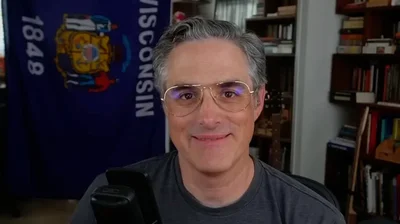
Look at the nice fellow in the featured image of this article. Look into his eyes. Look at the slightly awkward grin plastered across his face at the moment in a YouTube video on his channel that I've chosen to pause and take a screenshot. This is a man who wants you to feel "a sense of agony". To be frustrated and perplexed as to which outcome to choose. This is a man who knows you can't feed the world with a set of laser eyeballs. This is Fallout: New Vegas director Josh Sawyer, who recently made some points about RPG building that are worth dissecting in light of his reported new gig as head of Obsidian's upcoming Fallout game.
"Players are very conditioned by a lot of RPGs to expect like, 'Yeah, but [my character's] built different'," Sawyer said during an interview with The Examined Game. "Like, 'I'm going to be able to take this guy out. Then, you can't. You can help sort of ameliorate damage and you can make a bunch of very important decisions that have truly huge impacts, but you can't stop him."
The him Sawyer's talking about there is Eothas, the big god bloke from Pillars of Eternity 2: Deadfire who you can't squash under your boot. Sawyer's using Eothas as an example of a circumstance in an RPG the player can't overcome or otherwise wipe off the board to get whatever outcome they want, as might be the case in a power fantasy. Hence the "sense of agony", as you're presented with options or actions which feel imperfect, but still have enough pull to make it feel like you aren't just wasting your time choosing between them.
It's one of the many things pointed to as a difference between how Obsidian and Sawyer handled building New Vegas and how Bethesda depict post-apocalyptic America in their mainline entries. The latter, under Todd Howard, have been open about their philosophy tending to embrace facilitating the player doing what they wish as a way to make the experience feel unique. "What we like to do as much is possible is say 'Yes' to the player," his Toddliness told BAFTA in 2024. "'I wonder if I can do this?' 'Yes.' 'I wonder if I can do this...' And that when you have this curiosity for what's over that hill that the game rewards it. You know, the best part of what I get to do is when you see somebody else play the game and the way it affects them, the way they feel about it and the paths that they took. That they've kind of taken what we've made and they've made it their own."
So, now both Obsidian and Bethesda have new Fallout entries in their sights, these differing approaches will likely be something that'll set the two games apart, as was the case previously. People will take sides. You're a power fantasy Paul or an agonising box Alan, and there's little room for nuance between the two. On the one hand, the two studios' associations with these different approaches are well-earned. Fallout 3's main quest is a straightforward good vs evil affair between the Brotherhood and Enclave, with the fact you get to look cool wearing whichever side's power armour a key draw. Fallout 4's closer to New Vegas in terms of number of factions, but still, being a power-armoured saviour or conqueror of the wasteland via big boom is front and centre. The world feels like it bows to the player by the end, as when you're wandering Skyrim being congratulated for preventing the apoclaypse or winning a civil war for whichever side you choose.
Though, it would be reductive to paint Bethesda as being totally unable to present a story in which the player only has limited influence over the world around them. Oblivion, much as its tale very much ushers the Hero of Kvatch towards being a good boy and ending the Daedric invasion, positions them as but one powerful figure helping the person actually able to save the day to accomplish that task. Once that's done, the player is left to retire into madness, unable to do anything to heal the gaping wound Dagon's invasion has left in the Empire, planting the seeds for a great war that's already brewing ahead of the credits rolling. The god might be defeated, but it's still an ending dripping with agonising imperfection and deeply foreboding vibes.
The fly in my argument soup is that the player isn't presented with any alternative choices which might have a chance of cooling tensions between the Empire and Aldmeri Dominion or ending the crisis with the Empire in a stronger position, which would make Oblivion mesh more closely with what Sawyer outlines. I suppose there's also a question to be asked as to whether the "sense of agony" over the things the player has limited to no influence over are as acute if the full consequences of them aren't revealed within the confines of that individual game.
It's easy to get into the frame of mind that one of these approaches is the right one and the other's wrong, that RPGs letting you 360 no-scope divine entities or become the perfect doer of all things is the end of the world. But, in my attempts to draw any kind of silver lining from both Obsidian and Bethesda being corporately ordered to Fallout like they've never Fallouted before in the wake of mass layoffs, one of the few positives I can point to is being intrigued to see the two studios' RPG philosophies face off in the same series once more. Would I love New Vegas as much if it wasn't such a clear departure from brother from another mother Fallout 3 in terms of narrative and worldbuilding? Would I yearn for that "sense of agony" as much if I hadn't spent plenty of time feeling painlessly invincible? I don't know, man with a slightly awkward grin. But I think I'd like a bit of both in my Fallout.