I've spent enough hours in the cockpit of single engine aircraft to have a healthy respect for weather. Cloud, wind, ice, all the usual suspects. What I hadn't fully reckoned with, until this piece of research landed, is that the sky I fly through is only the thinnest sliver of a much bigger, much more violent weather system, one that starts 150 million km away away on the Sun.
A new study out of the University of Surrey's Space Centre has quantified something that's been a nagging concern in aviation circles for years, what happens to a plane, and the people in it, during a genuinely extreme burst of space weather. The short answer is really quite unpalatable.
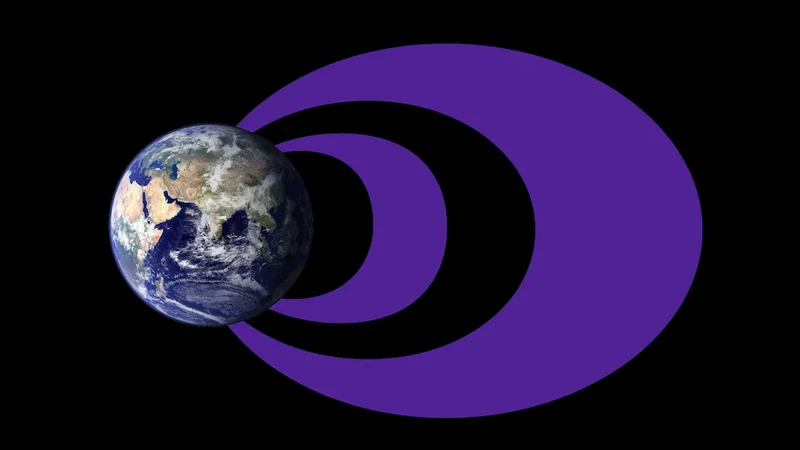
A visualisation of Earth's magnetic field lines and the Van Allen radiation belts they contain, the shielding that normally protects aircraft, and which thins out dramatically on polar routes like London to Vancouver (Credit : NASA)
At normal cruising altitude of an airliner, somewhere between 8 and 14 kilometres up, you're already getting more cosmic radiation than you would standing on the ground, simply because there's less atmosphere above you to soak it up. Usually that's a manageable, well understood dose. But during a solar storm, that background rate can spike dramatically. The Surrey team measured a solar storm in November 2025 that briefly pushed radiation levels at flight altitude to nearly ten times normal. Look back further, to the most powerful solar storm on record, in February 1956, and the numbers get properly startling! A passenger flying through an event of that scale could have absorbed roughly a full year's worth of flight related cosmic radiation in the space of a single journey.
Radiation dose to people is only half the story, and arguably not even the more pressing half. The paper spends real attention on what these particle storms do to an aircraft's electronics. High energy particles slamming into a chip can flip a bit here or there, glitches known as Single Event Upsets, and while one or two of these are a background nuisance any modern aircraft is built to tolerate, an extreme event can push that rate from a handful per hour into the thousands. This isn't hypothetical. Last year, Airbus grounded 6,000 A320s worldwide after a JetBlue flight from Cancún to Newark was forced into an emergency landing in Florida, traced back to a flight control computer's vulnerability to solar radiation.
The routes most exposed are the polar ones, London to Vancouver being the study's example, where Earth's magnetic field offers its weakest shielding. But the researchers note that during a sufficiently severe geomagnetic storm, that vulnerable zone doesn't stay neatly up near the pole. It can creep south, over the UK included.
NASA's Van Allen Probes detected a new, transient third radiation belt shortly after their 2012 launch, a reminder of how dynamic this region of near Earth space is, and how quickly conditions inside it can shift during a solar storm.
(Credit : NASA's Goddard Space Flight Center/Johns Hopkins University Applied Physics Laboratory)
What I find most useful about this paper isn't the alarm, it's the proposed fix. Right now, aviation has no dedicated scale for this kind of event, and the proton based alerts currently in use apparently cry wolf roughly ten times for every genuine warning. The Surrey team has built something more precise, calibrated against ground based neutron monitors, including one at Lerwick, that could eventually feed straight into flight planning. This could provide a clear threshold for when to simply monitor, when to reroute, and when to ground aircraft altogether. It's the same instinct that keeps any sensible pilot checking the weather forecast before engine start, just extended a great deal further upward.