TechRadar Verdict
The Ultimea Poseidon D60 is affordable for a 5.1 channel soundbar system, and impresses with solid surround speakers, generally clear dialogue, and broad connectivity options. However, you’ll have to make some sacrifices in terms of quality, with limited height effects, underpowered bass, and a wired setup that can get a bit messy.
Pros
- +Solid surround speakers create decent immersion
- +Clear dialogue for movies and series
- +Affordable price point
Cons
- -Bass is lacking in bite
- -No upfiring speakers for Atmos height effects
- -Wired setup is a bit messy
Why you can trust TechRadar
Ultimea Poseidon D60 review
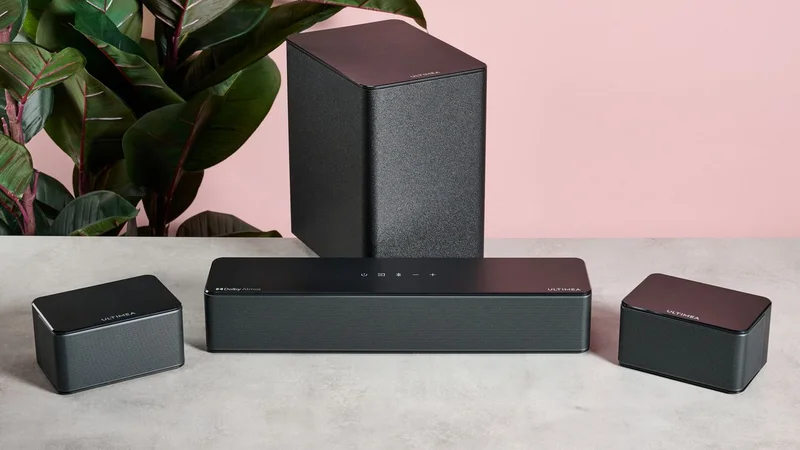
Looking to unleash the power of surround sound on your living room without breaking the bank? Then the Ultimea Poseidon D60 surely seems like a tempting proposition. This 5.1 channel system comes with a compact main bar, a small subwoofer, and a couple of surround speakers, enabling you to experience more expansive audio than your TV can provide alone.
Not only that, but the D60 supports Dolby Atmos, has a wide array of connectivity options, and customizable sound. All of that for less than $200 / £200? Seems like a sweet deal.
But is the Ultimea Poseidon D60 actually worth considering? Can it compete with some of the best cheap soundbars around? I spent a few days testing it, and this is my verdict.
First things first, let’s talk setting up. The D60 isn’t especially hard to get up and running. The sub is wireless, and pre-paired to the main soundbar, and both of those units just need to be hooked up with a power cable, as well as an HDMI or digital optical cord for the bar itself. However, the rear speakers are not wireless — you have to connect them up to the subwoofer with RCA cables. Depending on your placement of the sub, this can look pretty messy, and I prefer the solution offered by models like the Majority Bowfell Halo Atmos, where you wire the two surround speakers together with just one linked to a power output.
Otherwise, setup is simple. You can use either the included remote, or Ultimea’s companion app to adjust aspects such as channel levels, EQ settings, source controls and more. The included remote looks and feels a bit cheap and I found that it wasn’t always perfectly responsive, but the D60 does have HDMI CEC support, meaning you can simply use your main TV remote to alter the soundbar’s volume.
More generally, I have to say that the Poseidon D60 does look as cheap as its price suggests. It’s not an eye sore or anything, but each constituent part of the system is very plasticky and does little to stand out in a fairly convoluted market of plain black boxes. The LED display on the bar is also pretty small, and not the clearest.
Something I will applaud about the D60’s design, though, is how diminutive it is. The main bar, sub, and rears are all very small, and can easily fit into a smaller living space. Even in my relatively cramped apartment, the full system seamlessly slotted into my setup and, even if you’re limited on space behind you, the rear speakers can be placed beside the main bar for front surround effects.
Sign up for breaking news, reviews, opinion, top tech deals, and more.
But anyway, you must be wondering how the Ultimea Poseidon D60 performs by now, right? Well, in all honesty, it exceeded my expectations.
I started by throwing on my 4K UHD Blu-ray copy of The Boy and the Heron, and there were some positives right out of the gate. In a scene where the protagonist, Mahito, exits his house, the surround speakers did a great job of conjuring up immersion, with the sounds of birds and crickets chirping coming through with impressive clarity. Shortly after, the heron flew towards me on-screen, and the directionality was captured well — I almost jumped back in my seat.
As the heron swooped to the side, the D60 mapped his movement with precision, and it sounded as if he extended past the confines of my screen. As Mahito and the heron conversed, I found that the dialogue was pretty clean too. It wasn’t the most forward or expertly separated, but I had no issue following along — it didn’t sound muffled or tinny as I’ve experienced on other soundbars.
But after this, I was introduced to the D60’s Achilles’ Heel: its bass output. When a horde of fish and amphibians appeared, exclaiming “JOIN US”, it was meant to be accompanied by an all-consuming, almighty bass roar, but this roar sounded more like a meow. The D60 failed to provide the impact I was looking for, even after I turned the level of the sub up a notch.
I found that bass lacked substance as I tuned into other 4K UHD Blu-rays and Dolby Atmos content on streaming services. While dialogue remained consistently tight, and the rear speakers whipped up surprisingly prominent, well-balanced surround effects, the bass always just felt lacking. Why? Well, the sub is small and limited in terms of power output, meaning it can’t provide the impactful low-end you’d expect from pricier options.
Another area where the D60 struggles to compete with some of its rivals is in its lack of height effects. The main soundbar has no upfiring speakers, so the vertical Atmos effects are hardly the most convincing. If you want to experience more substantial height effects while remaining on a budget, then I’d suggest checking out a model like the Hisense AX5125H.
As you may expect, the D60 isn’t the most musically talented, with bass sometimes lacking impact, and guitars or vocals in the mid-range feeling short on texture and definition. But most tracks I threw at the soundbar system were clear enough for background listening, and Bluetooth connectivity makes playing tunes from your phone feel pretty seamless.
Speaking of connectivity, the D60 is pretty versatile. Of course there’s Bluetooth and HDMI eARC, but you also get access to digital optical, AUX, and USB playback. That’s a great line-up for a cheap soundbar, though it's worth noting that there’s no Wi-Fi streaming or HDMI input for connecting devices like games consoles or streaming sticks.
Other features include a 10-band equalizer, as well as a vast array of presets in the Ultimea app, and a bass boost mode. The D60 isn’t offering specialized options like room correction, speech enhancement, or a night mode, but the fundamentals are solid overall.
So, at the end of it all, would I recommend the Ultimea Poseidon D60? It’s a complicated one. If you want surround sound on a budget, then it’s certainly a decent solution. You’re not going to get the most amazing Dolby Atmos effects due to the limitations to height effects, and bass isn’t the most impactful. But the rear speakers work surprisingly well, and you get clearer dialogue than a lot of standalone TVs will offer.
If you’re more particular about your sound, then I think it's worth looking elsewhere. If your budget is flexible, I’d suggest checking out the Samsung HW-Q800F or one of its predecessors for seismic bass and incredible expansiveness, although the aforementioned Hisense AX5125H is another amazing surround sound option if you want something cheaper.
Ultimea Poseidon D60 review: price & release date
- Priced at $169.99 / £199.99 (about AU$240)
- Released in September 2023
The Ultimea Poseidon D60 was released in September 2023, and typically costs around $169.99 / £199.99 (about AU$240). This plants it firmly in the budget category when we’re discussing 5.1 channel surround sound systems. It’s available in a single black colorway.
Ultimea Poseidon D60 review: specs
| Dimensions | Soundbar: 15.7 x 2.8 x 3.5 inches / 400 x 70 x 90mm; subwoofer: 6.1 x 9.6 x 8.5 inches / 155 x 244 x 215mm; rear speakers 5.3 x 2.8 x 3.5 inches / 135 x 70 x 90mm |
| Speaker channels | 5.1 |
| Connections | HDMI eARC, digital optical, AUX, USB, Bluetooth 5.3 |
| Dolby Atmos / DTS:X | Yes / No |
| Sub included | Yes |
| Rear speakers included | Yes |
Should I buy the Ultimea Poseidon D60?
|
|
|
|
|---|---|---|
| Features | Not the most feature-rich, but has EQ options, a control app, and a good set of connectivity options. | 3.5/5 |
| Performance | Generally clear dialogue, effective surround speakers, but disappointing bass and lacks verticality. | 3.5/5 |
| Design | Pretty plasticky, but nice and compact, making it easy to slot into any setup. | 3/5 |
| Setup & usability | Simple setup, but wires can be a bit messy, remote not the most responsive. | 3/5 |
| Value | Limited bass and Atmos, but surround sound is very solid at this price-point. | 4/5 |
Buy it if…
You want affordable surround sound
If you want more expansive, immersive sound than your TV can offer, but you don’t want to spend a huge amount, then the D60 is a decent option. It comes with a soundbar, sub, and two rear speakers, and supports Dolby Atmos — though this is relatively limited.
You need versatile connectivity options
Want a soundbar with a wide range of connectivity options for a specific setup? It's likely that the Ultimea Poseidon D60 has you covered. It supports HDMI eARC for Atmos content, as well as Bluetooth, digital optical, AUX, and USB.
Don’t buy it if…
You want true Atmos
Sure, the D60 can decode Atmos content, but it doesn’t give you the fully fledged Atmos experience. It lacks upfiring speakers, meaning height effects are lacking. And though it creates a decent sense of width, it won’t provide the depth of pricier compact soundbars, like the Marshall Heston 60 or Sonos Beam Gen 2.
You’re looking for cinematic bass
I can forgive the D60’s lack of true Atmos, but I was a little disappointed by its bass output. Considering there’s a dedicated sub, the low-end output on offer is pretty underwhelming, so if you want an affordable option with meatier bass, you may want to check out the Majority option down below.
Ultimea Poseidon D60 review: also consider
| Header Cell - Column 0 |
|
|
|
|---|---|---|---|
| Price | $169.99 / £199.99 (about AU$240) | £169 (about $230 / AU$320) | $299 / £349 (roughly AU$449) |
| Dimensions | Soundbar: 15.7 x 2.8 x 3.5 inches / 400 x 70 x 90mm; subwoofer: 6.1 x 9.6 x 8.5 inches / 155 x 244 x 215mm; rear speakers 5.3 x 2.8 x 3.5 inches / 135 x 70 x 90mm | Soundbar: 15.9 x 3.5 x 2.4 inches / 405 x 90 x 62mm; subwoofer: 7.2 x 5.9 x 12.6 inches / 185 x 150 x 320mm; rear speakers: 3.5 x 2.4 inches / 90 x 62mm | Soundbar: 36.2 x 18.8 x 3.5 inches / 920 x 478 x 90mm; subwoofer: 8.5 x 12.3 x 11.9 inches / 210.5 x 310 x 300mm; rear speakers: 3.6 x 5.7 x 4.3 inches / 90.1 x 140.5 x 110mm |
| Speaker channels | 5.1 | 5.1 | 5.1.2 |
| Connections | HDMI eARC, digital optical, AUX, USB, Bluetooth 5.3 | HDMI eARC, digital optical, AUX, USB, Bluetooth 5.3 | HDMI eARC, 1x HDMI in, digital optical, AUX, USB, Bluetooth 5.3 |
| Dolby Atmos / DTS:X | Yes / No | Yes / No | Yes / Yes |
| Sub included | Yes | Yes | Yes |
| Rear speakers included | Yes | Yes | Yes |
Majority Bowfell Halo Atmos
I recently tested the Majority Bowfell Halo Atmos, and it’s in a very similar camp to the D60. It provides surround sound on a budget, with Dolby Atmos support and a wide array of connectivity options. However, it suffers from a lack of height channels and poor build quality. It offers better low-end output than its Ultimea rival, though I’d argue it's more lacking in terms of expansiveness. Read my full Majority Bowfell Halo Atmos review.
Hisense AX5125H
OK, it's a bit pricer than the competition, but the upgrade you’ll get with the Hisense AC5125H is considerable. Not only did it impress us with its cinematic sound, but it has HDMI passthrough, height channels, and DTS support. It's still very affordable for what it offers, so why not check it out? Read our full Hisense AX5125H review.
How I tested the Ultimea Poseidon D60
- Tested across the course of multiple days
- Connected to the Sky Glass Gen 2 TV
- Mainly used HDMI eARC connectivity
I spent a handful of days testing the Ultimea Poseidon D60 at home, using it to watch movies, stream videos, and listen to music. I had the system connected up to my Sky Glass Gen 2 TV via HDMI eARC, although I did test out other connectivity methods such as Bluetooth.
During listening sessions, I made sure to use a range of 4K Blu-rays, which I played using the Sony UBP-X700K Blu-ray player. When listening to music, I steamed tunes via Tidal as well as Spotify, and made sure to try out a range of Dolby Atmos and stereo format tracks.
More generally, I’ve spent years testing audio-visual gear here at TechRadar, and have reviewed everything from budget-friendly models like the Sony HT-SF150 to premium Dolby Atmos systems like the JBL Bar 1300MK2.
- Read TechRadar’s reviews guarantee
- First reviewed: August 2026
Harry is a Senior Reviews Writer for TechRadar. He reviews everything from party speakers to wall chargers and has a particular interest in the worlds of audio and gaming. Harry has a background in business tech journalism, particularly around the telecoms industry.