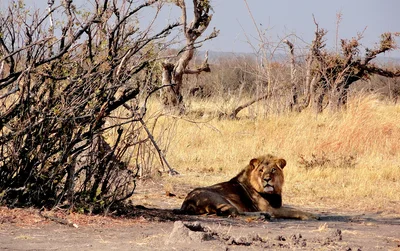
Imagine villagers living near the boundary of Hwange National Park, blowing vuvuzelas into the pitch-black night to drive wandering lions away from their homes.
Well, ever since the Fifa World Cup was hosted in South Africa, itâs been happening. And it has dramatically reduced livestock losses and the chances of fatal lion encounters in northwest Zimbabwe.
It also became the basis of a PhD research project. As a young ecologist working with the University of Oxfordâs Wildlife Conservation Research Unit (WildCRU), Dr Lovemore Sibanda was tracking lion movements using satellite collars and paw prints on the ground to understand the dynamics of human-lion conflict.
He noted that displaced lions, such as older males losing territory or females fleeing intruding males, were frequently leaving the park and entering surrounding communities. Because the only available food in these areas was livestock, tensions naturally flared, and rural communities would sometimes kill the lions in retaliation. Sibandaâs PhD work involved working with communities to find a solution to stop the killings.
âIt so happened that during that time the Fifa 2010 World Cup was happening in South Africa,â Sibanda recalls. âOne issue making international news was how the vuvuzela was irritating the (international) players. It made newspaper headlines. Even here in Zimbabwe, we felt the wave. The English football team was making a huge cry and were asking that vuvuzelas be banned.â
While goals were being scored on the football pitches in South Africa, people in the community came up with a âclever ideaâ, he says.
Dr Lovemore Sibanda, Zimbabwean conservation scientist and WildCRU researcher. (Photo: Supplied]
âThey suggested that if a vuvuzela can irritate a human ear, it probably also can irritate these lions that come out and kill our livestock,â he says.
Working together, they put the theory to the test. Sibandaâs team used their satellite tracking data to alert the villagers when lions were lurking nearby.
The villagers went out to meet them, armed with vuvuzelas.
âIt worked like magic,â Sibanda says.
Armed with the exact coordinates provided by the researchers, groups of 10 to 15 villagers could go directly to that specific spot.
âBy blowing all their vuvuzelas together, they created an overwhelming wall of noise right where a lion was hiding.
âThe lion will not stay there. The lion will run for its life back into the park,â Sibanda laughs.
âAnd that was my whole PhD. To show that blowing a vuvuzela to haze the lions was really effective in reducing conflict between humans and lions. It halved the number of livestock losses... And if you start to record a 50% decrease in conflict events, thatâs a huge achievement.â
Looking back, Sibanda says the experiment showed that local communities â too often overlooked by conservationists â can come up with simple, low-cost solutions to complex problems.
As someone originally from Lupane, a rural district right next to Hwange, Sibanda shares the frustrations and pain of villagers who lose their livelihoods to predators.
He points out a crucial, often ignored reality: âThe communities that live next to protected areas can wipe out all the wildlife if they decide to. The fact that they have not done it shows that theyâre willing to tolerate some form of damage from wild animals, and they should be respected for that.
A farmer oversees his field from a makeshift stilt hut in the coastal scrublands of southern Tanzania, where he sleeps during harvest to protect his crops from bushpigs, despite the threat from lions that hunt the same fields after dark. (Photo: Bernard Kissui)
âThey have the homegrown ideas to some of the problems that weâre facing. For generations we have lived alongside these animals⦠We have all the cheat codes.â
But even with those âcheat codesâ the daily reality of sharing a landscape with apex predators is fraught with danger and trauma.
Realities
Sibanda recalls a devastating incident in Magoli village, just outside Hwange, in which a 10-year-old was sent by his parents to borrow matches from a neighbour. Along the way the boy encountered an ageing, displaced male lion that had been hungry for days.
The child was killed instantly and dragged into the bushes.
âItâs a common story when you go to the communities. People talk about it as if itâs still fresh,â Sibanda says. He points to two other harrowing encounters, in Tsholotsho, where lions severely mauled villagers.
In one incident just before Christmas in 2014 in Gwenga, Tsholotsho, a man suffered severe head and shoulder injuries when a lion attacked him as he desperately tried to save his donkey. In a village next door, two years later, a village head spent months in hospital and suffered permanent damage to his knee after a pride of hungry lions retaliated when he and his neighbours tried to scavenge the remaining meat from a cow the predators had killed.
It is a trauma shared by communities across the continent. In Tanzaniaâs Burunge Wildlife Management Area, people still vividly recall a story of a lion that broke into a boma, seized a calf and began dragging it towards a gap in the fence. The owner, a young woman, clutched the calfâs head, straining with all her strength as the lion pulled back. By the time neighbours arrived, the lion had retreated. The calf survived with minor injuries, but the terror of the encounter remained.
Dr Darragh Hare, a researcher at WildCRU and director of the Morally Contested Conservation project, first heard the story during a research visit. What struck him was not only the danger but also the womanâs response.
The woman was not demanding that the lion be killed. She wanted people advocating for more lions to understand the cost of living with them â the losses, the fear, the calculations families make every night.
Across much of Africa such encounters are part of daily life.
Yet debates about wildlife management, anti-poaching enforcement and coexistence rarely include the voices of the people fighting off lions in the dark.
This exclusion breeds deep resentment, says Sibanda. He points to a stark contrast in how authorities respond to wildlife conflicts: if a lion is caught in a snare, helicopters and brand-new 4x4s arrive within hours to assess the situation.
âWhereas in situations where a human has been mauled by a lion, rarely do those helicopters and fancy 4x4s come in,â he says.
A clash of dictionaries
This glaring double standard is one reason Sibanda rolls his eyes when people in âvery important officesâ talk about âcoexistenceâ.
He believes the language of coexistence can be deeply misleading. To many conservationists, the word describes the goal of enabling people and wildlife to share the same landscape. But for villagers living alongside lions, elephants and crocodiles, coexistence is already a daily reality â one that often means accepting damaged crops, lost livestock and the constant risk of injury or death.
âSaying that people should coexist with wildlife ignores the fact that theyâre already coexisting,â Sibanda says. âAnd no one really wants to live with dangerous animals as their neighbours.â
Failure of good intentions
Sibanda argues that when âoutsidersâ â people living farther away from wildlife areas â try to impose solutions without first seeing the problem from the communityâs perspective, even the best intentions can fail.
He points to development projects that sound brilliant on paper but completely ignore local culture and social norms. In one remote location, NGOs built âBlair toiletsâ to improve sanitation. Every household received one, but they all gathered dust. Why? Because local tradition dictated that checking oneâs own excretions in the open was the only way to monitor personal health.
Dr Darragh Hare (right) engages with reperesentatives of communities living next to Hwange National Park and the Sikumi Forest Reserve. (Photo: Supplied)
In another instance, conservationists introduced ârocket stovesâ that required only a few twigs, reducing the need to cut down trees for firewood.
âWe like fires. The norm here is to sit around big fires to keep warm and tell stories,â Sibanda explains. While the intervention was good for the environment, aimed at reducing deforestation, there was still a big challenge. How do we tell stories when weâve always sat around a big fire and enjoyed storytelling from our grandparents?â
The lesson, he argues, extends well beyond rocket stoves or Blair toilets and exposes a deeper problem.
True partnership
To address that problem, Sibanda argues, the entire conservation model must be overhauled. Communities can no longer be treated as mere âstudy subjectsâ to be surveyed and exhausted by researchers.
âIâll start by saying itâs not an equal partnership. Currently, thatâs not the case,â he says of the typical NGO-community relationship.
True partnership, he argues, means giving communities the power to say no. It means rural villagers sitting on the executive boards of NGOs, co-writing grant applications, and managing their own conservation funds directly, rather than waiting for trickled-down benefits.
âI want to see a situation where local communities are the direct beneficiaries of wildlife,â Sibanda says, âwhere wildlife becomes an asset to promote a better life.â
Hare shares that vision.
âIn many places, wildlife conservation will only be a long-term success if it works for the people who call those places home,â he says.
Sibanda and Hare will explore these ideas further in a Tipping Points webinar hosted by Oppenheimer Generations Research and Conservation on Thursday, 23 July.
They will be joined by wildlife economist Dr Sue Snyman and Edwin Tambara of the African Wildlife Foundation. Titled âWhose Conservation is it Anyway? From Community Voices to Conservation Policyâ, the discussions will examine how the lived realities, interests and concerns of people who live alongside wildlife could be better reflected in conservation research, policy and decision-making. DM
This story was produced through Story Lab Africa, a collaborative initiative of Roving Reporters, Jive Media Africa and the Yazi Centre for Science and Society in Africa.