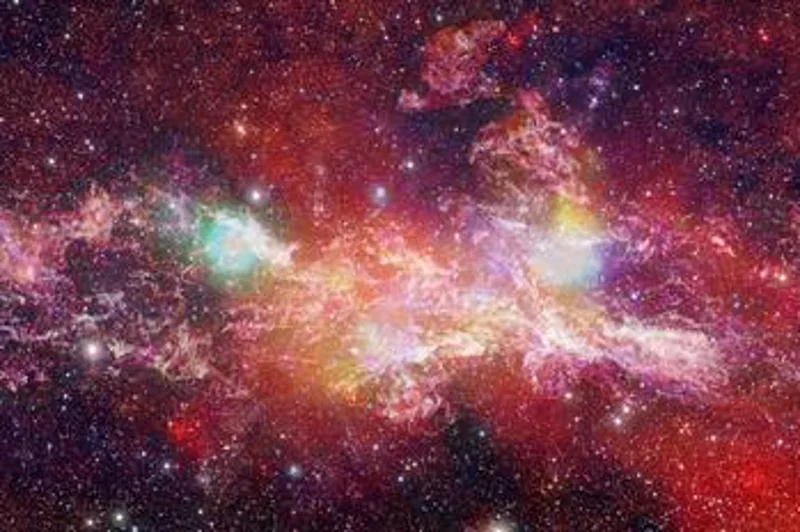
Our Milky Way galaxy underwent a complicated and violent process to grow to its current size, new research has shown.
The galaxy – the home of hundreds of billions of stars including our own Sun – underwent a pivotal event in its ancient history, the research shows. That included devouring another galaxy in its early life.
Scientists observing star clusters gathered near the Milky Way's centre have uncovered evidence that our galaxy swallowed a smaller counterpart roughly 11.8 billion years ago, when the universe was under 15 per cent of its present age. Marking the Milky Way's earliest known galactic merger, the event demonstrates how it expanded not only by generating its own stars but by absorbing smaller systems drawn into its gravitational grip.
Categorised as a dwarf galaxy to distinguish it from larger stellar systems like our own, the absorbed galaxy is estimated to have contained stars with a combined mass 500 million times that of the sun at the point of collision, measuring roughly a quarter of the size of the Milky Way at that time.
Researchers utilised the orbiting Hubble and Gaia telescopes to examine stellar clusters, each comprising hundreds of thousands of stars within a zone across the galaxy's innermost 20,000 light-years, evaluating their age, chemical signature and trajectory. A light-year is the distance light travels in a year, 5.9 trillion miles (9.5 trillion km).
These stars became part of the Milky Way after a galactic merger that occurred about 2 billion years after the Big Bang event that initiated the universe, they said. The dwarf galaxy where they originated was given the name Low-energy-Kraken-Heracles, or LKH, in recognition of three earlier studies that examined the possibility of such a primordial merger.
"The key finding of our research is the unambiguous discovery of the first merger event experienced by our galaxy in its infancy," said astrophysicist Davide Massari of the National Institute for Astrophysics, or INAF, in Bologna, Italy, lead author of the study published in the journal Nature Astronomy.
Whether the Milky Way's early growth was fueled by homegrown star formation or a galactic merger has been a matter of debate, Massari said. The new study indicates that the merger infused the Milky Way early in its history with a large volume of stars and interstellar gas that feeds star formation, as well as the mysterious substance called dark matter.
"I would say that from the point of view of stars, the merger was rather peaceful, with no star-to-star crashes. But from the point of view of the gas, the merger was more 'explosive' — likely, the collision between the gas from LKH and that from the Milky Way triggered the formation of many stars," Massari said.
Massari said there are probably many stars that originally formed in the dwarf galaxy that still are buried in the inner regions of the Milky Way, some of them inside stellar clusters. Because of all the interstellar dust in this region, however, it is very difficult to identify individual stars, Massari said.
The Milky Way is known to have been involved in two other massive galactic mergers. It absorbed a dwarf galaxy called Gaia-Sausage-Enceladus about 1.8 billion years after the LKH merger. And over the past approximately 6 billion years it has been combining with the Sagittarius dwarf galaxy.
"Every single one of these mergers had an influence on the events that have led to the formation of our own solar system, and ultimately of Earth," Massari said. "This is why I think that reconstructing the pieces of the Milky Way's past effectively contributes to answering the big question about, 'Where do we come from?'"