Your support helps us to tell the story
From reproductive rights to climate change to Big Tech, The Independent is on the ground when the story is developing. Whether it's investigating the financials of Elon Musk's pro-Trump PAC or producing our latest documentary, 'The A Word', which shines a light on the American women fighting for reproductive rights, we know how important it is to parse out the facts from the messaging.
At such a critical moment in US history, we need reporters on the ground. Your donation allows us to keep sending journalists to speak to both sides of the story.
The Independent is trusted by Americans across the entire political spectrum. And unlike many other quality news outlets, we choose not to lock Americans out of our reporting and analysis with paywalls. We believe quality journalism should be available to everyone, paid for by those who can afford it.
Your support makes all the difference.
Read more
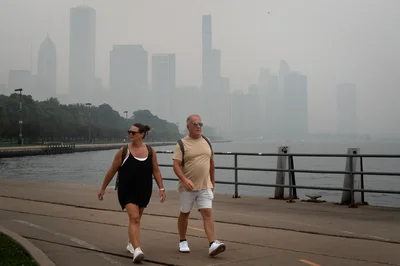
Chicago’s air quality has improved after last week’s wave of Canadian wildfire smoke, but experts warn the threat may not be completely gone, especially indoors.
The Windy City dropped significantly on IQAir’s list of the world’s worst air quality cities, falling from near the top of the rankings last week to No. 44 Tuesday. While no U.S. cities remained in IQAir’s global Top 10, experts say clearer skies do not necessarily mean cleaner indoor air.
More wildfire smoke is expected to move back into parts of the Great Lakes region and the northern U.S., including Michigan and other states bordering Canada, through Tuesday as more than 900 wildfires continue burning across Canada, the National Weather Service said Monday.
Joshua Rogers, president of Alertify, an AI-powered noise and smoke monitoring company, said smoke particles that entered homes during the poor air quality event may still be circulating indoors through air conditioning systems without proper filtration.
"People want to feel safe in their homes, and our data shows that they were not safe in this instance," Rogers told CBS Chicago.
Wildfire smoke particles that entered Chicago homes during last week’s Canadian wildfires may still be circulating indoors through air conditioning systems without proper filtration, experts say (Getty)
Upgrading HVAC filters to a MERV 13 or higher can better capture wildfire smoke particles, experts say (AFP/Getty)
Alertify analyzed sensor data from 31 centrally air-conditioned apartments across five Chicago multi-family buildings over a weeklong period, tracking indoor air quality during the wildfire smoke event. AQI – or air quality index – measures air pollution on a scale from 0 to above 200, which signifies a hazardous level.
"So when the air quality was sort of 600 to 700 AQI, it was actually around 340 in the apartments that we monitored," Rogers said. "We found that the levels of particulate matter indoors were also very, very high, shockingly high. Actually, in this case, in fact, we'd never seen levels like this that come from exogenous sources."
Wildfire smoke contains tiny particles known as PM2.5, which can travel deep into the lungs and pose health risks, especially for children, older adults and people with respiratory or heart conditions. The particles can enter homes through doors, windows and ventilation systems and may remain indoors without proper filtration.
Experts say a common misconception is that air conditioning units automatically filter wildfire smoke, CBS Chicago reports. Instead, many systems recirculate indoor air, and without high-efficiency filters, smoke particles that enter a home can continue circulating indoors even after outdoor air improves, according to the U.S. Environmental Protection Agency.
Researchers and public health officials are working to better understand the long-term health effects of wildfire smoke through a Chicago Department of Public Health project that uses air quality sensors across the city to monitor pollution levels.
"This is a global issue; it's a national issue," Dr. Alex Sloboda with CDPH told CBS Chicago. "There are hundreds of sensors throughout the city that are daily monitoring for these similar pollution particles that we've seen from the wildfire to help inform those communities.”
The Independent has contacted the CDPH for comment.