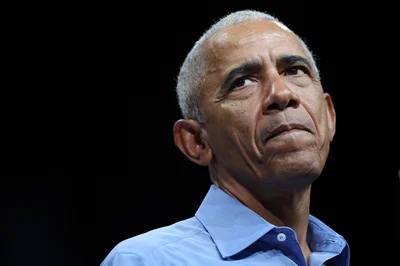
NORFOLK, VIRGINIA - NOVEMBER 01: Former U.S. President Barack Obama speaks while campaigning for Virginia Democratic gubernatorial candidate, former Rep. Abigail Spanberger during a campaign rally in the Chartway Arena on November 01, 2025 in Norfolk, Virginia. Spanberger will face off against Republican candidate Winsome Earle-Sears in the Commonwealth of Virginia’s off-year election for governor and other statewide offices on November 4. (Photo by Win McNamee/Getty Images)
Getty Images
Social media has made socialism cool stateside and the war in Iran uncool. At least according to Wall Street Journal columnist Allysia Finley.
Actually, it’s not all social media that has Finley up in arms, it’s TikTok. Supposedly “the platform fuels the rise of socialism and opposition to the war in Iran,” but also perhaps helped win the 2024 presidential election for an alleged foe of socialism who is also the architect of the Iran invasion, Donald Trump. Don’t worry, Finley has an answer for the seeming contradiction in a piece that routinely pairs contradiction with innuendo: “Might TikTok engineers have tweaked algorithms to help Mr. Trump in hope that he would suspend its death sentence?”
Which on its own would be interesting. As Finley notes, “Mr. Trump tried to ban TikTok by executive order in August 2020,” but since TikTok apparently controls U.S. electoral outcomes per Finley, its engineers who are possibly puppets of the Chinese Communist Party (according to Finley the latter is “impossible to know, which is the problem.”!?!?) might have saved Trump so that he would save them, thus allegedly giving “the Chinese Communist Party a license to spy on Americans and meddle in U.S. elections.”
The election narrative is funny considering Finley’s colleague Holman Jenkins, and how he’s so artfully discredited the Russian election collusion narrative over the years. Except that a persistent truth long promoted at the Journal’s editorial page about the ineptitude found inside government never applies to China. Not only can members of the CCP allegedly tilt American elections in ways expert political strategists and foreign governments never have, they can apparently do so thanks to a wildly popular business they may control, which would make TikTok the first government-run business in history that is not only powerfully competent, but that the whole world wants to spend ever more time with.
Finley’s claims about TikTok and the latter as the barrier to so much better in the United States recall Barack Obama, though with one difference. Obama claimed he was a victim of Fox News, while Finley claims capitalism, the war in Iran, and the man who saved TikTok are victims of – yes – TikTok. As Obama put it in 2017, “"If I watch Fox News, I wouldn't vote for me.”
In response to Obama and his Fox frustrations, one guesses Finley might have suggested he look inward at his own policy stances. What would have been true for Obama would perhaps be true for Finley today about Iran. Except that Finley won’t entertain the possibility that American exhaustion with wars predates TikTok.
In Finley’s view, voters would be far more sanguine about Donald Trump’s decision to go to war with Iran if only Trump hadn’t saved TikTok. Oh well, if we ignore how thoroughly toothless social media bans have been in Australia, how polling about the war has been negative from day one, how Trump himself seemingly hates the war too given his persistent and wishful posts about how we “have no idea how badly they want to make a deal,” we can at least ask why Finley’s Journal colleague Gerard Baker similarly thought the war a loser from the beginning.
Rather than address reasonable unhappiness with the war, including that of Baker, Finley writes that “TikTok is fentanyl for young minds” which, in addition to sounding like the talking point of competitors who had their clocks cleaned in the marketplace by TikTok, signals that TikTok is many things, none of them government run. To suggest otherwise would be for Finley and her editorial board colleagues to retract all that they’ve written for decades about the batting average of businesses that must endure government intervention in their operations.
As previously mentioned, Finley claims TikTok has made socialism a winner too, but then as the Journal’s editorial page has lamented with great regularity since Trump re-entered office in 2025, the 45th and 47th president takes a backseat to few when it comes to cheering federal management of private resources: think export controls, taxes of exports in return for the right to export, “golden shares” in companies, proposed bailouts of failed companies, antitrust browbeating of prosperous companies, and bottomless subsidies for companies that do as Trump desires…While Finley blames TikTok for the rise of socialism at the ballot box, a more realistic answer is that when a socialist runs against a socialist, a socialist has to win.
Concluding an essay bursting with innuendo, Finley wonders if the Communist Party might be “covertly amplifying the rancorous voices” of Zohran Mamdani and Tucker Carlson. The right-leaning not prone to unsheathing the victimhood card would say they hope so, that if we can’t beat the amplified then the problem is them. Get it? If not, see Obama.