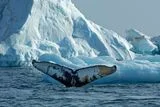
After 45 years working in Greenland, whale biologist Mads Peter Heide-Jørgensen had grown used to the rhythms of its waters. What researchers found along the island’s east coast, however, did not fit the old pattern.
Fin whales, humpbacks, and common minke whales, species once rarely seen in coastal East Greenland, were arriving by the thousands and feeding alongside one another. A new study in Frontiers in Marine Science links the change to warmer water, retreating summer ice, and capelin that have shifted their feeding grounds into the Greenland Sea.
“I was very surprised and also very curious about what was behind the change,” Heide-Jørgensen told Discover.
Read More: A Slow-Moving Humpback Led a Drone Pilot to One of the Rarest Whale Births Ever Filmed
Baleen Whales Gather Along East Greenland
In August 2015 and 2024, the researchers surveyed baleen whales from the air across waters extending 31 miles (50 kilometers) from the East Greenland coast. They added observations from flights in 2022, reports from Inuit hunters collected between 2023 and 2025, ship-survey records dating to 1987, and tracks from 15 satellite-tagged whales between 2019 and 2025.
The team then compared the whale records with changes in water temperature, salinity, and sea-ice cover. Whale sightings increased as the water warmed and the summer ice retreated.
Ship surveys did not record a humpback whale in the area until 2006. Seven were observed in 2007, 26 in 2015, and more than 150 in 2024. Minke and fin whale encounters also increased over time. In August 2025, a ship crew reported seeing as many as 50 baleen whales together near 69 degrees north, above the Arctic Circle.
Those flights found all three species along much of the coast between 60 and 70 degrees north, and the study indicates they likely extend farther north. For summer 2024, the researchers estimated regional abundances of approximately 4,000 humpbacks, 6,000 fin whales, and 4,500 minke whales.
How Capelin Drew the Whales North
Sea-surface temperatures along East Greenland rose by approximately 1.8 degrees Fahrenheit (1 degree Celsius) after the late 1990s. The summer sea-ice regime also changed after 2000, reducing the pack ice along the coast. Because all three whale species tend to avoid ice-covered waters, the retreat opened more feeding habitat.
The food moved, too. Capelin shifted their summer feeding grounds from the waters north of Iceland toward East Greenland. Researchers identified the small fish in the stomachs of minke whales from the region, while fin whales and humpbacks likely feed on both capelin and krill there.
During their approximately four-month stay, the whales may consume roughly 1.1 million tons of prey. Consumption at that scale could reshape the region’s food web.
Climate Winners in a Changing Ecosystem
Species that gain access to habitat or food as temperatures rise are sometimes described as climate winners. In East Greenland, however, the whales’ expansion is unfolding alongside pressure on animals that depend on sea ice. Narwhals, for example, are now encountering temperate whales across more of their coastal habitat.
“You may say that they are ‘winners,’ but if the ice situation in East Greenland had remained the same as it was 30 years ago, then the whales may just have found other areas in the North Atlantic to feed. I don’t know, but of course the new feeding areas could be beneficial for the baleen whales,” Heide-Jørgensen told Discover.
The researchers describe this transition as borealization, meaning that species associated with Atlantic waters are becoming more prominent in an Arctic ecosystem. The whales are not the only sign of the change.
“I believe it will become more Atlantic than Arctic in function and species occurrence,” Heide-Jørgensen concluded. “We have even had tunas that were caught as bycatch in mackerel fisheries in East Greenland — who would have thought that tuna could be caught in East Greenland?”
Read More: How Whales Die — and the Remarkable Life Their Bodies Support Afterward
Article Sources
Our writers at Discovermagazine.com use peer-reviewed studies and high-quality sources for our articles, and our editors review for scientific accuracy and editorial standards. Review the sources used below for this article:
- This article references information from a study published in Frontiers in Marine Science:Feeding frenzies of baleen whales along East Greenland