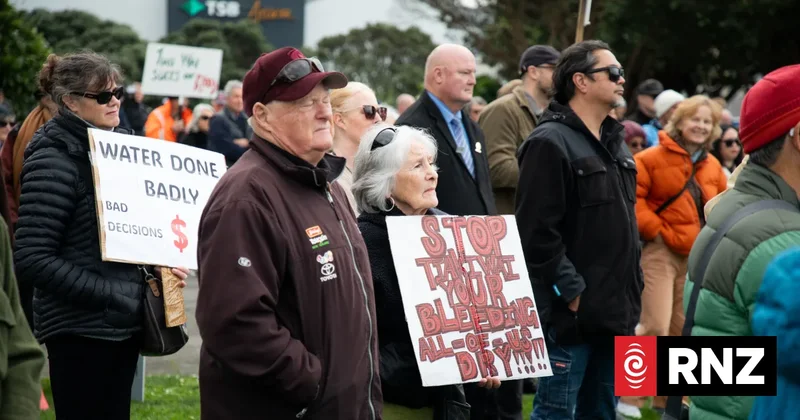
Some Wellington residents are fed up and stressed by the prospect of rising water bills as they marched on parliament in a bid to get the organisation to lower costs.
And a former Wellington mayor-turned MP, who turned out to the protest, admitted his was among councils which could have invested more in water infrastructure in previous years.
About 300 people turned up in central Wellington on Thursday to raise concerns about their water bills in a cost of living crisis, as part of the Stop Tiaki Wai group.
Water bills were increasing by 13.3 per cent on average across the region this year, and were projected to reach over $6000 per year in a decade.
Lower Hutt resident AJ said that's shocking.
"The people are fed up, you can't get blood out of a stone can you?"
She said her first water bill was about $500 for the quarter.
"I came out here today, because the cost of living is through the roof, and this is just one more bill that people have to find money to pay - and people can't find that money anymore."
Mary Head, an Upper Hutt resident and pensioner, said she's frustrated about the way her water bills were being calculated.
"There's only my husband and I at home, and the amount of water we use, is negligible to say a family - and yet we are paying the same or more of a family of six or eight," she said.
Tiaki Wai said in its first years' of operation, the way water services would be calculated was taken from councils' rates bills.
In Upper Hutt, Porirua and Lower Hutt water bills were being calculated through a combination of a fixed rate and property value.
In Wellington city, most people's bills were based on property valuation, board chairperson Will Peet recently told RNZ.
The entity has said it wants to move to a single-pricing model in the future, as well as install water meters.
But Head said the indicative costs Tiaki Wai had put out for that so far - at half-a billion dollars for the programme - were ridiculous.
Protest organiser Guy Nunns admitted he can't actually stop Tiaki Wai - which was set up under the government's Local Water Done Well policy.
Nunns said he would be paying his bill this year - but suggested he would encourage people to not pay their bills if the costs don't change.
That's not something Wellington City Councillor Karl Tiefenbacher, who was among the crowd at parliament, agreed with.
"I don't think that really works. To be fair I am against the fact we have no rates cap on top of Tiaki Wai - I think that's the issue."
He asked what the point of rates caps against councils were, if there was none against water entities.
"I think water is the biggest issue we have. I think this protest actually represents what is wrong with our society at the moment, and that's that it's becoming unaffordable."
When asked whether he thought spending was needed to upgrade failing pipes and water plants, Nunns said "no one" was happy with the current state of infrastructure.
"We have always paid for water infrastructure in our rates, people have not necessarily understood that, they'll be understanding it now - but at $2200 a year, and until recently I was the sole occupant of the property, that's not realistic."
New Zealand First MP and former Wellington city councillor and mayor Andy Foster was also at the protest.
He was asked whether the council he led between 2019 and 2022 did enough to invest in pipes during its years in power.
He said his council set in motion more investment and was heading in the direction of a CCO for infrastructure, but also said more could have been done.
"We were going to fix it, so long term, yes, there was under-investment in infrastructure, but that is true of pretty-well every council in the country."
Tiaki Wai said it needed to spend $25 billion dollars across three decades to fix the regions old failing water treatment plants and pipes.
Officials said there's a major crisis point at Seaview, where a crucial outfall pipe was leaking into the harbour and the Waiwhetū stream.
They also said about 100 kilometres of pipe at the point needed to be replaced each year.
In a recent interview with RNZ, Brewster urged anyone facing hardship to contact the organisation, saying Tiaki Wai had policies in place to help those who were really struggling to pay bills.
But he said debt collection would have to be pursued for those who were refusing to pay for no reason.
"If you are refusing to pay the bill and not contacting us then we, we would unfortunately, we would have to pursue that.
"Because at the end of the day there is an obligation to pay the bill, if nobody pays their bill we've got no money to fix the system."
He said on Thursday, he respected the rights of Wellingtonians to join the protest and express their views.
But he urged the protesters to respect those working at Tiaki Wai trying to upgrade the region's infrastructure.
Tiaki Wai was focused on delivering safe, reliable and affordable water services, he said.